So I started reading the Green Lantern series sometime around 1980, picking up issues here and there until getting it every month starting with #141 in 1981, the first appearance of the Omega Men.
Eventually, I dropped the book after #157 (1982):

…which was still near the beginning of the “Hal Jordan in Space” storyline (more on that in a bit). I seem to recall enjoying that specific issue, since I liked Hector Hammond as a villain, but GL being stuck in space all the time began to wear a bit thin on me, I guess, or the next issue didn’t grab me. Whatever the reason, I stopped with that #157.
While I did check in with a random issue partway through the run (the infamous “exploding boy” cover on #162, which I wrote about…21 years ago? Really?) I didn’t hop back on the Green Lantern train ’til #171, the infamous Alex Toth issue that all the writers removed their names from:

Now I don’t know if I knew it at the time, and given my love of fanzines I can’t see how I didn’t know, but the whole Hal in Space thing was coming to an end, with a brand new creative team and direction for the book starting in #172 (1984). I presume everyone else was sick of the space stories, or sales had dipped far enough that they were ready to try literally anything else, or maybe they just ran out of Gil Kane inventory covers to run. But I kept reading, Len Wein and Dave Gibbons showed up, turned things around, everything was great, and so on.
And it was all well and good for, oh, another decade or so.
That Green Lantern comic went through a few more creative changes over the next few years, with everyone doing interesting and sometimes peculiar work, before that series wrapped up in 1988. I followed the GL franchise into Action Comics Weekly, DC’s new serialized format that was released…well, you can guess how often it came out. And there were the well-received Emerald Dawn minis retelling Hal’s early years as a Lantern, and a new ongoing series that launched in 1990.
That 1990 series was also quite popular, and I enjoyed it quite a bit myself, even if the writer for that series is now considered persona non grata in the comics business, or, well, anywhere for that matter. It was a thoughtful, imaginative run that culminated in a tie-in to the whole “Death and Return of Superman” storyline going on elsewhere in the DC Universe. A storyline in which GL’s stomping grounds, Coast City, is destroyed.
The final issue of that writer’s run is #47, in which Hal comes to terms with that huge loss with his old partner, Green Arrow. And, when the writer actually did a signing at my previous place of employment waaaay back when, before His Troubles were known, he’d basically said as such, that he had other plans for the big 50th issue, that the Coast City thing was dealt with.
But DC was still chasing that “Death of Superman” dollar and wanted Big Changes for the characters that had been around a while and seemed possibly moribund compared to the edgier, “hipper” comics being produced by their competitors. So word came down from on high that Hal was to go away and be replaced with a new fella. And as it turned out, the way Hal went away was to make him go crazy over the destruction of Coast City and start killing his fellow Lanterns to gain enough power to resurrect the city and its inhabitants.
Am I sure this is exactly how it went down? I mean, that this was ordered by DC, not that was what happened in the comics, because that was definitely what happened in the comics. All I have is The Former Writer’s statement on the matter, and given how many brains “The Death of Superman” story broke, it all seems plausible.
At any rate, Hal was gone, we had a new guy, Kyle Rayner, on board as the one (and only!) Green Lantern. And I read his comics up through issue #55:
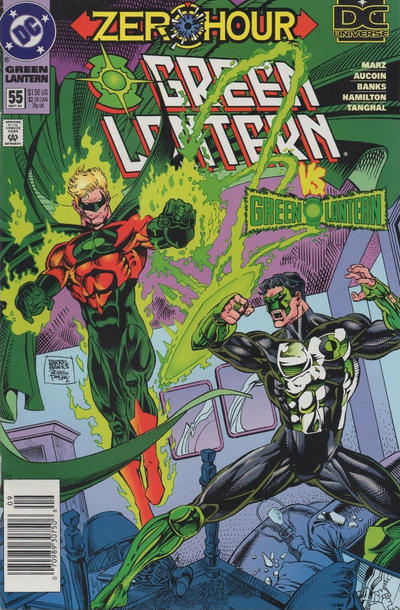
…and it wasn’t so much that I didn’t like Kyle Rayner, as I didn’t like what they did with Hal Jordan, and I gave up reading Green Lantern again. That was 1994.
Now they did a lot of things with Hal Jordan in the meantime…he popped up in that Day of Judgement mini-series, he was the Spectre for a bit in his own comic, and I read all of those. But it wasn’t until 2004 and the series Green Lantern: Rebirth that DC finally put Hal back in the green and black space togs. That is what finally got me back into reading GL comics, correcting a bizarre decision to try to push a new version of the Golden Age/Silver Age transition without just sort of letting it occur naturally.
From Rebirth we went right into a new ongoing series launching in 2005, and I’ve been reading Green Lantern comics in all their various incarnations ever since.
Until, I’m thinking, right about now. It may be time for the third big Green Lantern break.
I was trying to talk this out on Bluesky, and I think about as far as I got was that it was “too much.” Every comic is crowded with characters, crowded with lore, crowded with ever increasing stakes and risks…it’s practically sensory overload. The alien Lanterns are no longer fun guest-stars, they’re just more noise.
The exact example I used was that it seemed like after the Sinestro Corps War, a genuinely fun and interesting multipart super-battle amongst opposing Lantern armies, every Green Lantern event continued to chase that high. It seemed fine at first, particularly with the introduction of new Lantern Corps based around different spectra (I don’t care what anyone says, I liked the Red Lanterns). But it all just seemed to go on and on and on until this last one, the GL Corps versus the…Starbreakers, I guess? It’s just one more mass of action figures to throw at the GL action figures.
Going back to that 1980s GL series, when I was talking about the “Hal in Space” story. That storyline kicks off with Hal’s bosses, the Guardians of the Universe, calling him on the carpet to remind him that he’s got an entire sector of space he’s supposed to be watching over, not just Earth. As such, the Guardians banish him from Earth for a year, and tell him to work his beat for once. It actually does come across as odd to see Hal not in his regular earthbound stomping grounds.
Which of course isn’t to say Hal didn’t take off into space occasionally prior to this, But there was a balance…sure he may have left Earth once in a while, but he always started there and usually ended up back there, if not at the end of the issue, but eventually at the end of the story. It made him slightly more relatable.
Now, it feels like it’s the opposite, with stories beginning and ending in space and if Earth is seen at all, it’s only sporadically. Even the early issues of the current Green Lantern run, with Hal stuck on Earth, while good and maintaining my interest, were mostly about Hal trying to figure out how to leave Earth.
And while the lore and history of the Corps have always been part of the comics, they weren’t the be-all/end-all like they seem to be now. It felt more special when we got the Deep Lore once in a while, not with every outing.
This may be the first time and last time I’m doing this, but I’m going to refer to something from the Family Guy TV show. There is a line Peter says, in regards to The Godfather, a line that the show’s creator Seth McFarlane apparently liberated from a college professor, in which he says the film “insists upon itself.”
It is a weird critique to make about anything: it’s both exacting enough to sound like a very specific jibe, and it’s vague enough to be wide open to interpretation. But regardless, you sort of get what’s being said here.
This is the Green Lantern franchise as it is currently: it insists upon itself. It’s self-referential, it’s repetitive, it’s Green Lanterns solving Green Lantern problems.
I tried to stick with it, I really did. But I’m just not feeling it right now, and who’s to say if I will again? Am I going to go back to new GL stories when I’m 70? Feels unlikely.
And it’s a real shame, too, because they’re bringing back the old GL villain Krona for a new story, and I have bit of a nostalgic fondness for him. But Krona is who you bring in when you want some big, universe-shaking threat and frankly, what’s one more to add to the pile here.
Thanks for this–very interesting. Without being a big GL fan, the whole idea of an extensive Superhero X in Space storyline turns me off because, for the most part, DC and Marvel’s space “universes” are so solidly stuck in the 1940/50s-style pulp SF style of boring monocultural planets full of aliens that are just 2D humans in fancy dress. They’re basically boring and unimaginative as science fiction, which is not really what I’m after.
I hope this is how I find out your were a member of H.E.A.T.
I had been reading the current series in the trades (thanks, public library!) and stalled out around the start of the most recent volume, for exactly the sorts of reasons you describe.
Honestly, this is the very reason I kind of petered out on the recent series, finally. Smaller scale stories, Earth-bound stories, would be nice occasionally.
I’ve read interviews with various super-hero comics writers who grumble that editors will nix stories set off-earth/ in a fantasy setting. Thor can go to Asgard, but he has to come back to Earth fairly quickly. Aquaman can’t spend all his time in Atlantis. GL characters can’t be out in space all the time. Stop sending the X-men to space or Limbo or the Savage Land.
I think the editors are right, in most cases. There are exceptions, but I think most readers want to have a recognizable world as an anchor.
@James Morrison: great point about aliens/non-humans often being basically humans with one trait. Atlantis has the same issue; people who argue about who should rule isn’t any more interesting when they’re under water.
Blogposts begetting blogposts and all that, but had a scan around and can’t find anything about the writers taking their names off GL 171. Do you remember why? Keith Giffen was one, it seems…
Noel Naive was used as the pseudonymous name of the scripter on the issue, which is a bitter sounding alias to choose. That was apparently the name under which the editor, Joey Cavalieri, chose. Robin Snyder was listed as original co-scripter while Giffen was the co-scripter and plotter. I’m not sure who Robin Snyder is as I have never come across her (his?) name in comics before. I guess that editorial needed so many changes and rewrites to the script that eventually Snyder and Giffen requested their names be removed, due to it not being their story any longer. So, Cavalieri decided he would take on credit for the writing, but did so under the name “Noel Naive”.
Update: Oh, this Robin Snyder was the same one who has been publishing the uncollected work of Steve Ditko. I guess it’s not surprising it’s the same person, considering this Snyder was also working in comics. I don’t know why I wouldn’t connect it was the same Robin Snyder.
He also seems to have some credits on short stories at DC with their various genre anthologies.
Rewrites and pseudonyms aside, Green Lantern #171 does boast art by Alex Toth & Terry Austin, and that’s not nothing!
(Is it possible Toth took it upon himself to change the script, necessitating rewrites?)
Green Lantern #171 looks very pretty, but the main story borders on nonsensical. And GL tooling around in a spaceship with Dorine strikes me as a poor man’s Doctor Who.
I’m impressed by how long Hal has lasted, even with his long absence. He probably works best in an ensemble. My favorite individual Lanterns are John Stewart and Kyle Raynor. They both have enough personality to work on their own. John was great in the cartoons and Kyle was his best in Morrison’s JLA, IMO.
—-
Of all the “army of X v. our heroes” stories in comics (and now movies), I think the best was by Wolfman and Perez in Crisis on Infinite Earths: all the villains v. all the heroes. That battle has the benefit of being pretty novel for its time, but they also gave the conflict room to breathe, real stakes, and a sensible ending. Neither side could really win, so they were interrupted instead, after casualties on both sides.
The worst “everybody v. everybody” fight I can recall is maybe all of them from Bendis’ Legion of Super-Heroes, mostly because of unclear storytelling. Not being able to recognize some of the redesigned Legion characters (or their powers) didn’t help.
https://cleaner-whale-8f37ad.instawp.site/2013/03/11/in-which-mike-was-too-lazy-to-scan-all-these-himself/
This previous blogpost by Mike references the GCD which says: “Noel Naive is used for the Cavalieri rewrite of a Snyder script, as Robin Snyder and co-plotter Keith Giffen had their names removed because of the extensive revision to the original script. Giffen stated in an April 15, 2011 e-mail to John Wells that Cavalieri requested the Noel Naive pseudonym as a show of solidarity.”
I enjoyed Morrison’s GL with Hal. One trade in space, then he was banished to be on Earth because comics then back in space again. I like that we did se new GLs and that Hal knew their names, as they did his. And that there were other hero groups in space.
The current series I’m likely stopping on, though as Mike knows I’ve been giving my comics to a friend’s after I read them (the GLs, a few others).
The story I loved best in Rebirth was when Hal and Cowgirl were held captive by a vague eastern Europe country and when they escape and he sees the JLA, their response was that they thought he was in space the whole time.
Joe Sposto – how dare you
Tom W – I knew that it was a fake name used on that issue of GL almost from the get-go, but I don’t know the details beyond what’s in the Comics Database listing. If I had to guess, I’d say Toth fiddled with the script to the point of annoying everyone else.
Matthew Murray – Oh, guess I did cover that already. Write a blog long enough, eventually I address everything!
RE: “This is the Green Lantern franchise as it is currently: it insists upon itself. It’s self-referential, it’s repetitive, it’s Green Lanterns solving Green Lantern problems.”
I feel that this perfectly describes DC’s current approach to storytelling as a whole, aggressively slanted to longtime readers who demand the same story over and over with diminishing returns. (which is why the Absolute Universe, with its promise of a “new” take on the familiar is appealing.) In the mainstream DCU, it’s now just the Justice League versus Darkseid (or Perpetua or Batman Who Laughs or Brainiac, etc) in a never-ending quest to top the stakes (and sales) of the previous Event. Wash, rinse, repeat, except it’s starting to feel like they’re skipping the the washing and rinsing phases as the climax of each Event is just the launch of the next.
I’ve always preferred street-level superheroing since the constraints seem to lead to more interesting stories. It’s no surprise to me that Batman and Spidey have the best rogues gallery.
I am genuinely shaken to find out that you’re Hal Jordan guy after reading this blog for 20 years.
As for the current run, assuming Adams is still writing it, well, I started blogging this year and I did not care for the most recent trade at all. Hope you don’t mind the link.
https://www.tumblr.com/joegualtieri-blog/795725119435702272/squibs
I remember thinking — a few years after the Sinestro Corps War had concluded — that Green Lantern had, in large part, decided to remain a war book. It was rarely a superhero book, and often not the “cops in space” book that it sometimes presented itself as. It was a green army versus a red army, or a yellow army, or a different green army, or whatever. And their weapons could do pretty much anything, so the winner was determined by whichever side concentrated harder.
And that… just kind of sucked the air out of any drama for me.
I liked the early Adams issues, because it felt super-heroey again. And then… SPACE, and a million other GLs. It made me miss that original space exile story — at least in those, Hal would go to a planet and have to puzzle out their culture and what the problem was. There’s little of that kind of fun in these.
I’m interested in knowing what Mike–or anybody–thought of the Marv Wolfman/Joe Staton GL run (where the Omega Men were first introduced)? Personally, I preferred it to the Len Wein/Dave Gibbons run.
For that matter, how do people feel about the late ’70s revival with Danny O’Neil and Mike Grell as the creative team (and later Alex Saviux as well)?
“it wasn’t so much that I didn’t like Kyle Rayner”
It wasn’t that Rayner sucked, it was that Jordan & John Stewart were BETTER.
Guy Gardner DID suck.
“Starbreakers”
“STARBREAKER! BREAKING TOWARDS THE SKY! STARBREAKER! BREAKING UP SO HIGH!”
“I’m not sure who Robin Snyder is”
He was involved in the early 80’s Archie/Red Circle revival of their old super-hero line. Which reminds me, I need to get some issues of The Fly to read again!
I was always more of a fan of the Kyle Rayner iteration, Hal Jordan always comes across as an unimaginative bore, where Hal would create a giant hand, Kyle would create a giant mecha suit! They gave a magic wishing ring to he most unimagitive character they could.
In theory I love the idea of Green Lantern, but I don’t think any creator has really ever met the potential. The whole color spectrum cast of thousands always felt like a lazy/ dumb idea to me – what makes your character special when there are a thousand characters with he exact same power set.
When I first started seriously reading comics in the 80s, Green Lantern was one of the few DC super hero titles available in Australia (a local re-publisher had the rights to most of the big name Dc heroes at the time publishing them in 80pg bw oversized editions non sequentially).
Anyway, Green Lantern was one of the few actual DC comics I could get, so I stayed picking up issues around the GL in space saga. I must not have thought much of it at the time because I want picking it up regularly like Firestorm and All Star Squadron which were the other DC super hero titles available at the time.
I started getting it regularly when Len Wein and Alan Davis started their run – I was a big fan of Davis from his work on the UK Warrior magazine, it definitely breathed new life into he character. If I remember correctly, Davis didn’t stick around too long unfortunately and I wasn’t enamoured with Joe Staton who I think took over at the time.
It was always an effort for me to tolerate the blandness of Hal Jordan, it was around his time he had his hissy fit and gave up the ring for awhile. I still picked up the title on occassion to check in. I think the nadir of story telling for me was when Hal Jordan was having a relationship with that pre-pubescent corp member, Arisa? And all the hoops the creators jumped through to try to justify it. DC had an unfortunate attraction to underage relationships around that time, see Terra in Teen Titans as another example.
Anyway, Green Lantern, great potential never achieved in my opinion.
Anyone here remember that Sugar & Spice mini that came out whereever it came out? Each issue had them having to find some obscure thing like the Orb of Ra. One issue had them finding Itty. Remember the weird purple thing Hal talked to in space all the time. Those were my WTF issues?
Wasn’t Starbreaker part of a JLA/JSA team-up back in the early 70s?
Hal has been my favorite GL, that Showcase issue came out the month I was born, and I recall a lot of conversations about Wally being [customer’s] Flash. I think it is a generational (or Crisis) thing.
Sean, I loved that Wolfman/Staton run. The second part of the three-part Dr. Polaris story (“Snowblind”) is my favorite GL issue of all time! (I got it signed by Joe Staton a few years ago at Baltimore Comic-Con.) I was sorry the creative team changed so soon after the Exile in Space story started, because I really think they were firing on all cylinders.
Just want to echo my appreciation of the Wolfman/Staton run also. I’ve always wanted a collection of it. Maybe if they follow up the GL/GA omnibus.
@ Rob S. and Daniel T.
I also enjoyed the Wolfman/Staton run, and I think that Joe Staton is probably my third favorite Hal Jordan/Green Lantern artist — with Gil Kane as THE definitive Hal artist, closely followed by Neal Adams.I also recall some superlative George Perez, and Jim Starlin, cover art from that run–and cool Adam Strange back up stories.
@Wayne and Chris B
I recall Itty!
Also, I agree that it is all generational–which is why most DC characters which were created as replacements or reboots from the ’90s and beyond I generally find to be uninteresting–also, unfortunately, they often have really bad costume designs if they are from the ’90s. The main thing I know about Kyle Rayner is that he has a horrible looking costume.
I do agree with the point about the whole color spectrum thing a a gazillion Lanterns being way tedious. As to Hal’s giant hand constructs versus Kyle’s giant mecha suits constructs–that’s generational as well. Hal was created in, what, 1958 or so? Nobody in the US knew about Japanese manga or anime in 1958, although I guess Astro Boy existed in Japan at that time–which was only 13 years after the end of WW II. Hal Jordan, as a test pilot, was supposed to be emblematic of the Cold War ideal of American pragmatism and “can do-ism.” He was loosely modeled on real heroes of the time like flying ace Chuck Yeager–the first pilot to exceed the speed of sound.
And, apparently, Gil Kane modeled Hal’s look on Paul Newman.
So, different strokes for different folks, but I never found Hal boring–often stoic, yes, but not boring. But definitely they did Hal dirty with the whole Parallax business–and the Arisia stuff as well.
Barry Allen, too, as a police scientist, was supposed to represent scientific breakthroughs and better living through chemistry and Cold War progress; Ray Palmer, too.
It is kind of sad to think that as comics went from the Silver Age to the Bronze Age the hero’s journey trope was subsumed by the hero’s downfall trope. And the heroes girlfriends/wives either perished (Iris Allen- West)or were turned into antagonists or made insane ( Carol Ferris, Jean Loring).
I also think Mike Grell should get more credit for being the closest thing to a Neal Adams replacement that DC had in the late ’70s; however, it would have been cool to see Jim Aparo draw some GL/GA issues.
One ’90s replacement character I do appreciate is Star Man (Jack Knight)–but he is really more of a direct legacy character, as Ted Knight’s son, than a replacement character, like Kyle Rayner or Cassie Sandsmark.
@ Snark Shark –I agree that Hal and Alan and John are the three Earth Green Lanterns who make the cut for me. Guy Gardner is just an annoying jerk. Kyle–I can understand why he was created at the time, but he seems redundant if you have Hal and John around. But I get it that people have a sentimental attachment to him, if they are from the generation that grew up with him. And there are about 4 or 5 other Earthling Green Lanterns that have been created since the New 52, right? Jessica Cruz, Simon Baz, Teen Lantern (Keli Quintela), Gold Lantern (Kala Lour) from the future Legion of Bendis Heroes, and the other future Green Lantern (or is she from an alternate reality?), Sojourner Mullein. So, there are a lot of Earthling Lanterns out there at this point.
Robin Snyder is a writer who is generally associated with Steve Ditko as a friend and, I guess, editor or consultant on a lot of Ditko’s self-published work from the 1980s and beyond.
He also had an anthology comic called Robin Snyder’s Revolver that was published through Renegade Press in the ’80s. It ran for six issues as an anthology series and featured an eclectic mix of stories and art by Steve Ditko, Pat Boyette, David Day, Ernie Colon, Alex Nino, Steve Bissette, Erik Larsen, Tom Mandrake, and others.
I believe there were a few other anthology packages edited by Snyder(and sometimes including stories he wrote) with art by Alex Toth, and others, also published by Renegade Press.
Those Red Circle/Archie Adventure Series The Fly comics from the’80s feature so really amazing Ditko art and are worth tracking down–even if the stories are bizarre.
Sean: My biggest issue with Green Lantern at this point is where they’re from. You have how many Earthling Green Lanterns and all of the are from America? Last I checked, the only non-American Green Lantern-ish character is Keli Quitela, who hacked the green lantern tech and isn’t actually in the Corps.
I know these comics are mostly created and read by Americans, but it just seemed so unbelievable to me.
Green Lanterns are space cops, but they don’t seem to do a lot of crime solving. Crime fiction has proven time and again to be possibly the most successful way to do serialized storytelling. Dress it up in superhero aesthetics for sure, but the Lanterns should be doing stuff like chasing down starship thieves, interplanetary smuggling rings, etc. Morrison started to do that in the first part of his run, but didn’t really keep it up.
I think Far Sector was so well received in part because it was an actual crime story, in a new, fleshed-out setting that was allowed to breath. That’s the type of story that Green Lantern can tell better than any other superhero.
@ Matthew Murray
A very good point!
On a tangent, The Grey Lensman characters ( interplanetary space cops) from pulp fiction should become available for use in the public domain around the same time that Batman does.
Although I have never read any Grey Lensman stories by E E “Doc” Smith, I recall reading that Gardner Fox and/or John Broome used them as inspiration for the creation of Hal Jordan and the Green Lantern Corps in the As Silver Age.
It will interesting to see if anyone puts them to use in new adventures.