test post
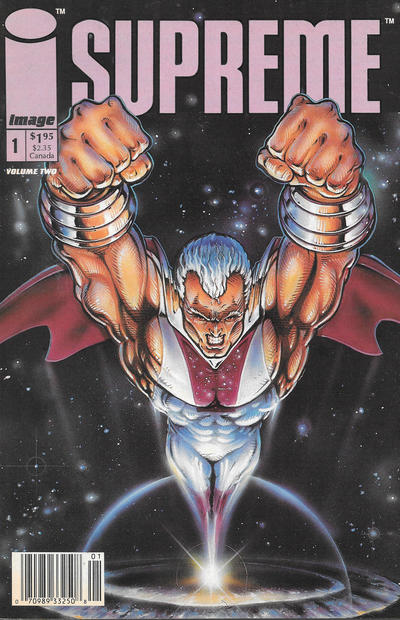
This is Supreme.
Under deconstruction since 1969
test post
This is Supreme.
So last time I told you mostly about what was supposed to happen in Fantastic Four #296, the triple-sized 25th anniversary issue of The World’s Greatest Comic. (And the time before that I just kept yappin’ about the Barry Windsor-Smith cover.)
Now, why triple-sized I’m not exactly sure. To use a variation of an expression I’ve used before, this was a 10 pound plot in a 20 pound bag, hardly requiring the space used for what the story needed. If it had followed John Byrne’s original plans, filling the pages with references to the team’s history, it might have at least made for a visual feast.
As it stands, it’s a Jim Shooter plot/a supposed Stan Lee script, and a parade of artists, starting with the aforementioned Windsor-Smith for a moody five pages focusing on ol’ Benjy Grimm:
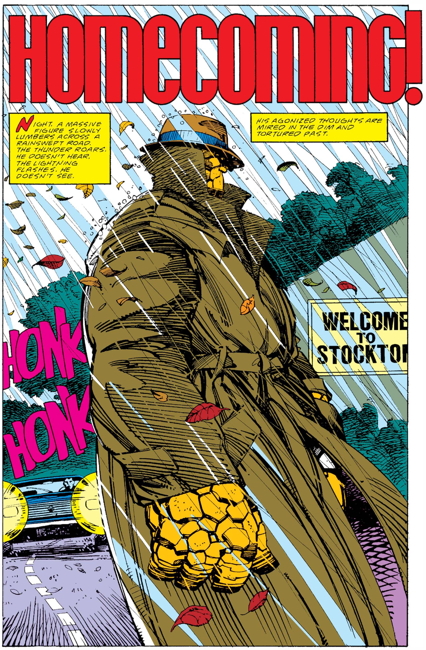
…followed by a flashback to the origin, also drawn by Windsor-Smith but but with additional artwork by Kerry Gammill and Vince Colletta, giving it that retro-1960s feel.
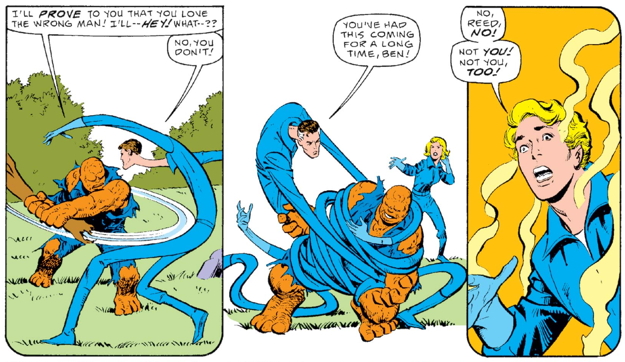
It’s a strong kick-off to the anniversary issue, contrasting where we are “now” (i.e. 1986) and how things were at the beginning. Maybe a little long, given the 10 pages it takes out of the 64 total. And like i said, it’s not like there’s a whole lot of story here. In short, the rest of the FF discover that the Thing, alienated from the team and the world, has retreated to Monster Island, home of their old enemy the Mole Man, to live among the creatures there. They fly out to get him, fight a bunch of monsters, convince the Thing that the Mole Man’s plan to raise a new island is going to wipe out the U.S.’s Pacific coast, and Ben is back on the team. The end.
Of course, there’s usually more to a good Marvel story than just the plot, and that’s the characterization. I do like this bit where, prior to seeking out Ben, Sue Richards gives her husband Reed a good shouting at in regards to how he’s let the Thing guilt-trip him for so many years:
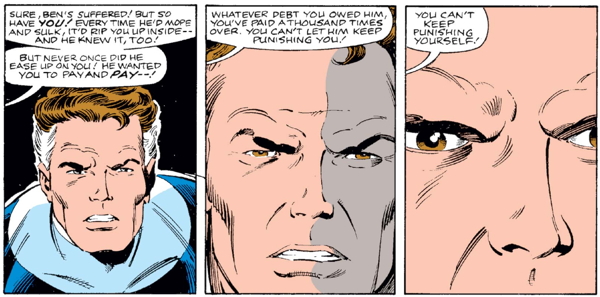
But Reed still wants to fly out to the island to settle things with his former best friend man-to-man.
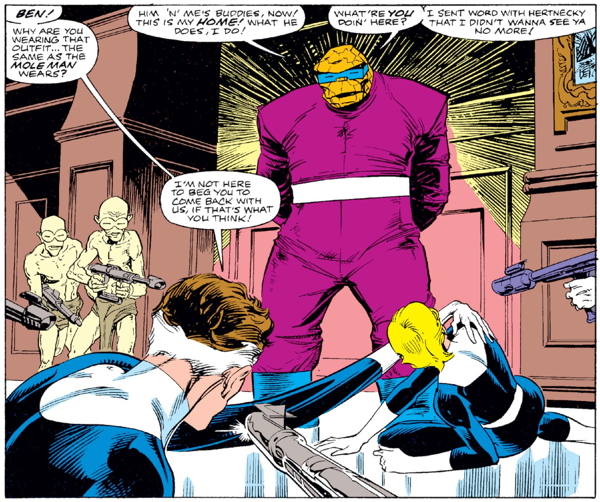
And then there’s the Thing his own self…spending the issue giving the FF the cold shoulder, defending his new pal the Mole Man, determined to turn his back on his old way of life forever…but pushing back a bit when Moley calls his former teammates his “enemies.”
Speaking of the Mole Man, he is not unaffected by Ben’s decision to crash at his pad:

He also has his own private chamber that he absconds to time and again, but when Ben busts in to talk to him:
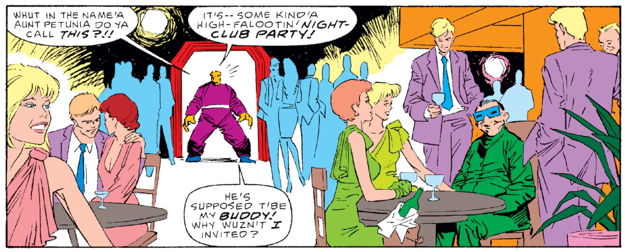
…he discovers that the Mole Man, despite his disdain for the surface world, finds comfort using holograms to pretend he is part of that world, and easily loses himself in that delusion.
It’s interesting little character bits like this that drive the story along, which, as I said earlier, feels a little overlong. While the various artistic contributions range from “nicely done” to “it relays the plot in pictorial form,” with Jerry Ordway’s lengthy participation probably being the best of the bunch next to Windsor-Smith, ultimately the story doesn’t feel that…special.
Byrne’s idea of visually including the history of the team in this issue would have at least been something. Mostly, though, this was a just a climax of sorts to some of the ongoing soap opera threads that Byrne had left behind due to his abrupt departure from the title. It wasn’t that long ago that I was talking about Justice League of America #200, and what a perfect anniversary issue that was, with the hook of great artists providing individual chapters in a storyline that celebrated the origins of the team while equally celebrating the characters that came later.
This FF anniversary was almost there, referring back as it does to the Mole Man’s appearance as the team’s very first adversary in issue #1. Plus, don’t forget that the team’s co-creator, Stan Lee, is attached to this new story. But the story just lacks…oomph. Aside from that wonderful Windsor-Smith cover, and some nice art and character bits inside, there’s nothing here that really grabs you. I don’t know how fast they had to scramble to assemble this issue, with Byrne bailing out so close to its publication, but the comic is simply…there. Not a celebration, not an exciting reflection on What Has Come Before and Where It’ll Be Going. It’s just a means to an end.
That end being that the ultimate upshot of the whole endeavor is to get Ben Grimm back as part of the Fantastic Four. He hadn’t held that position for a couple of years by this point, since the end of the Marvel Super-Heroes Secret Wars mini-series. It’s a restoration of the status quo, of sorts.
The one interesting thing this story does is that it doesn’t necessarily resolve the main emotional conflict, that Ben is alienated from the team. Superficially, yes, Ben had rejoined and it looks like everything’s back to normal, but…his old girlfriend Alicia is still romantically attached to his teammate Johnny, he’s still a “monster,” he still blames Reed, and Reed never really hashes out the whole guilt-trip thing with him. And when we get to the issues that follow, and the new creative teams that take over the book, we see that Ben’s emotional journey continues along a darker path.
Don’t be alarmed by the title, everything’s fine, I’m not going anywhere. But like I noted yesterday, my initial attempt at my Monday post someway, somehow, caused a glitch in the matrix here. Comments couldn’t be posted on the post, and for some folks the site as a whole wasn’t loading properly.
Well, I managed to do a brand version of that post that appears to work fine…some of you have posted a couple of comments, so it all looks good.
As I also said yesterday,I wondered if the 16-year-old template I’m using is part of the problem. I’m using a WordPress theme called “Hanami,” which has been a solid and faithful visual layout for my site for all this time, but it’s very possible the cracks are starting to show. Hence, my quest for a newer, more modern-looking theme that will retain the simplicity of what I have now, but be more responsive to, say, desktop and mobile screen sizes. Oh, and will also allow for a banner across the top of the page with my site name and tagline superimposed over it.
And also won’t break everything. That’ll be good, too. Any ideas, feel free to let me know in my hopefully-functioning comment section.
If you were around the last time I changed up the site, back in early 2010, you know that was a bit of a challenge. But that was switching from Blogger to WordPress, a full transition of blogging platforms. This new template, whatever it is, will hopefully just be a visual shift on an existing platform, one that will hopefully work better with the software involved.
My feeling is that it’ll be a smooth transaction, since my site isn’t terribly demanding programming-wise. But I imagine there will still be a period of adjusting things here and there once I make the switch, so I’ll give you sufficient warning before I start messing around with the site.
Speaking of that Squeak the Mouse post, a couple of you noted that the cat vs. mouse cartoon characters Herman and Katnip are more of a direct inspiration. In fact, it’s specifically cited by folks from
as such…this in-depth article by Brian Cronin tells you all about it.
Plus, in response to my calling Justice League of America #200 “post-Bronze Age,” Athelind asks
“I’m intrigued that you refer to a 1981 comic as ‘post-Bronze Age,’ I tend to think of the Bronze Age as running from around 1970 (Adams/O’Neil on Batman and GL/GA, Kirby leaving Marvel, Spider-Man Drug Issues) to around 1985-86 (Crisis on Infinite Earths/The Dark Knight Returns/Watchmen, the shift from newsstands to specialty shops, the black & white/indy boom).
“I’m curious to know what your benchmarks are for the transitions between Silver, Bronze, and Iron.”
And…hoo boy. I’ve talked about this before (like here and here and here), and, okay, at that last link, I note that Overstreet defines “Bronze Age” as “1970-1984.” But I’m also old enough to remember when Overstreet used to define “Bronze Age” as an informal, not generally accepted term.
But to keep this from going on too long (too late, I know) in my head I generally think of “Silver” as “mid-’50s to late ’60s,” Bronze as “’70s,” and anything past that more or less as “Modern,” because I’m fighting “Copper Age” with all the power my aging body will allow. And I don’t think I’d ever heard Iron Age before, which Googling tells me is 1985 to 2011, and man, I just don’t have it in me right now. I know I’ve said “Modern Age needs to be broken up,” but every time someone suggests something my initial reaction is “no sir, I don’t like it.” So, yeah, don’t pay attention to me on this…I’ll come to terms eventually.
Basically, all I meant was “post 1970s,” as ’70s JLA certainly felt different from ’80s, even early ’80s, JLA.
And in other site news…I will be returning to the “My Fantastic Four-Ay” series shortly, and will be getting into my non-spoiler-free post about the final issue of Rick Veitch’s Swamp Thing 1989. So, yes, soon I shall posts on the site that aren’t just about the site. I’m sure you all will appreciate that!
For reasons unknown to me, the post I put up on Monday IS CURSED, and somehow 1) messed up the rendering of my page for some readers, and 2) would not allow comments to be posted. I’ve been running tests (you may see “test” comments from me here and there ’til I get around to deleting them), and even if I strip ALL the HTML mark-up from that post and reload it, it still acts oddly. Even creating a new post and copying everything over doesn’t seem to work.
Thus, for now, that post is rescinded, until I try to simply rewrite it from scratch. Other posts seem to accept comments just fine. So…I dunno.
Keep in mind the template I’m using for this site is 16 years old, and it’s probably a miracle that it hasn’t really broken yet. Not saying this is an incompatibility with the current WordPress software causing this, but it’s possible.
Anyway, any more weird glitches turn up, please email me and let me know. Thanks.

So there you see above, my copy of the original Justice League of America #200 from 1981, propped up there against a copy of the new Justice League of America #200 treasury-sized facsimile edition due out in your better comic shops this week, and even in mine, too.
For a long time I’ve pushed for a hardcover reprint of this, as it’s the absolute ideal of an Anniversary Issue. Written by Gerry Conway (with some assistance from Roy Thomas), the story is based in the origins of the team, presenting a sequel to those events while demonstrating the changes the League has undergone in the decades since.
And how does it do that? By pitting the original members of the team against the members that joined later, dedicating multiple chapters to the individual battles. Plus, each chapter is illustrated by perfectly-matched artists…Aquaman versus the Red Tornado? Drawn by Jim Aparo. The Flash versus Elongated Man? Drawn by Carmine Infantino? The Atom versus Green Lantern? FREAKIN’ GIL KANE:
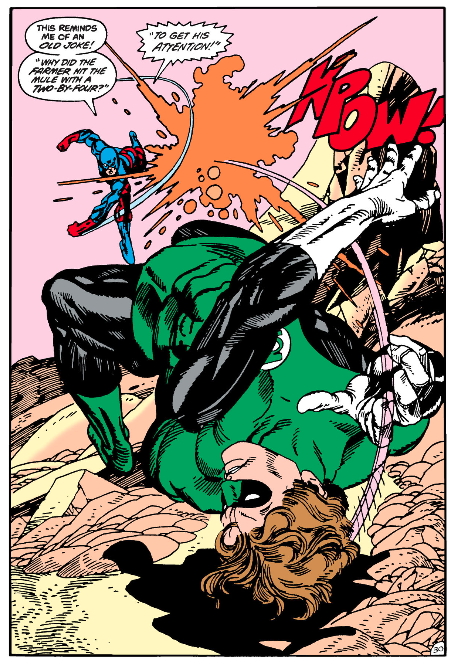
Batman…excuse me, The Batman (they were pushing that pretty hard at the time) versus Green Arrow and Black Canary? You feel like they probably wanted that to be by Neal Adams, but instead we get Brian Bolland, who nails it perfectly.
I didn’t even mention Pat Broderick, or Dick Giordano, or Joe Kubert, or the bookends and between-chapter bits by George Pérez, who also did the wraparound cover…basically, I’m saying this is a beautiful comic. And each fight gets a swell full-page shot like that Atom/GL clash pictured above.
Now I didn’t get that hardcover I wanted, but this oversized treasury edition is a welcome second choice for getting this wonderful comic back into print. Especially at this size, which is far easier on your pal Mike’s beleaguered eyeballs.
Even after four-plus decades, the comic still holds up. It’s a delightful piece of post-Bronze Age comicking, balancing the heavy use of captions and dialogue of the era while showcasing the beautiful artwork. Conway’s story expertly weaves in and out of the individual chapters, pulling together a plotline that propels the action along while still paying homage to the Justice League tales of the past. And don’t skip Conway’s “behind the scenes” text piece in this issue, which oges into some detail about how this story was assembled.
In conclusion…just buy it already. It’s great.
Now hopefully DC will give up a similar reissue of Detective Comics #500, the other Great Anniversary Issue of the period.
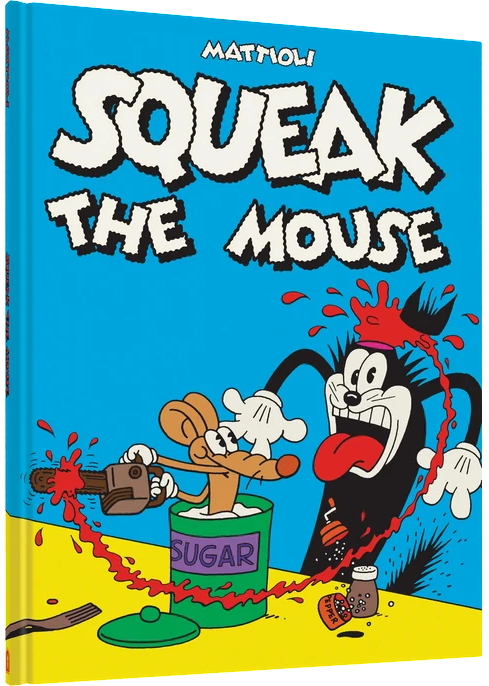
So I had a copy of this on the shelf at the shop, Massimo Mattioli’s complete Squeak the Mouse hardcover published by Fantagraphics a year or three back.
Have you read this? I don’t know just how far these comics seeped into the awareness of comic fans. But, as you can see from the delightful cover pictured above, this is a knockoff on the dynamic between the classic Hanna Barbera cat and mouse characters Tom and Jerry. It basically answers the age-old question “what if Jerry could rip open Tom’s intestines with a chainsaw, and then go [EXPLETIVE DELETED] Tom’s girlfriend and all her buddies?”
What I am saying is that there is a whole lot of explicit violence and, shockingly, explicit sex in these Squeak the Mouse comics. I first read these in a couple of paperback volumes from the late ’80s/early ’90s, which gave me a real sense of “…should I be reading this? I mean, is it allowed?” It was expertly done and lovingly drawn, with the occasional weird insert of a photo panel that is invariably disturbing in context.
Anyway, I said I “had” a copy because someone bought it on Sunday. This person is a Simpsons fan, and was seeking out my, alas, very few available back issues from the franchise. Very quickly, though, his eyes fell upon my Squeak the Mouse book and snapped it up, saying it reminded him of the Simpsons’ own in-universe violent Tom and Jerry parody, “Itchy and Scratchy.”
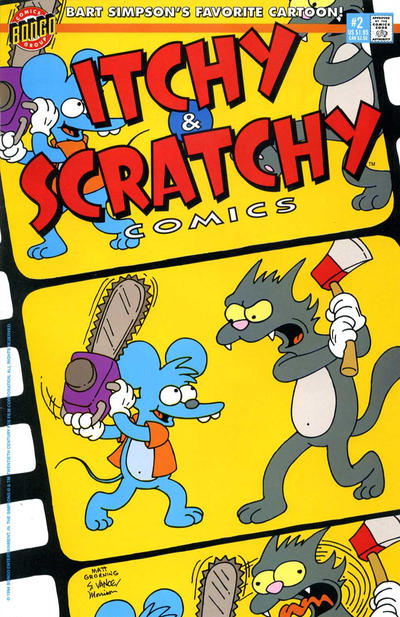
I explained to this customer 1) Squeak the Mouse actually preceded The Simpsons by a few years, and 2) this is really really really really really more violent and adult than its TV follow-up. It was literally stopped by U.S. Customs at one point for “obscenity.”
I told this person several times, surely to the point of annoyance, that one of these things is not like the other, but the purchase was nevertheless completed. (And this customer also gave me a 5-star review online, so I presume he hadn’t read the book yet.)
I mean, as I said on Bluesky talking about this, I did my part. I gave him sufficient warning! But I also wondered if Squeak the Mouse was in fact an inspiration for “Itchy and Scratchy.”
A little researching (i.e. Googling about) doesn’t seem to see any explicit admission that Squeak the Mouse was a direct influence, and after all the idea of “Tom and Jerry but super-violent” isn’t really a hugely unique stretch. But it’s also likely Simpsons creator Matt Groening knew of its existence, given his early involvement in cartooning, so who’s to say.

Found by my former boss amongst his belongings, this colorful wooden toy paddle once had a rubber band and a ball stapled to it for hitting-and-bouncing play. Alas, the ball is long gone, the rubber band was still attached but dried to brittleness, but that solitary staple remains.
At least I can still use it to swat people who put the comics in my shop out of order. “Hey, did you put that Miles Morales back in the Scarlet Witch section?” SMACK!
My thought process on this item was “huh, I bet this is pretty old…no wait, it’s only from 1987, it’s not that old…but ’87 was nearly 40 years ago, so it is old.” …In case you were wondering what it’s like to be my age.
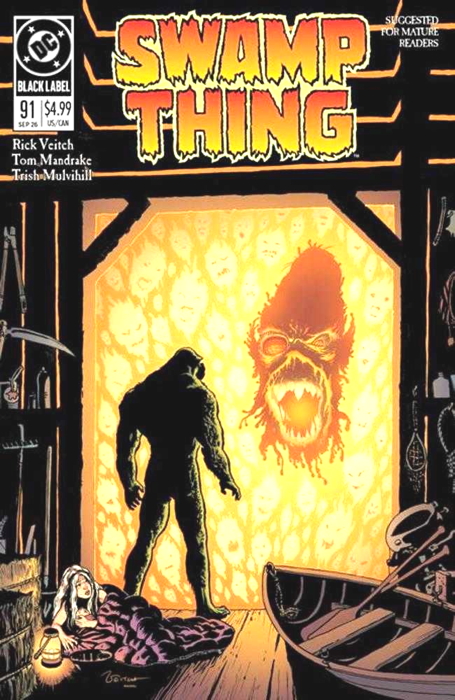
At long last, it’s here. Decades after Rick Veitch’s 1980s run on Swamp Thing was cut short by editorial disagreements, we’ve finally seen the intended ending, completed and in full.
I’m going to try to remain SPOILER free discussing this, though I may dance around specific bits. It may be best if you read your comic first.
…
Finished? Good.
I’ve noted before that, when this whole hoohar came to pass in the late ’80s and Veitch departed the book, he offered up brief synopses of the final four issues that were printed in the Comic Buyer’s Guide trade paper. I had owned a copy of this at one time, but discarded it long ago for reasons I can’t comprehend now (given the piles of ‘zines and mags I still have) but I did read that article at the time. As such, I have vague memories of how things were supposed to have played out, at least in the final issue.
Specifically, that Veitch had a specific name in mind for Swamp Thing and Abby’s child, but did not reveal it in that article. Also, that Swamp Thing’s encounter with Jesus would have given him an advantage in his final conflict with Arcane.
As such, it was…very weird to see things finally play out on a printed page, panel by panel, witnessing for myself what was meant by those brief descriptions I read so long ago. As I’m trying to remain spoiler-free here, I won’t detail specifically what I am possibly misremembering about that conflict with Arcane and how it plays out, which I may be conflating with Arcane’s treatment in the latter part of the Mark Millar run.
Also, as to the child…I’m so used to the character of Tefe being the Official Kid of Swampy and Abby, that it’s strange to get an entirely different character here. And Veitch did not disappoint with the name, giving us the perfect, and perfectly ambiguous, sobriquet.
Given how deep into the DC Universe weeds Veitch got with his stories, especially in this final run of issues, it’s not surprising that it all plays into the resolution of the series. It does leave me with more questions, that I’ll be bringing up in a later post about this mini-series that isn’t coming out the day of the last issue’s release. In particular, if this was the original intended ending of the story back in 1989, how exactly was any new creative team supposed to follow up on that? I mean, yes, on one hand Veitch was a polite host and left the toys intact for the next folks to play with. But on the other hand, the memory (at least for the reader, if not the characters in-universe) would always float over the new works.
But that’s all a moot point, I suppose, since DC Continuity went in one direction, and as a Black Label book, this Swamp Thing 1989 series is essentially one of Marvel’s What If stories, but with 100% less “and the Fantastic Four never came to be” within. To be fair, I’m not completely certain what Swamp Thing’s current backstory is in the DC Universe…revisions in the New 52 relaunch were confusing, to say the least, and I’m not sure if the “Rebirth” initiative forced everything back into place. Look, if we need a Swamp Thing: Year One story to straighten things out, I volunteer. Well, “volunteer” in a way that I get a paycheck.
In an odd way, the Veitch conclusion to the story could, if you squint here and apply some paint there, still allow for how things did play out in the Swamp Thing title after Veitch left. I suppose I coould try to explain how that would work, but I need to save something for my Swamp Thing: Year Eleven series, sure to come after the success of the first ten.
But overall…I’m glad this all saw the light of day, and that I was still around to read it. Veitch is a master Swamper, it goes without saying, and the art from the late Michael Zulli, Vince Locke, and Tom Mandrake was all beautiful and ideal for the project. Todd Klein’s spot-on mimicry of John Constanza’s lettering was vastly appreciated, as was the expert and appropriately-applied coloring of Trish Mulvihill. The backmatter from Veitch, Klein, and that real barnburner from Steve Bissette gave us wonderful insight into what this series was and what went into making it happen (and almost not happen). And of course, I can’t forget close personal friend Rich Handley, and his delightful text pieces inside each front cover, giving us the proper context for what we’re reading.
Seems like only yesterday we were wondering about these weird unknown comics showing up in a listing for an upcoming Swamp Thing trade paperback. Still wondering about New Titans #0‘s inclusion, though. Any answers for me there, Rich?
Only one more single-vote receiver to go after today’s installment of the Final ’90s Countdown! And like I always say, getting only one vote isn’t a thing of shame, but rather a testament to all the beloved books that came out during this usually maligned decade! That said, here we go with
Supreme (Image Comics/Maximum/Awesome, 1992 – 2000)
 So, where to start with this comic? It’s got bit of a convoluted history but we’ll get through it!
It all kicks off in Youngblood #3 (August 1992), where the character is introduced. A creation of Rob Liefeld and Brian Murray, Supreme, a somewhat more violent take on Superman, got his own series in November 1992, in a first issue inexplicably labeled as “Volume 2.” …I’ve seen explanations for that ranging from “someone messed up” to “it’s implying a long previous history” to “it’s setting up an eventual ‘Volume 1’ series that would go into the character’s past history.” (And we sort of get that last one, but more on that later.)
But whatever the reason, the actual premise of the series itself sounded interesting to me at the time, in which Supreme, active during World War II, leaves the Earth for decades and returns in our absolutely current and modern year of 1992. And then, let the kicking of asses and the taking of names ensue.
I have to admit, despite thinking the premise was neat, the execution on these early issues were…not to my taste. It was very much an Image Comics of the Early ’90s with “kewl” looks and crossovers with other Image heroes and so on. A brief glimpse at this Grand Comics Database gallery of covers for the first 35 issues shows a whole lot of jagged lines and gritted teeth and just did not seem to Be For Me.
…Um, I realize that I did have someone place a vote for this as their favorite ’90s title, so I really don’t mean to yuck your yum, as people on podcasts say. I’m just giving my surface-level personal response to these “before-times” Supreme comics and for all I know, they read great. I see Shawn McManus drew a couple of them…I like his work! And Keith Giffen is in here somewhere, too!
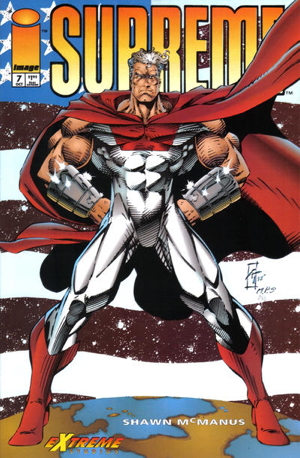
Anyway, all that said, I don’t recall a whole lot of memories about these earlier Supremes during their initial sales at the shop. There was some anticipation for the first issue, sure…Image Comics was still in its Age of Hotness, after all. And I remember it selling fairly well when it came out. I mean, it did have a pretty striking cover by Murray. I know I linked to the cover earlier, but I’ll go ahead and put it here because honestly, I do like it.
Note that’s the newsstand cover, as the cover comic shops got had an embossed foil logo that doesn’t really show up great in scans like this. But still, that’s a cover that made customers go “whoa, look at this” and pick it up…and then they’d ask what “Volume 2” meant, and friend, only Rob Liefeld’s hairdresser knows for sure. (I should note here that there is an origin series for Supreme, called The Legend of Supreme, masterminded by Keith Giffen and Robert Loren Fleming, that covers his origin. If you need a “Volume One” to counter that “Volume Two,” this is close enough, I think.)
So anyhoos, Supreme continued on Supreming, until something very weird happened to the title in 1996. Specifically, this happened:
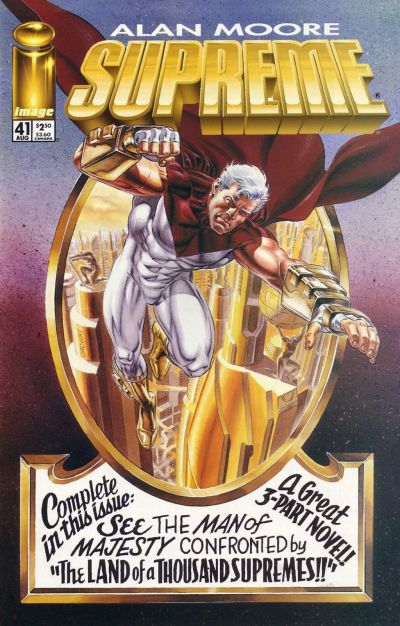
Alan Moore…yes, that Alan Moore, not any of those other Alan Moores you may be thinking of, took over writing chores with issue #41 (art by oe Bennett and Marlo Alquiza). With its Superman #1 (1939) inspired cover by Jerry Ordway, clearly changes were afoot, especially when you compare that cover to the ones in the gallery I linked earlier. This isn’t the hyperkinetic, violent Supreme we’d been seeing. This is something more retro, more “Silver/Golden” age-y. (And here’s the second printing of that #41, if you’re interested.)
And that’s what we got! Before Moore launched the America’s Best Comics line in 1999, here he was doing fun, silly, Silver Age Superman-inspired stories, complete with his own Lex Luthor type, his own Jimmy Olsen type, his mild-mannered secret identity, his superpowered pet dog, and on and on. Every story was a tribute to that sort of storytelling, as told through modern eyes…not ironically, not parodic, just played straight but still with a sense of humor about itself. It was Moore’s own antidote to the grim ‘n’ gritty trend of the ’80s to which he inadvertently contributed.
(One of my favorite gags is the Jimmy Olsen stand-in character, Billy Friday, finding himself in an endless series of transmutations that continue from issue to issue, referencing the many transformations Jimmy Olsen himself would undergo in his comics.)
This style of Supreme comic continued on for quite some time, and transcended multiple publishers and decades. The original series of Supreme ended its run at Image Comics with #42 in 1996. It picks up with #43 under the name Supreme: The New Adventure, running ’til #48. Then it’s off to Awesome Comics, where we get issues #49 through #56 (including two #52s, a #52A and a #52B), running ’til 1998. We then jump ahead a year, remaining at Awesome, where we get Supreme: The Return. This starts the numbering over again with #1, running until #6 in 2000, essentially being issues #57 through #62.
And yes, that was Alan Moore on all those issues. Notable other artists on these books include Chris Sprouse and Rick Veitch, though to my recollection everyone who worked on the book did a swell job.
So, with #6/#62 from that last series, that was it forever, right? That was the end of this great Silver Age-y experiment, and Supreme was never seen again, correct?
My dates at the top there, of 1998 through 2000, basically reflect the inception of the Supreme title until its eventual end at Awesome. It more of less kept the same numbering throughout, except for that final batch of comics, but I’m still considering it all part of the same run, especially given what comes later.
And what comes later, you may ask? Why, Supreme #63, of course, in 2012 from Image Comics.
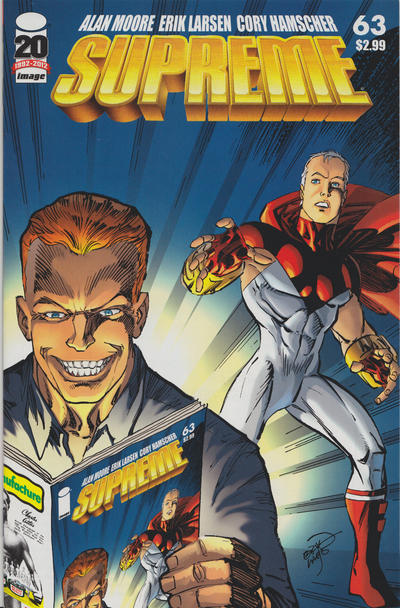
Turns out there was still one script left by Mr. Moore, and Erik Larsen illustrated it for this debut issue of a new run of the title. And then the subsequent issues, running through #68 in 2013, had Larsen scripting and drawing, building on Moore’s work on the title while edging it away from the retro look ‘n’ feel that had dominated so much of its run. I read these too, and to my memory they were still a lot of fun…it wasn’t what Moore was doing, exactly, but Larsen comics have an energetic energy all their own and it was applied nicely to the concept.
There was one further Supreme comic in 2015, unrelated (or…is it) to previous goings-on. Supreme: Blue Rose, by Warren Ellis and Tula Lotay, is an interesting take on the very nature of superhero comics themselves [SPOILERS, maybe] , in particular the idea of “reboots.” We find ourselves in a world where Supreme’s reality has been rebooted yet again, but the reboot was somehow incomplete/flawed. It’s one of the few stories to actually dive into what a reboot would actually mean for the fictional world being rebooted (Astro City #1/2 being another classic example) and it makes for fascinating reading for those of us mired in all this superhero universe silliness.
Now, as for reprints…only a few issues of the pre-Moore Supreme were reprinted, with issues #12 though #16 showing up in Supreme Madness from Image. All the Moore Supreme (through the end of The Return) was reprinted in two trade paperbacks from Checker Books, but sadly my memory of these was that the print quality wasn’t that great…everything looked a little fuzzy, like they were low quality scans or they were shot from the original printed pages. I mean, it’s not bad, just not ideal. If that’s all you can find, it’ll do in a pinch.
There we have it…Supreme. A comic with somewhat inauspicious beginnings, looking an awful lot like everything else on the stands at the time, that turned into an almost-forgotten classic. Alan Moore’s run reminded us all of the whimsy and wonder that comics used to give us, while it was surrounded by gritted teeth and sloppy crosshatching. At least he was able to put out as many issues as he did, even if it was under several imprints and with a decade-long gap before his final issue saw the light of day.
Before I wrap up here, I do have one memory from the old shop, shortly after Moore had been on the book for several issues. I had a customer talking to me about how much he loved the Supreme comics, how the character was cool and tough, how ever issue was action packed. “Not like whatever weird things are happening in the comic now,” he said.
As much as I thought Moore’s Supreme run was objectively good, it was a little bit of an eye-opener to encounter someone with the exact opposite opinion. I simply nodded in agreement, probably. I had to look at it from his side…here I am, reading this amazing comic about a super-powered guy who takes no guff from anyone, who’s badass and kicks ass…that suddenly becomes a title involving superpets and looks like it came from the ’60s. I’m sure it was quite the shock.
ADDENDUM: I know I didn’t get into all the spin-offs, like Lady Supreme and Kid Supreme an’ all that, but this post was long enough as is. Just wanted to acknowledge that, yes, I know such spin-offs existed.
…Well, I was working on a new installment of the Final ’90s Countdown and I’m like a third of the way through the proposed entry and I just looked at the time. Eep!
So, I’ll finish it up Monday night and have it out for Tuesday. Sorry about that, pals. Apparently I had a surprising amount to say about this particular comic, and I didn’t want to rush through the entry just for the sake of getting it out “on time.”
Thanks for your patience, pals!