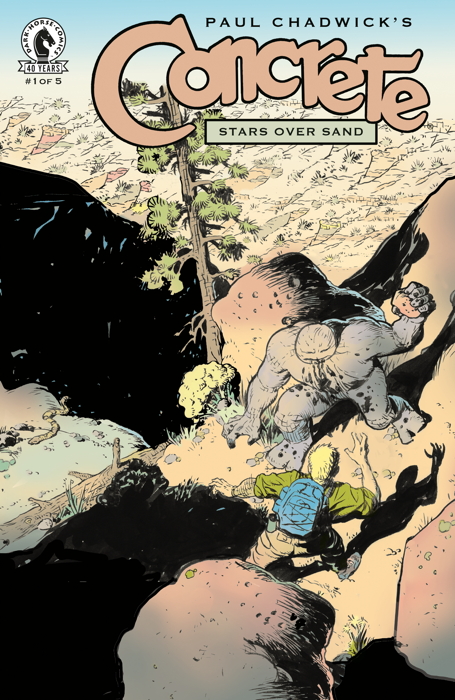
Look, it’s been a long time since we’ve had a Concrete comic, I don’t need to tell you that. There were some short stories that popped up in the 2011 series of Dark Horse Presents that were collected into the Three Uneasy Pieces one-shot in 2012, which was the last time a comic called Concrete was on the stands.
Prior to that, the last long-form Concrete story was The Human Dilemma, a six-issue run in 2004-5. Which, by the way, ended on a…cliffhanger? Unresolved plot line? Not sure what to call it, but I’ve been waiting over twenty years to see some forward progress on that particular bit of business, which, I’m glad to say, you do see at least a tiny bit of in this story. This isn’t quite on the level as where we were left off with Miracleman #24 back in ’93, keeping us waiting ’til the new stories started up in 2022…especially given that Miracleman as a whole is likely to remain unresolved forever. Well…let’s just consider ourselves lucky Paul Chadwick is around and able to continue his comic.
Despite the 21-year-gap, Chadwick just picks things up right from where they left off, which…actually, works a lot better than you’d think, thanks to the general nature of Concrete stories. There’s not a lot of story-to-story, mini-to-mini continuity that one has to keep track of. Primarily all you need to know is that Concrete was once a dude named Ron whose brain was transplanted into some kind of biomechanical body by aliens, and now uses that body to travel the world and do interesting things, accompanied by an assistant and a doctor who monitors his condition.
This new mini, Stars Over Sand, at least in this first issue, does lean pretty hard on events from previous decades-old stories. Well, “lean pretty hard” in relative terms, because there’s nothing here that isn’t explained or at least can’t be figured out from context. It’s just a little strange to have carry-overs from previous stories like that.
To enter [SPOILER] territory, the big “cliffhanger” I was sort of talking around earlier in this post was Concrete’s “baby,” a miniature version of himself that more-or-less budded off his body in that Human Dilemma story. That’s probably the biggest change to the Concrete “formula,” in as much the series has one, in that we now have an apparently-inert but still alive child version of Concrete the cast has to concern themselves with, along with whatever new shenanigans Concrete himself is up to.
What’s particularly interesting is the character development of the doctor, Maureen, that we’ve seen along the course of Concrete‘s existence. Inspired by the arrival of this new series, I’ve pulled out my original run of the Dark Horse Presents anthology series to reread the earliest short stories, and very early on Maureen’s interest in Concrete is almost solely scientific. It was a characterization that carried through for years, at least to my memory, before taking a sudden, more…intimate turn in Human Dilemma, seemingly resulting in Baby Concrete’s creation. There is a short sequence in this new issue where Maureen goes from commenting on the child’s current inert status to actually cradling the child, with concern and care in her face. It’s a more motherly turn that would have been hard to imagine earlier in the Concrete timeline, but given she could very well be considered one of the baby’s “parents,” it’s an understandable development.
Okay, despite all that other stuff, it’s still a Concrete story, with Concrete’s own musings on the world, the environment, and his place in it, and it’s all as expertly done as you would expect from Chadwick. The art is beautiful, the writing is sensitive, bereft of melodrama even given the occasional melodramatic moments, and overall it is an engrossing and relaxing experience. There’s really no other comic quite like it. I understand “cozy” is a term now thrown around to describe certain types of entertainment experiences. I’d imagine one could call this comic “cozy” — it gives you want you want and what you need, while still gently surprising you.
It appears Chadwick is lettering the comic himself, as I’m assuming longtime letterer Bill Spicer has retired in the meantime. (I used to see Mr. Spicer on a regular basis at my old job…loved chatting about old comics and ‘zines with him, since he’s an ol’ ‘zine editor himself!) Alas, there is a typo on the very first page of the story, but let’s just say the character speaking just stumbled over his words a bit. I mean, whomst amongst us…? And anyway, who am I to talk about typoos. Um, I mean, typos.
One more thing that kinda/sorta threw me off slightly was dialoge references to the internet and YouTube…I mean, yes, the internet obviously existed when that last mini came out, but the series existed for so many years prior to wide use of cell phones and social media and all that. It was like when Carl Barks wrote one last Duck story and one of the nephews referenced a fax machine. Okay, yes, this tech existed in one form or another since the 1800s, but this was clearly a reference to modern tech that felt very strange to see in the eternally mid-century Duck stories. I don’t get the sense that Concrete stories are in “real” time, so if we have a sliding timeline at work here, then surely Ron had his cell phone out taking pictures of those weird lights he saw on that long-ago hike where he first encountered those aliens. (I haven’t reread the origin or its revised version in a while, so maybe he did take pics, I don’t remember.)
Anyway, I am more than pleased that Concrete is back. It’s a longtime favorite — 40 years longtime, in fact — and I hope it sells a bazillion copies so that Mr. Chadwick will be inspired to cut the gap down between series to something less than 21 years.
• • •
Oh, hey,
MAD Magazine #600 is out, and it has a swell new wraparound cover by Serio Aragonés (click to MAD-size):

A few years back, there was a run of media stories about the “end” of MAD and how it would be no more, and to this day I have people coming into the shop commenting on the fact that this American institution had been cancelled. “Nope,” I would say, and whip out the latest copy from the shelf, much to their shock.
In fact, the mag just relaunched with a new #1, only available through comic shops, and went mostly reprint. As time went on, the new content slowly increased, and for the Special #600 (“Big Deal!” as MAD has said about previous milestones) it is almost all new stuff! Classic material from some of the artists most associated with the magazine, like Al Jaffee and Jack Davis, is included, because it wouldn’t feel right to leave them out.
And reverting it to the original numbering is very welcome. MAD isn’t a thing to be Rebooted with an All-New Beginning! It’s a continuing observer of our times, and having that numerical link back to its history gives it, in a way, a little more weight and validity than it had as what almost felt like a special “Classics” side-series replacing the original.
I know print satire and lampooning like this isn’t “hep” and “groovy” with the kids like it used to be, and that to an extent MAD exists as a nostalgic artifact for adult readers. And I’m sorry that’s the case, given I’ve written before about how, amongst the jokes and silliness there was a real education about seeing through the veneer of advertising, cutting through the babble of politicians, and basically learning to recognize bullshit when you see it. Frankly, that’s needed now more than ever.
There are lots of jokes about MAD itself in this issue, which, sure, they’ve earning it. Sergio contributes “A MAD Look at MAD” which is exactly what you hope it would be. There’s a reference to the infamous “middle finger” issue which I love. There’s a solid Dave Berg gag…not a gag by Dave Berg, but a gag about Dave Berg. Jaffee’s in here with a great “Snappy Answers to Stupid Questions” article. And there’s plenty more fun stuff in here, too. If you haven’t looked at MAD in a while, this would be a good one to check out.
I hope MAD is around for another 600 issues. I hope it’s around for another 6,000 issues. Goodness knows it’s not like the world is going to run out of things it can use for subject matter.