[This post contains SPOILERS for the endings of Supergirl: Woman of Tomorrow, the Supergirl movie, and also one chapter of The Ballad of Halo Jones.]
So one of my favorite incomplete works from Alan Moore is the science fiction strip The Ballad of Halo Jones, drawn by Ian Gibson, in which we follow the life and times of the titular character. Alas, a disagreement between Moore and the publisher truncated the comics’ run, and all we got is what we got.
I bring it up here because I wanted to point out this sequence (scanned from Quality Comics’ 1988 reprint of the story, in which the art was “stretched” to fit a standard comic book page). In this sequence, Halo Jones is a member of the military, and while on patrol on this planet, they shoot and kill an enemy sniper, to which the team has this response:
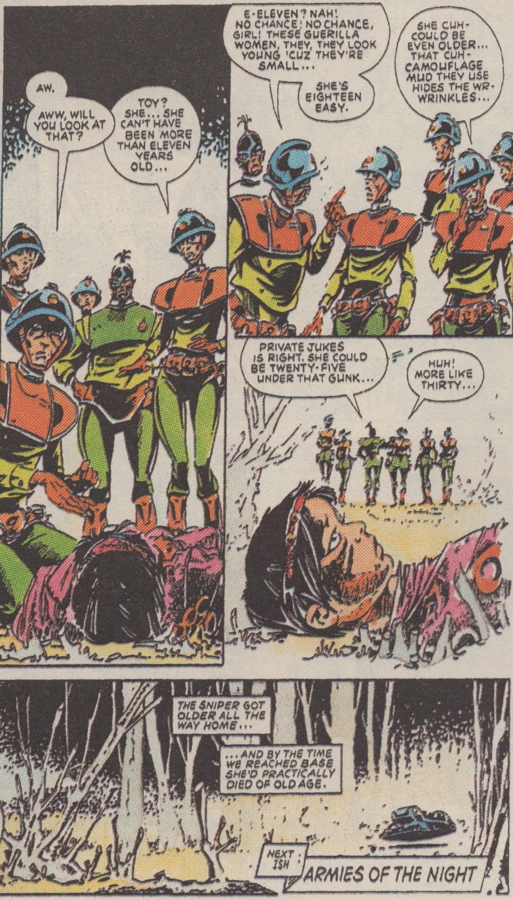
The obvious point here is that they can’t believe they just shot a child, and attempt to justify the incident by talking themselves into the idea that this wasn’t just a little girl, but an of-age adult. And as things progress, they talk themselves into thinking she’s progressively older and older until, as the caption says, “she’d practically died of old age.”
Now, it’s clear what’s going on here. The girl isn’t literally aging, it’s a psychological response by the squad to having killed a child and trying to rationalize it. The art shows what happened, the dialogue and captions tell a different story.
In a 1987 issue of The Comics Journal, in a review of an earlier reprint of Halo Jones from Titan Books, the otherwise insightful and informative article has this to say about that same sequence:

I mean, the person who wrote this article is a smart person, so I’m just chalking this up to a brain fart. “Whomst amongst us…” and all that. Who knows how he missed this? Was he reading just too many comics he had to write about, rushing through the volume and not allowing the implication to sink in? I don’t know. Regardless, what was written in that review is not what was happening in the comic.
Again, it happens. Look, even Roger Ebert didn’t quite get the “multiple choice origins” for the Joker in The Dark Knight, so none of us are infallible before God.
Which brings me to Supergirl: Woman of Tomorrow by Tom King and Bilquis Evely.
This 2021 comic book series was the primary inspiration for the new Supergirl movie, which heavily borrowed characters and plot elements from it, but not every detail. And the movie also included folks who did not appear in the comic, like, oh, say, Lobo. One of the frequent complaints I’ve seen about the translation of the comic to film is that the book’s ending had been altered, or drastically misinterpreted.
I hadn’t read the comic before I watched the movie, as I noted in my look at the film. However, I’ve since perused the source material, as well as did some searching online for more reactions.
And what I found was interesting: there is a portion of the comics’ readers who are confused by its ending. Which…I find puzzling.
Here is the last page of the book, more or less (I cropped the panels for increased legibility, where I could). At this point, the bad guy, Krem, has been released from the Phantom Zone, aged and repentant, begging Ruthye for forgiveness for what he’s done. Ruthye had been talked out of killing Krem as vengeance for her father’s death, and Supergirl stands by her here.
In panel one, we see Ruthye smack the kneeling Krem with her walking stick:
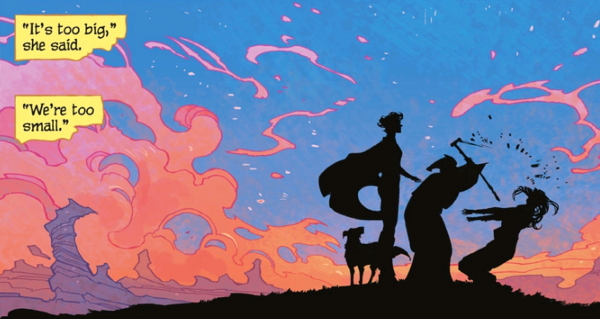
In panel two, we see Krem on the ground with his hands apparenly flailing in the air, as Ruthye walks away.

Then we see Supergirl and Krypto walk away in the opposite direction, as Krem reaches for his head.
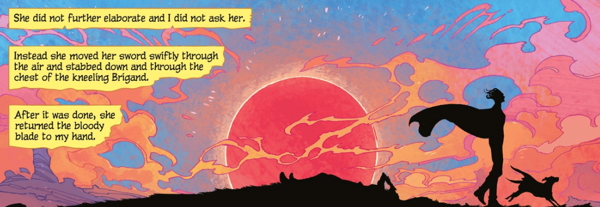
And here, is Krem, alone, just remaining on the ground.

What Ruthye does to Krem here is slightly open to interpretation. Does she kill Krem, despite the point of entire book being about eschewing vengeance, giving the story a darkly ironic ending? Or does she simply bop him on the head, indicating that despite whatever personal growth he underwent while imprisoned, she still hates his guts?
Well, it’s the latter, Tom King his own self said so. Krem is still alive, just with a likely bleeding and sore crack on his noggin.
While there is admittedly some ambiguity there, there is no ambiguity about what’s going on in the captions. An additional note about what’s going on here: it’s been 300 years since the events earlier in the book. Ruthye is elderly. Supergirl and Krypto are, it seems, immortal. In that time that’s passed, Ruthye wrote a book about the events in this story, about which she’s said

Ruthye straight up tells Supergirl, and the reader, what she wrote is a whole lotta bullshit. As such, those excerpts, describing Supergirl’s dispatching of Krem with a sword, is a fictional rewriting of the actual end of the adventure. That book had been written as some point in the past, and since Krem is still alive now under the captions presenting those excerpts, clearly Supergirl ain’t killed nobody with no sword. (Apparently it was a ruse by Ruthye to keep Krem’s comrades from seeking their own vengeance on her.)
That all seeems pretty clear. And yet, when researching responses online, I found people confused by the ending. Okay, yes, I’ll give a pass to those who thought Old Ruthye killed Krem at the end. It’s contrary to the spirit of the book, and shouldn’t be interpreted as such, and c’mon Supergirl was standing right there, but you can’t put it past that wily Tom King to give such a dark punchline to a story that tried so hard to avoid it.
But there were folks confused by those captions. They were saying one thing, we were seeing something else in the artwork. Even though it should be understood that Supergirl hasn’t killed anyone, some readers were apparently still confused by what they were being told. It’s not what’s shown, the timing doesn’t work out (the book relating a death that happened in the past, though the person killed is still alive in the present), but the old Unreliable Narrator trick can still muddy the waters, it seems.
Interestingly, Ana Nogueira, the screenwriter for the Supergirl film, also didn’t quite grasp the book’s ending. She straight up says in this Variety article
“[Krem] essentially has changed, and she kills him anyway, because she still just has this anger, and you understand there’s this element of deserve, right?”
Now, again, I’m not going to fault someone entirely for not getting that, for all the reasons I stated previously, while also saying that same someone probably shouldn’t have thought that, also for previously-given reasons.
What that seemingly leads to, though, is that Krem’s death still has to happen in the film, and the responsibility is transferred to Supergirl.
“So, we wanted to craft a villain who would deserve this, but we also wanted Kara to really care about preserving Ruthye’s innocence, and to feel like she could take on [killing him], that she could be the one to bring justice to this man, and do it without burdening this child.”
This change to the story’s ending took on a more deliberate stategy, despite seemingly being based on a misunderstanding. In this article on Comic Book Resources, director Craig Gillespie related
“I met with James [Gunn, head of DC Studios], and we talked about it, and James was adamant about it. I think it’s an amazing thing. To lean into – knowing the kind of movie that we’re making, and where her character is heading, that she has to go through this emotional journey. There’s no other logical conclusion to what she would do.”
Realistically, I don’t know how this more brutal interpretation of Supergirl will play into future DC films, as frankly, how many more will feature the character? She’s on deck for the next Superman movie, but it certainly doesn’t seem likely we’re getting any more standalone Supergirl films. To whatever end this choice was made, to have Supergirl capable of taking a life, they probably just have the one shot for it to play out. Whatever arc they intended will likely never see a conclusion.
These are a couple of extreme examples of misinterpreting the text. One is a simple misunderstanding of a description of a mental state in an otherwise solid print article. The other dictated the course of a multi-million dollar franchise, for good or ill. (Possibly “ill,” given how the film’s doing.)
Does the change in the Supergirl ending ultimately matter? No, not really. Whatever story is there for the films to work out will either work out or it’ll just dry up into nothingness, awaiting the next attempt at getting DC superheroes onscreen. It’s probably disappointing to fans of the original comics, but hey, if they could fiddle with the ending of Watchmen, or even The Scarlet Letter, nothing is sacrosanct.
I still think Supergirl is a pretty good film. I also think Supergirl: Woman of Tomorrow is a pretty good comic. That one is different from the other is…nothing new, given the Hollywood of it all.
Of course, that hopefully still-upcoming Swamp Thing movie had better be 100% faithful to the comics or I’m writing letters. Letters, I tell you.


 I’ve noted before the main difference between this series of posts and the series I did focusing on