And here we are, at long last, with the final part of the ’80s Countdown, where I tallied up your votes for your favorite 1980s indie book and presented the winners, in ascending order, over a particularly extended period of time. But we’ve reached the conclusion, with the top vote getter, including my own vote, and it should be no surprise which title it is.
Love and Rockets (Fantagraphics 1982-1996)
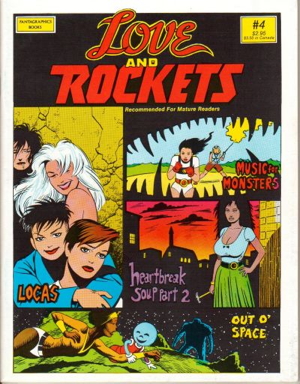 For over forty years, the Hernandez Brothers (Jaime, Gilbert, and occasionally Mario) have been gifting the comics world with some of the best cartooning and most realized worlds and characters to have ever graced the medium. It’s hard to believe it’s been that long, as you look at the work being produced and you can see no decline, no lessening of their powers — only an ever-continuing evolution and refinement of their craft. The stories remain as entertaining and compelling as they ever were, the artwork perfectly expressive. Every new comic from them is a master class in How To Do Comics and we are lucky to get them.
Did I oversell it yet? Honestly, I don’t think I have.
Reams have been written on Love and Rockets and its ancillary works and I’m honestly not sure what else I can add to it. I can say this series has special meaning to me, in that the brothers hail from Oxnard, CA, as do I, and I can often recognize references to the area in their works. Especially when they just straight up put my previous place of employment in the background:

In full disclosure, I should mention that I’ve known the brothers for…well, about as long as I’ve been in the comics business, currently 35 years and counting. They were already friends with my former boss, Ralph, when I started working for him…they had even helped move his store when he upgraded from one tiny hole-in-the-wall to a slightly larger hole-in-the-wall. Ralph was, in fact, the first comics retailer to carry their original self-published version of Love and Rockets #1 (often referred to as the “black and white” edition), which I will show you here scanned from my own personal collection, he bragged:

But before I met them in person, I was already a fan. I kinda knew Jaime and Gilbert’s work already, in that their art would adorn stickers and fliers for various local punk rock bands…somewhere I think I still have a sticker or two by Jaime from ye olden tymes. But getting a whole magazine filled with their work…well, that was pretty great. And coincided with my specific attraction at the time to independently-produced comics outside the worlds of Marvel and DC. Not that I didn’t still love reading those, but getting to read different, “weird,” and personal comics scratched an itch that the four-color super books didn’t.
And Jaime and Gilbert (and sometimes Mario, who once drew my old boss Ralph into an issue!) have continued to scratch that itch over the decades, with ever-wonderful and innovative work. Jaime’s stories generally focus on the inhabitants of Hoppers 13 (essentially Oxnard), primarily Maggie and Hopey and their assorted friends, enemies, and frenemies. Gilbert’s focus is mostly on the Latin America town of Palomar, a generational saga based around Luba and her family, plus other inhabitants. Which isn’t to say there aren’t other unrelated stories and gags that appear during the run, but those are the biggies. And following these comics for forty years, watching the characters age and change, is a rare and rewarding experience in comics.
There have been five iterations of Love and Rockets over the years, starting with the self-published issue I scanned above. This was followed by the 50 issue run published by Fantagraphics from ’82 to ’96, which then published a twenty issue run in a standard comic book format (as opposed to the previous magazine-sized issues) from 2001 to 2007. This was followed by Love and Rockets: New Stories, publishing eight annual issues from 2008 to 2016 as squarebound graphic novels. Then Love and Rockets returned in 2016 in its original magazine format, and continues publication to this day.
Amongst those various L&Rs, Jaime and Gilbert released many minis and one-shots that, mostly, to various degrees, tied into their ongoing sagas. Of note was Gilbert’s Luba’s Comics and Stories (running eight issues from 2000-2006), Penny Century by Jaime (seven issues, 1997-2000), and Whoa, Nellie! also by Jaime (three issues in 1996).
The comics are usually in black and white, but there are been the rare color editions, such as the Mechanics mini in 1985, mostly reprinting some of aime’s work from the earlier issues with some new material. There was also the Maggie and Hopey Color Special in 1997, with new material by Jaime.
Gilbert has produced, and is still producing, several standalone graphic novels, tangentially related to the L&R Universe, featuring the character Fritzi in her various movies. Proof That The Devil Loves You is probably a good place to start with these.
And just so we’re clear, this doesn’t even cover all of the L&R material that has been put into the world. Usually in this series of posts I like to list the various reprintings of the comics being discussed, but boy howdy are there a lot of options here. A brief glance at the Fantagraphics catalog gives you an idea of what’s available. There are paperbacks devoted to either Jaime or Gilbert, reprinting their stories from the magazines and comics. Some comics have been reformatted into standalone graphic novels. For the adventurous among you, you can get the collection of the first fifty issues.
At any rate, there’s a lot of material here, and it’s hard to tell you where to start, other than “the beginning,” so maybe that “first 50” collection isn’t such a bad idea after all. But aside from just jumping onto the newest issue and hoping for the best, I’d probably recommend the collection Heartbreak Soup for Gilbert, and “The Death of Speedy” by Jaime (reprinted here). I mean, those are the obvious ones, but any given issue of the current series would probably give you an idea if these comics are for you. And I certainly hope they are, because they’re great.
And here we are, finally at the end of this series of posts that took, oh, only about ten months to finish. It was fun, though, looking back at all these indies and seeing what you folks liked and reminding myself of why I liked many of them. Thanks for participating in the poll, and…will I do another poll like this for 1990s indies? I don’t know, let me recover from this one first!
 Well, this will be a tricky entry since I spent a
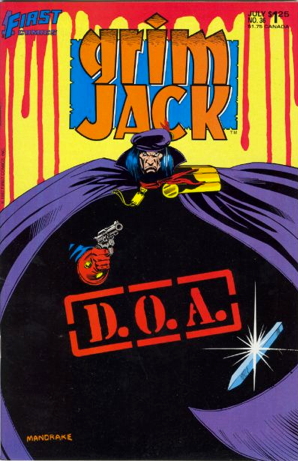 Grimjack, the soldier/detective/bounty-hunter/bodyguard/etc. for hire who operates in the multi-dimensional city of Cynosure, first appeared as a back-up story by creators John Ostrander and Tim Truman in Starslayer #10 in 1983. After a run of stories there (capping off with an issue-length crossover with the titular Starslayer his own self), Grimjack moved over to his own first issue in 1984, running 81 issues (and a graphic novel) through ’til 1991.
 Under most circumstances the phrase “most unique” is, oof, a cringeworthy nonsensical usage. If something is already unique, then it’s by definition one of a kind and unusual, it can’t be more of that. It’s like something is “extra infinite.” However, occasionally exceptions must be allowed, and in this case, I believe referring to Tales of the Beanworld as “the most unique comic ever published” is an allowable description.
 I did read Jon Sable Freelance for a while, starting somewhere in the early issues (not with #1, but around issue #10 or #12 or so) and kept up with it for a couple of years. Near the end there, I was mainly picking it up for my dad, as it was one of the few comics I was buying that he was also reading. I eventually dropped the book, as it was costing me a whole $1.75 a month, and I wasn’t enjoying it quite as much. (At least I was still buying Groo the Wanderer which my dad was also reading.)
 This is another case the listing the first ongoing series featuring the character in the header there is a little misleading as to the size and impact of the property. After first appearing in the
 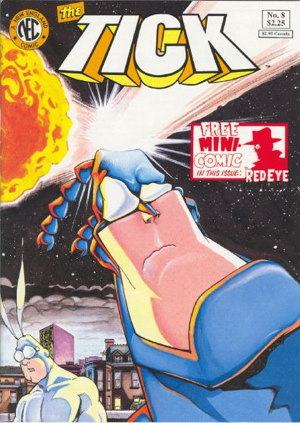 I’m a’gonna get the shameful confession out of the way first. I…never really got into any of the Tick comic books or its many, many spinoffs beyond the initial issues by creator Ben Edlund (those cited in the heading just above).
 Hoo boy, where do I even start? Well, technically, I’ve started already, as I’ve got a