Only one more single-vote receiver to go after today’s installment of the Final ’90s Countdown! And like I always say, getting only one vote isn’t a thing of shame, but rather a testament to all the beloved books that came out during this usually maligned decade! That said, here we go with
Supreme (Image Comics/Maximum/Awesome, 1992 – 2000)
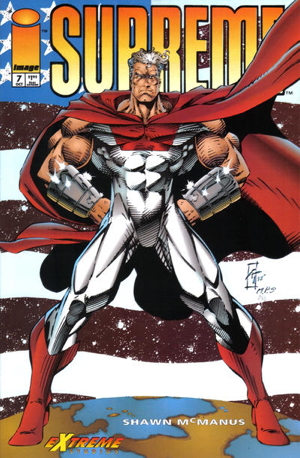 So, where to start with this comic? It’s got bit of a convoluted history but we’ll get through it!
It all kicks off in Youngblood #3 (August 1992), where the character is introduced. A creation of Rob Liefeld and Brian Murray, Supreme, a somewhat more violent take on Superman, got his own series in November 1992, in a first issue inexplicably labeled as “Volume 2.” …I’ve seen explanations for that ranging from “someone messed up” to “it’s implying a long previous history” to “it’s setting up an eventual ‘Volume 1’ series that would go into the character’s past history.” (And we sort of get that last one, but more on that later.)
But whatever the reason, the actual premise of the series itself sounded interesting to me at the time, in which Supreme, active during World War II, leaves the Earth for decades and returns in our absolutely current and modern year of 1992. And then, let the kicking of asses and the taking of names ensue.
I have to admit, despite thinking the premise was neat, the execution on these early issues were…not to my taste. It was very much an Image Comics of the Early ’90s with “kewl” looks and crossovers with other Image heroes and so on. A brief glimpse at this Grand Comics Database gallery of covers for the first 35 issues shows a whole lot of jagged lines and gritted teeth and just did not seem to Be For Me.
…Um, I realize that I did have someone place a vote for this as their favorite ’90s title, so I really don’t mean to yuck your yum, as people on podcasts say. I’m just giving my surface-level personal response to these “before-times” Supreme comics and for all I know, they read great. I see Shawn McManus drew a couple of them…I like his work! And Keith Giffen is in here somewhere, too!
Anyway, all that said, I don’t recall a whole lot of memories about these earlier Supremes during their initial sales at the shop. There was some anticipation for the first issue, sure…Image Comics was still in its Age of Hotness, after all. And I remember it selling fairly well when it came out. I mean, it did have a pretty striking cover by Murray. I know I linked to the cover earlier, but I’ll go ahead and put it here because honestly, I do like it.
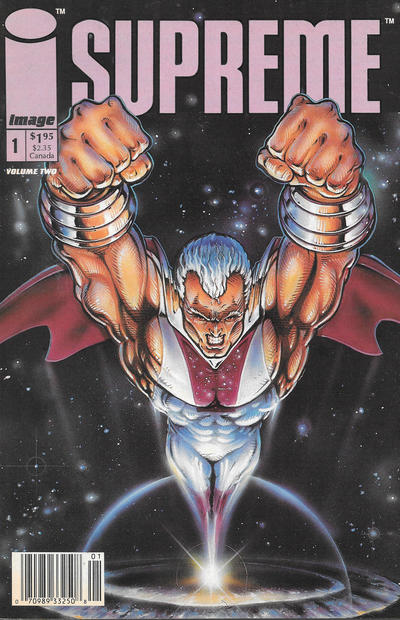
Note that’s the newsstand cover, as the cover comic shops got had an embossed foil logo that doesn’t really show up great in scans like this. But still, that’s a cover that made customers go “whoa, look at this” and pick it up…and then they’d ask what “Volume 2” meant, and friend, only Rob Liefeld’s hairdresser knows for sure. (I should note here that there is an origin series for Supreme, called The Legend of Supreme, masterminded by Keith Giffen and Robert Loren Fleming, that covers his origin. If you need a “Volume One” to counter that “Volume Two,” this is close enough, I think.)
So anyhoos, Supreme continued on Supreming, until something very weird happened to the title in 1996. Specifically, this happened:
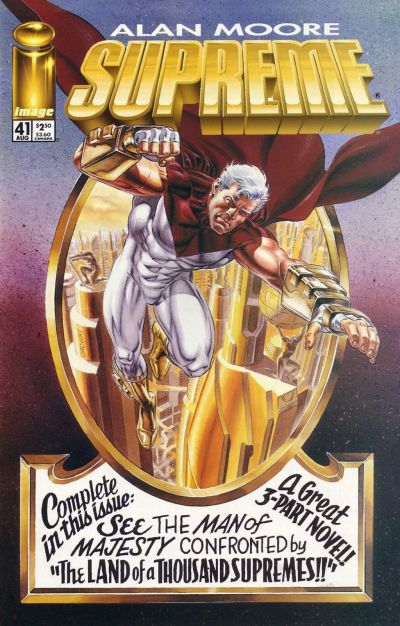
Alan Moore…yes, that Alan Moore, not any of those other Alan Moores you may be thinking of, took over writing chores with issue #41 (art by oe Bennett and Marlo Alquiza). With its Superman #1 (1939) inspired cover by Jerry Ordway, clearly changes were afoot, especially when you compare that cover to the ones in the gallery I linked earlier. This isn’t the hyperkinetic, violent Supreme we’d been seeing. This is something more retro, more “Silver/Golden” age-y. (And here’s the second printing of that #41, if you’re interested.)
And that’s what we got! Before Moore launched the America’s Best Comics line in 1999, here he was doing fun, silly, Silver Age Superman-inspired stories, complete with his own Lex Luthor type, his own Jimmy Olsen type, his mild-mannered secret identity, his superpowered pet dog, and on and on. Every story was a tribute to that sort of storytelling, as told through modern eyes…not ironically, not parodic, just played straight but still with a sense of humor about itself. It was Moore’s own antidote to the grim ‘n’ gritty trend of the ’80s to which he inadvertently contributed.
(One of my favorite gags is the Jimmy Olsen stand-in character, Billy Friday, finding himself in an endless series of transmutations that continue from issue to issue, referencing the many transformations Jimmy Olsen himself would undergo in his comics.)
This style of Supreme comic continued on for quite some time, and transcended multiple publishers and decades. The original series of Supreme ended its run at Image Comics with #42 in 1996. It picks up with #43 under the name Supreme: The New Adventure, running ’til #48. Then it’s off to Awesome Comics, where we get issues #49 through #56 (including two #52s, a #52A and a #52B), running ’til 1998. We then jump ahead a year, remaining at Awesome, where we get Supreme: The Return. This starts the numbering over again with #1, running until #6 in 2000, essentially being issues #57 through #62.
And yes, that was Alan Moore on all those issues. Notable other artists on these books include Chris Sprouse and Rick Veitch, though to my recollection everyone who worked on the book did a swell job.
So, with #6/#62 from that last series, that was it forever, right? That was the end of this great Silver Age-y experiment, and Supreme was never seen again, correct?
My dates at the top there, of 1998 through 2000, basically reflect the inception of the Supreme title until its eventual end at Awesome. It more of less kept the same numbering throughout, except for that final batch of comics, but I’m still considering it all part of the same run, especially given what comes later.
And what comes later, you may ask? Why, Supreme #63, of course, in 2012 from Image Comics.
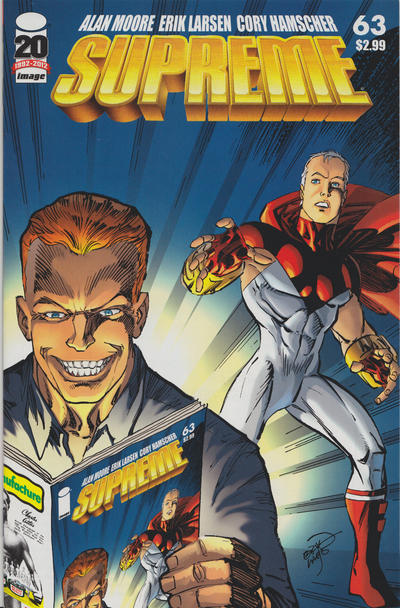
Turns out there was still one script left by Mr. Moore, and Erik Larsen illustrated it for this debut issue of a new run of the title. And then the subsequent issues, running through #68 in 2013, had Larsen scripting and drawing, building on Moore’s work on the title while edging it away from the retro look ‘n’ feel that had dominated so much of its run. I read these too, and to my memory they were still a lot of fun…it wasn’t what Moore was doing, exactly, but Larsen comics have an energetic energy all their own and it was applied nicely to the concept.
There was one further Supreme comic in 2015, unrelated (or…is it) to previous goings-on. Supreme: Blue Rose, by Warren Ellis and Tula Lotay, is an interesting take on the very nature of superhero comics themselves [SPOILERS, maybe] , in particular the idea of “reboots.” We find ourselves in a world where Supreme’s reality has been rebooted yet again, but the reboot was somehow incomplete/flawed. It’s one of the few stories to actually dive into what a reboot would actually mean for the fictional world being rebooted (Astro City #1/2 being another classic example) and it makes for fascinating reading for those of us mired in all this superhero universe silliness.
Now, as for reprints…only a few issues of the pre-Moore Supreme were reprinted, with issues #12 though #16 showing up in Supreme Madness from Image. All the Moore Supreme (through the end of The Return) was reprinted in two trade paperbacks from Checker Books, but sadly my memory of these was that the print quality wasn’t that great…everything looked a little fuzzy, like they were low quality scans or they were shot from the original printed pages. I mean, it’s not bad, just not ideal. If that’s all you can find, it’ll do in a pinch.
There we have it…Supreme. A comic with somewhat inauspicious beginnings, looking an awful lot like everything else on the stands at the time, that turned into an almost-forgotten classic. Alan Moore’s run reminded us all of the whimsy and wonder that comics used to give us, while it was surrounded by gritted teeth and sloppy crosshatching. At least he was able to put out as many issues as he did, even if it was under several imprints and with a decade-long gap before his final issue saw the light of day.
Before I wrap up here, I do have one memory from the old shop, shortly after Moore had been on the book for several issues. I had a customer talking to me about how much he loved the Supreme comics, how the character was cool and tough, how ever issue was action packed. “Not like whatever weird things are happening in the comic now,” he said.
As much as I thought Moore’s Supreme run was objectively good, it was a little bit of an eye-opener to encounter someone with the exact opposite opinion. I simply nodded in agreement, probably. I had to look at it from his side…here I am, reading this amazing comic about a super-powered guy who takes no guff from anyone, who’s badass and kicks ass…that suddenly becomes a title involving superpets and looks like it came from the ’60s. I’m sure it was quite the shock.
ADDENDUM: I know I didn’t get into all the spin-offs, like Lady Supreme and Kid Supreme an’ all that, but this post was long enough as is. Just wanted to acknowledge that, yes, I know such spin-offs existed.
 I’ve noted before the main difference between this series of posts and the series I did focusing on
 The first thing that surprised me when I started doing my research on this title was just how few of them there were, and how short of a run they had. The first mini-series, Tales of the Jedi but later referred to as Knights of the Old Republic, ran five issues from ’93 to ’94. Then there were another half dozen or so mini-series, ending with Tales of the Jedi: Redemption in 1998. In my memory, it always felt like there was so much more than that, probably because I’m recalling the many times at the old job having to sift through the section and restock missing issues.
  Man oh man, where do I even start.
 Well, once again I find myself in the tricky position of having to write semi-knowledgeably about a comic book series that I did not read. And embarrassingly enough, it’s a series written by the prolific and popular funnybook scribe Peter David, whose work I normally followed but somehow I managed to bounce off this particular endeavor.
 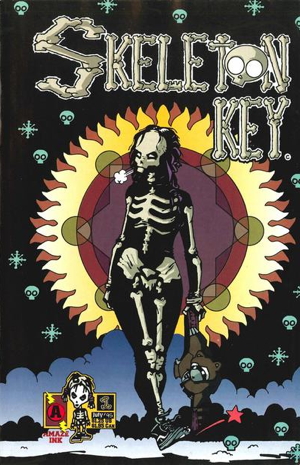 Andi Watson’s fantasy adventure series about a high schooler named Tamsin, who gains possession of the titular skeleton key, a magical item that can open any door and turn it into a path to other realities. Along the way she encounters Kitsune, a fox spirit, who becomes her partner in Skeleton Key-ness and adventures through all these other worlds with her.
 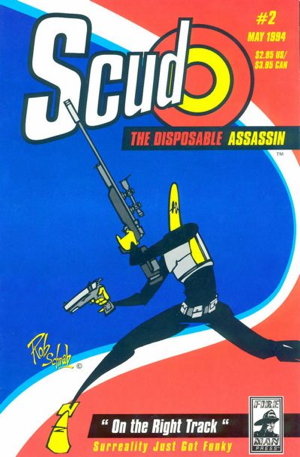 Now this was one popular series. Scud (as we will refer to it here instead of your pal Mike typing out the full name every single time) was written and drawn by Rob Schrab, a quite talented gent that surely is most famous for being in the
 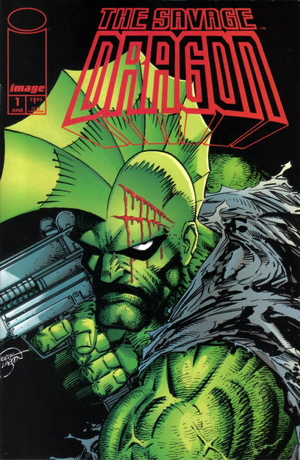 Hoo boy, here’s a biggie. With Todd McFarlane’s Spawn, these are the two Image Comics launch titles (kinda sorta…more on that in a moment) still continuing today. And most amazingly, Savage Dragon‘s Erik Larsen has written and drawn all 277 issues so far (more or less) of the series.
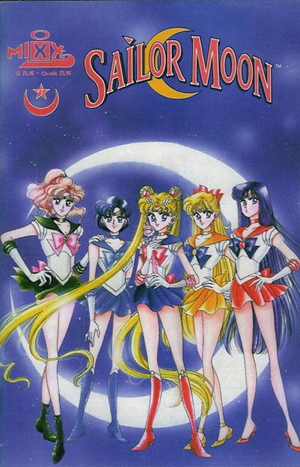 Now the heading here, indicating Sailor Moon‘s Tokyopop run starting in 1998, may be a tiny bit misleading. This series is, I believe, the first ongoing U.S. series featuring the property, but the series, created by Naoko Takeuchi, was originally serialized in the Japanese magazine Nakayoshi starting in 1991.