My Fantastic Four-Ay: Part Eleven.

So last time I told you mostly about what was supposed to happen in Fantastic Four #296, the triple-sized 25th anniversary issue of The World’s Greatest Comic. (And the time before that I just kept yappin’ about the Barry Windsor-Smith cover.)

Now, why triple-sized I’m not exactly sure. To use a variation of an expression I’ve used before, this was a 10 pound plot in a 20 pound bag, hardly requiring the space used for what the story needed. If it had followed John Byrne’s original plans, filling the pages with references to the team’s history, it might have at least made for a visual feast.

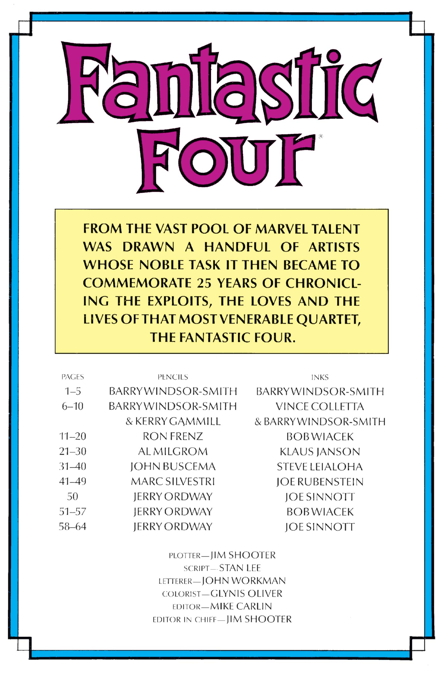
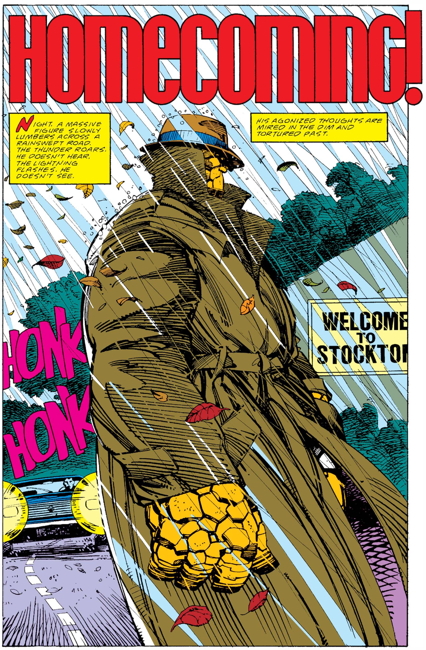
As it stands, it’s a Jim Shooter plot/a supposed Stan Lee script, and a parade of artists, starting with the aforementioned Windsor-Smith for a moody five pages focusing on ol’ Benjy Grimm:

…followed by a flashback to the origin, also drawn by Windsor-Smith but but with additional artwork by Kerry Gammill and Vince Colletta, giving it that retro-1960s feel.
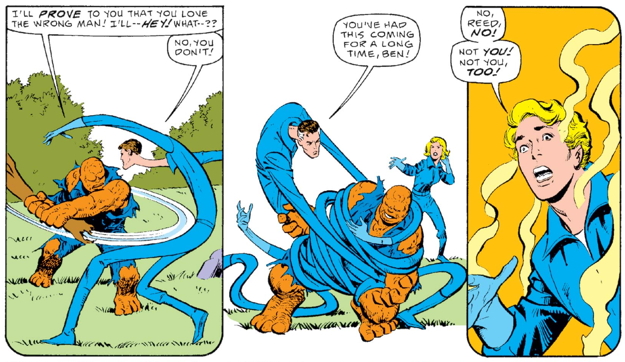

It’s a strong kick-off to the anniversary issue, contrasting where we are “now” (i.e. 1986) and how things were at the beginning. Maybe a little long, given the 10 pages it takes out of the 64 total. And like i said, it’s not like there’s a whole lot of story here. In short, the rest of the FF discover that the Thing, alienated from the team and the world, has retreated to Monster Island, home of their old enemy the Mole Man, to live among the creatures there. They fly out to get him, fight a bunch of monsters, convince the Thing that the Mole Man’s plan to raise a new island is going to wipe out the U.S.’s Pacific coast, and Ben is back on the team. The end.

Of course, there’s usually more to a good Marvel story than just the plot, and that’s the characterization. I do like this bit where, prior to seeking out Ben, Sue Richards gives her husband Reed a good shouting at in regards to how he’s let the Thing guilt-trip him for so many years:
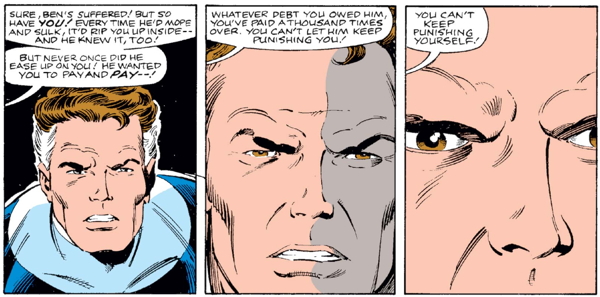

But Reed still wants to fly out to the island to settle things with his former best friend man-to-man.
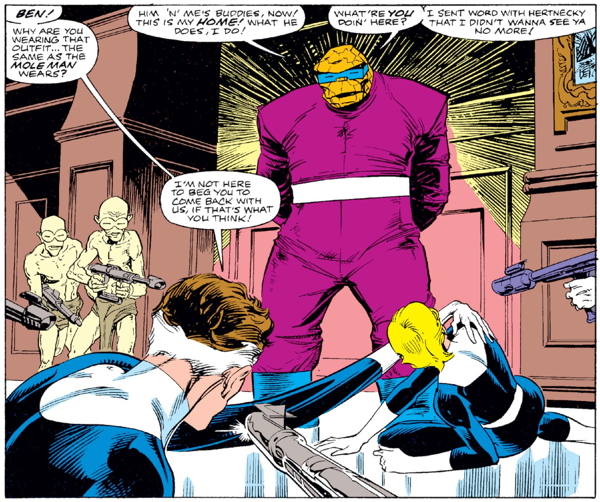

And then there’s the Thing his own self…spending the issue giving the FF the cold shoulder, defending his new pal the Mole Man, determined to turn his back on his old way of life forever…but pushing back a bit when Moley calls his former teammates his “enemies.”

Speaking of the Mole Man, he is not unaffected by Ben’s decision to crash at his pad:


He also has his own private chamber that he absconds to time and again, but when Ben busts in to talk to him:
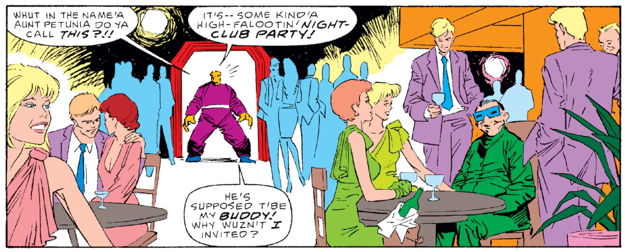

…he discovers that the Mole Man, despite his disdain for the surface world, finds comfort using holograms to pretend he is part of that world, and easily loses himself in that delusion.

It’s interesting little character bits like this that drive the story along, which, as I said earlier, feels a little overlong. While the various artistic contributions range from “nicely done” to “it relays the plot in pictorial form,” with Jerry Ordway’s lengthy participation probably being the best of the bunch next to Windsor-Smith, ultimately the story doesn’t feel that…special.

Byrne’s idea of visually including the history of the team in this issue would have at least been something. Mostly, though, this was a just a climax of sorts to some of the ongoing soap opera threads that Byrne had left behind due to his abrupt departure from the title. It wasn’t that long ago that I was talking about Justice League of America #200, and what a perfect anniversary issue that was, with the hook of great artists providing individual chapters in a storyline that celebrated the origins of the team while equally celebrating the characters that came later.

This FF anniversary was almost there, referring back as it does to the Mole Man’s appearance as the team’s very first adversary in issue #1. Plus, don’t forget that the team’s co-creator, Stan Lee, is attached to this new story. But the story just lacks…oomph. Aside from that wonderful Windsor-Smith cover, and some nice art and character bits inside, there’s nothing here that really grabs you. I don’t know how fast they had to scramble to assemble this issue, with Byrne bailing out so close to its publication, but the comic is simply…there. Not a celebration, not an exciting reflection on What Has Come Before and Where It’ll Be Going. It’s just a means to an end.

That end being that the ultimate upshot of the whole endeavor is to get Ben Grimm back as part of the Fantastic Four. He hadn’t held that position for a couple of years by this point, since the end of the Marvel Super-Heroes Secret Wars mini-series. It’s a restoration of the status quo, of sorts.

The one interesting thing this story does is that it doesn’t necessarily resolve the main emotional conflict, that Ben is alienated from the team. Superficially, yes, Ben had rejoined and it looks like everything’s back to normal, but…his old girlfriend Alicia is still romantically attached to his teammate Johnny, he’s still a “monster,” he still blames Reed, and Reed never really hashes out the whole guilt-trip thing with him. And when we get to the issues that follow, and the new creative teams that take over the book, we see that Ben’s emotional journey continues along a darker path.

My Fantastic Four-ay: Part Ten.

[NOTE: examination of John Byrne’s past work is meant solely in a critical and historical context, and is not meant as a condoning of any specific statements he has made or creative choices he has taken.]

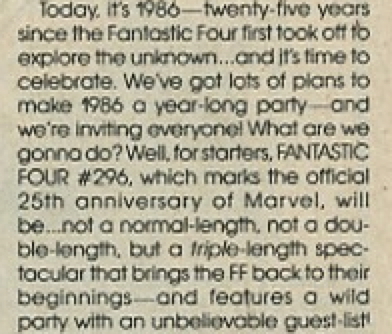
So we’re still going to be talking about Fantastic Four #296, the triple-or-so-sized anniversary issue of the title. Last time I didn’t get much farther than the cover, and this time…well, the aheader I am, the behinder I get, because I was Googling around and discovered some heretofore unknown to me information. And it’s information I should have realized was out there.

As previously discussed, John Byrne’s departure from the series was very sudden and apparently unexpected, as it appears a combination of office politics and burnout (so to speak) on creating the stories themselves is what caused him to self-remove from those chores. However, it didn’t dawn on me that maybe he let slip some of his intended plans for future stories here and there, like in the Amazing Heroes Preview Special an’ such.

And in fact, he did briefly chat ahout said comics there, but he talked about the same things in greater length in Marvel Age #37.


As I said, I happened to be Googling around and caught someone referencing this very issue of Marvel Age, noting that Byrne revealed his own plans for the upcoming anniversary issue. Thus, did I seek out this sacred tome (i.e. asked a pal for a copy) and dug into the long-hidden secrets of this lost comic.

Or maybe not so lost. We’ll see.

A production note: my source on these pages was relatively low resolution, so I doubled the size, just in case you were wondering why everything’s so fuzzy and pixelated. By which I mean these scans, not me.

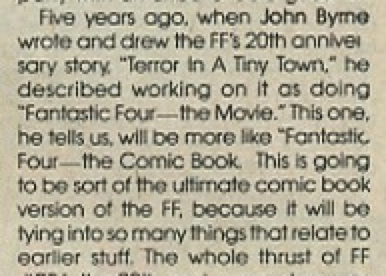
This is all from an article entitled “Marvel 25th Anniversary,” written by Kurt Busiek, which surprised me just a tad. Within, creators are asked what they’ve got planned for their books for The Big Occasion, and that includes a certain Mr. Byrne, who has plans for #296, big plans indeed, oh yes.


Now it doesn’t specify in the article whether the “guest list” means surprise character cameos in the story, or guest artists helping to fill out this monster of a book. Regardless, let’s see what the story will entail.


No, Byrne didn’t just invent Ultimate Comics. Basically what he’s saying (as he explains more in the bit I trimmed off) is that the 20th anniversary book was more a standalone adventure, concerned primarily with itself, while this 25th anniversary book would contain more “fannish” callbacks and references. Like, for example, an autographed photo of the Infant Terrible on an endtable, you know, like that.


Now here’s where it gets interesting. Byrne’s story is called “Return to Monster Island,” in which we go back to the Mole Man’s hangout from that very first Fantastic Four adventure in 1961. And what’s interesting about that is what does in fact happen in the published, Byrne-free #296, plotted by the then editor-in-chief of Marvel, Big Jim Shooter, with the scripting credited to the FF’s co-creator Stan Lee.

The noted retelling of the origin also happens in the published #296, but it appears as a reminiscence of the Thing’s. Also, the visit to Central City does not appear.


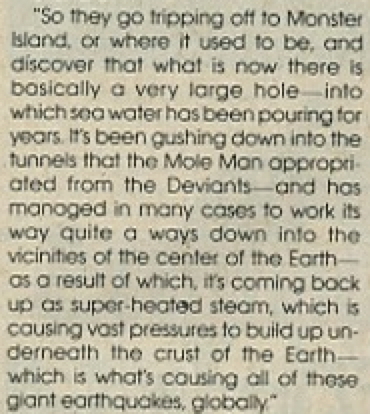
Now this sounds interesting, and probably would have made for a fascinating visual, with seawater just pouring into a giant open wound in the Earth. But again, not in the published comic, as when the FF reaches Monster Island, it is still intact.


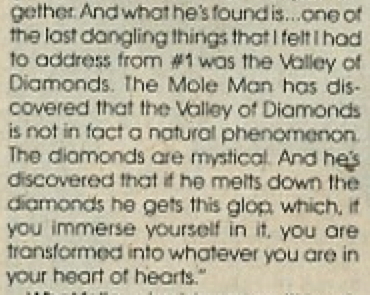
That would have been a wild twist on that ancient detail, which…you know, why not? It’s not like all those giant diamonds played too heavily in any future plot points, beyond maybe emphasizing their literally-blinding brilliance. This gives them some measure of purpose, and their transformative powers sets up what is the likely resolution to a certain in-story problem:


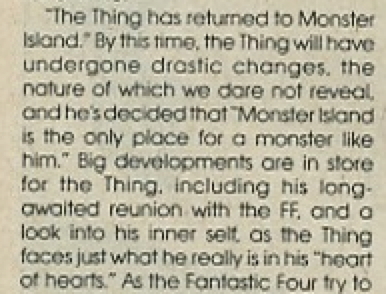
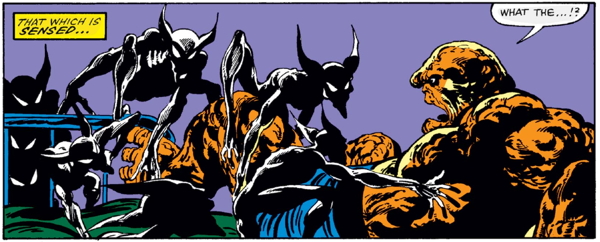
First, yes, in the printed #296 the Thing had also come to Monster Island to hang out with other monsters, but at this point he just looked like the normal orange rocky monster he always was. (Only decked out in a jumpsuit and googles just like his new best pal, the Mole Man.)

In Byrne’s version, it seems pretty clear that the solution to the Thing’s new drastic, presumably physical, changes, would be exposure to that diamond goo. It would turn him to his “true self,” which wold mean (in the uninteresting resolution) regaining his human form as Ben Grimm, or (in the more compelling, psychological twist) becoming his true form as the real Thing, the blue-eyed idol of millions. That would certainly say a lot about what the Thing thought of himself, and, done right, couild have been a swell reveal.


In the published follow-up issues, the She-Hulk situation isn’t really addressed right away, as we’re more focused on the Thing’s mental state and his depression over The State of Stuff. It does come to a head with She-Hulk and the Thing having bit of a tussle in #299, but clearly circumstances at this point have departed from Byrne’s plans.


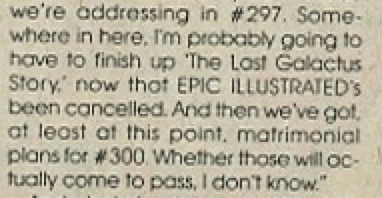
…or have we, as the published #300 does in fact have a marriage, between Johnny Storm and the Thing’s former girlfriend, Alicia Masters (or is it? More on that later!). Byrne’s comment on “whether those will come to pass” leaves it perhaps open to some kind of avoiding the marriage in his version of #300, but that’s hard to say. (That comment also refers to his tease of maybe finishing the long-uncompleted “Last Galactus Story,” which…well, it’s not too late!)

It’s kind of a no-brainer that going back to the setting of the very first Fantastic Four adventure could be the basis of a Special Anniversary Issue. As such, it makes sense that Shooter would stick with that basic outline for the story. (Plus, “Return to Monster Island” is blurbed at the end of #295.) It makes a very FF-kind of sense that the Thing, feeling alienated and alone, would go to Monster Island to be with other “monsters” like him. I’m sure Byrne had run all his plans for the issue, and once Byrne left, the idea was “well, let’s just kinda stick with what he was planning.” He probably should have had some kind of notation on the main page, at the very least as “inspiration.”


Maybe Jack Kirby, too, but at least get gets a mention in the afterword Stan supposedly wrote in the back of the comic. Ah well.

It was strange to see this alternate take on what the anniversary issue could have been, even if it wasn’t, at least on the most basic level, all that different from what we actually got. And what we actually got…will be discussed in the next installment! Finally!


Special thanks for the production assistance from Bully, the Little Fantastic Bull!

My Fantastic Four-ay: Part Nine.


Listen, this is one humdinger of a cover. Drawn by Barry Windsor-Smith, it effectively depicts the state of the Thing as it had been at this time…alienated and alone, divided from the rest of the Fantastic Four.

You would think the moodiness of the piece might be slightly diminished by Marvel’s 25th anniversary framing border, which appeared on all the Marvel comics around this time, showing a parade of celebratory heroes. If anything, it enhances the Thing’s isolation, his somber demeanor separating him from the party that literally surrounds him. Yes, the Thing is also in the border:


…which maybe undermines my point a little, but that is the Heroic Part-of-the-Team Thing, not the put-upon, feeling-his-inhumanity Thing.

In short, what I’m saying is this is a good cover, one that even leans into the forced company-wide cover layout to give it additional meaning. Was that Windsor-Smith’s intent? Probably not, but that’s how it works.

Anyway, this is an extra-sized issue, 64 pages or thereabouts, marking not only the 25th anniversary of the modern Marvel superhero universe, but the 25th anniversary of the comic what kicked it all off. It’s hard to believe now that there was ever a time the FF was around only for 25 years. I mean, I’ve been in the comic book business for nearly 38 years now, and I’m just trying to imagine the FF starting 13 years ago and hitting its 25th anniversary now.

And frankly, it’s difficult to think of the series as having been around only 25 years, at that point, given just how much has gone on with its pages over that timeframe, and how many interpretations of the team. And, yes, how many repeated plot points (a problem the series still hasn’t shed, as we approach its 65th anniversary this year).

When this issue came out in 1986, I’d been reading the comic since about 1983, and had bought the back issues of the John Byrne run back to its beginning in 1981’s #232. The wrap-up of Byrne’s final storyline, which he departed partway throough, had actually been a relatively smooth transition, with sympathetic creators following in his footsteps and applying familiar story beats and styles of artwork. And, yes, working at least partially from Byrne’s plot points.

That all means we hadn’t yet seen a Fantastic Four issue free of Byrne’s influence post his departure. This issue, #296, would be the first in six years. But is it really free of that influence? The issue is literally about the Thing’s emotional and literal separation from the team that had been his family, a situation that Byrne himself instigated (assisted by creative teams over on The Thing solo series) and didn’t resolve before he left.

(On top of that, there’s the whole “Johnny Storm dating Alicia Masters” business that Byrne introduced, which also played into the Thing’s current situation. And I realize I said in a previous installment that I was going to address this particular twist on the title’s formula in a “future installment.” Don’t worry, it’s still coming, but it’s going to be a little bit down the line, when a certain something happens.)

All this means that this giant anniversary issue (released so close to the 300th issue, which is probably why that one is regular-sized) seemed as if it would be our first taste of where the FF would go. Ultimately (spoiler for the next installment of these posts) it isn’t really, beyond a reinstatement of the membership’s status quo, given its one-off nature and the gimmick of a Stan Lee script (over Jim Shooter’s plot). Plus, given some information that I just discovered, it may not be as free of Byrne’s influence as I thought! But more on that next time.

I imagine I was probably ready to drop the book once that final Byrne story wrapped up in #295. But, boy, I’d been a sucker for Oversized Anniversary Issues almost from the start of my comics collecting, and the timing of that 25th anniversary issue kept me on the title for at least one more issue. Which itself kept me reading until that #300, and then beyond…at least for a bit.

I’ll dip into the actual contents of the issue with the next part of these posts. That cover, though…that cover is the stuff. It wasn’t just that this was a big special issue that got me to pick it up, it was that great, evocative drawing of my favorite FF character, which said so much with so little effort. But don’t you worry…there’s a whole lot of effort expended within, to not nearly the same effect.

My Fantastic Four-ay: Part Eight.

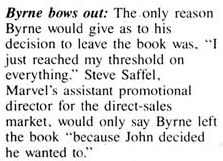
And so it came to pass, in the mid-1980s, that John Byrne wrapped up his five year run on Fantastic Four, as reported here in the March 1986 issue of The Comics Journal:


(Please forgive the pixelation, as I increased the size from the source image from here.)

It’s all very…politic, with Byrne’s “on everything” seemingly bearin a lot of weight, especially in light of some later interviews. The Comics Journal mentions instances of editorial interference on some of Byrne’s books in then-recent months, such as pages of Fantastic Four #286 being redrawn, and an issue of his Incredible Hulk run being pulled from publication*.

A link found on this page shows up this 2005 Comic Book Resources interview, now accessible at archive.org, where Byrne says

“JB: A lot of factors, most internal office politics, contributed to my finding myself in a position, creatively, where doing the best work I could was simply not good enough. Not for the FF, anyway. I fear I am one of those artists who is heavily impacted by the environment in which he works. The work suffers if I am not happy, and in those final years of Shooter’s reign, I was most definitely not happy!”

This 1999 interview on Sequential Tart (linked at the same Fandom page) adds the detail that he’d likely reached the end of wanting to work on the title:

“JB: Six years on the same book, basically. That works out as a long time, even when you love the characters as much as I love the FF. It simply started to get old, and, around the same time, things in the office got dicey, and I used that as an excuse to leave.”

In the Comics Journal article, he notes that he’s still open to working for Marvel, even though the only work he had going at that moment was the covers to the Official Handbook to the Marvel Universe Deluxe Edition covers (which he leaves after #11 from October 1986). But, at that point he had his Superman reboot gig over at DC Comics (which he also leaves after about a year, but that’s another story).

I was reading the ‘zines at the time, as well as the Marvel books Byrne was working on, so I knew about the abrupt departures and editorial shenanigans that may or may not have brought Byrne to his decision.

And it was abrupt, as Byrne started a multi-part story in what would end up being his last full issue, #293, which I talked about last time. A huge bubble covers a city, and the FF enter to find that time passes much more quickly inside than outside, resulting in centuries having passed. Also in the issue, Kristof (the young boy programmed with Doctor Doom’s memories) is briefly shown, setting up threads for a possible future plotline.

But with #294, Byrne was no longer writing or drawing, and credited only with the plot as Roger Stern took over scripting, with Jerry Ordway and Al Gordon on art chores. With #295, the conclusion to the story, Byrne’s contribution is reduced to a “special thanks” in the credit box.

To be honest, as creative team transitions go, this was an easy one to make. Roger Stern is of course an absolute pro, and can write entertaining superhero comics with the best of them. And the art team of Ordway and Gordon is a pleasure to look at:


Whether it was due to the influence of Byrne’s plot or not, these two issues following up on the opening chapter for this story very much retained the look ‘n’ feel we’d been accustomed to during Byrne’s run on the book. Maybe the art was a little more smoothly refined compared to Byrne’s own self-inked work (which, don’t get me wrong, appealed greatly to me), but certainly of a piece compared to the art in Byrne’s later issues that was inked by others (including Ordway and Gordon, in fact, adding to artistic continuity). The overall tone of the story felt familiar to what we’d been reading for the previous half-decade, so the pain of losing one creator was mollified by the excellence of the replacements.

And so, I thought, that was that. Things were going to be fine. We were still getting our regular dose of John Byrne over on the Superman books, and this swell replacement team of Stern, Ordway and Gordon were going to be knockouts on the FF.

It didn’t quite work out that way, alas. Stern would stay on the book for a bit, though with a different, if fascinating, art team, and the title would slowly move away from the Byrne era of The Superstar Creator Doing His Thing and more toward something a little more…traditional, maybe? While still dealing with the repercussions of what had gone before.

It was an interesting time for the team, and while I had primarily stayed on the book for Byrne’s work, I found myself wondering how Marvel was going to follow that act. Thus, I stuck around for quite a while after his departure to see what they’d try next. And while Stern and that Mysterious Art Team (that you can totally Google, I don’t know why I’m being coy about it) would give us some readable entertainment, we had a giant anniversary issue in #296 to get through first.


And, hoo boy, it’s certainly somethin’.


* That story eventually gets published in Marvel Fanfare.

My Fantastic Four-ay: Part Seven.

So I spent a lot of time talking about John Byrne’s 1980s run on the Fantastic Four, probably focusing too much on the specifics without saying, in the big picture, that it was classically-done superheroing. Imaginative, usually well-drawn, stories that, with the occasional exception, paid off and rewarded the reader for their investment of half-a-buck or so.

One time (warning: name-drop ahead) Scott McCloud asked me what was the current title on the stands that perfectly encapsulated the standard of A Superhero Comic. What was “One Exact Unit of Superhero Funnybooking,” one could say. At the time, in the late ’90s, I told him “Avengers by Kurt Busiek and George Pérez,” and not just because Scott and Kurt are old friends. It was genuinely the Platonic idea of a superhero comic…well-written, well-drawn, rewarding to read. Had Scott asked me a decade and a half earlier, I would have said John Byrne’s Fantastic Four.

But all things come to an end, and Byrne’s run, having begun in 1981, finally reaches its end in 1986’s #293:


First of all, it doesn’t feel like Byrne’s run was only five years long, given its reputation. It is a significant milestone in the series as a whole, essentially “resetting” the series that had, to some extent, gone a bit off the rails in the years following Lee and Kirby departures from the book. Byrne’s “Back to Basics” approach gave the title a new baseline from which to work, a several-year run that was almost entirely jumping-on points for new readers.

And it’s not like five years is anything to sneeze at. Every issue, plus the annuals, written and drawn by Byrne (with #266 mostly penciled by Kerry Gammill, though Byrne inked it all and did pencil three pages of it), even while he was working on other projects. This did affect the art somewhat, ’til Byrne wisely brought inkers on board to assist in the back half of his tenure.

Second, #293 has only the second cover on one of Byrne’s FF issues to not have been drawn by him (the other being Eliot Brown’s Doctor Doom mask cover). I’m pretty sure I knew already that Byrne was going to be departing, but it was a strange thing actually to see that David Ross/Joe Rubinstein image on the physical copy of the comic in my hands. Even looking at it to this very day makes me recall that sense that there’s a monumental change afoot.

I was in my mid-teens then, but this may have been the time I had personally experienced such a transition on a comic I was following. I was used to multiple teams of artists and writers on comics, of course, but I think Byrne was my initial exposure to The Superstar Creator, the Big Name doing Significant Work on a signature title. Such an immense talent, I thought, would be a hard act to follow. In fact, how could one follow Byrne on a title that he so very much made his own?

It’s a feeling I would have again, when Alan Moore left Swamp Thing, when Peter David left Incredible Hulk. Absolutely classic runs where the creators left their imposing marks, and also giving readers the feeling “who could possibly even follow that?” In the case of Swamp Thing, we got Rick Veitch as the next writer/artist of the series, who turned out to be just the guy to pick up where Moore left off, giving us his own wild run that, while unfortunately truncated at the time, is ginally getting its due.

In the case of Incredible Hulk, it took…a little while longer for the comic to find its footing, though it became very clear that David’s long run did away with the viability of the simple “Hulk smash!” formula that he disdained. The more successful follow-ups delved more deeply into the variable personalities of the Hulk character, such as the immensely popular Immortal Hulk series from a few years back.

Fantastic Four was more a case of the latter than the former, where Byrne’s run cast a long shadow, and the creators that followed found they had big shoes to fill. Eventually, we’d get some significant new directions, but the path from here to there did hit some rough spots along the way. For next time, I’ll delve a little more deeply into this specific story that ends the Byrne run, and where the book goes from there. A lot of changes are ahead, as folks come aboard and try to deal with the pieces that were left behind by this sudden departure of so outsized an influence.

My Fantastic Four-ay: Part Six.

I’m just about ready to move on from John Byrne’s 1981-1986 run on the Fantastic Four, but I wanted to touch upon this particular storyline because, among other things, it sets up a character that will return again and again in future creative teams’ efforts on the title.

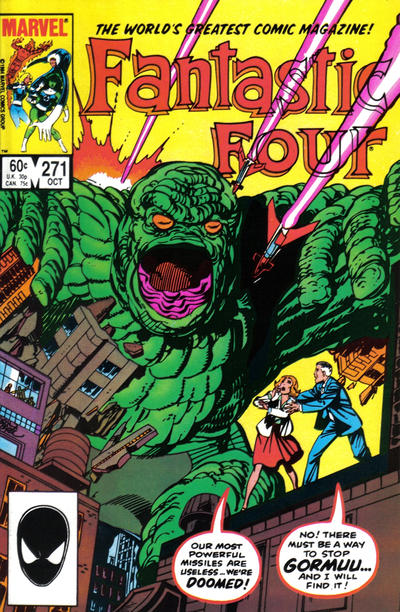
I remember picking up issue #271 and being quite taken with the throwback cover to the 1950s/early ’60s Marvel monster comics, before Stan Lee, Jack Kirby and friends dived back into the superhero genre:


I’m not sure where I’d been exposed to that era of Marvel monster books initially…perhaps some of the reprints that popped up as filler material in some of the Giant-Sizes I’d collected, or a friend whose uncle had a handful of original copies of these books (before being all destroyed in a rainstorm, having left his box of them outside. But I was certainly familiar with them, and found them amusing and charming enough that I would eventually draw out my own spoof splash page of such a story (“FONDUU, THE CHEESE DISH THAT WALKED LIKE A MAN!”).

Byrne’s pastiche of the Marvel monster period (this time involving a pre-superpowered Reed and Sue as the intrepid humans against the alien menace) takes up the majority of this issue. It certainly succeeds in evoking the essence of that era, even if it suffers a little in retrospect as the bad guy is coincidentally defeated in pretty much the exact same way the bad guy is defeated in Avengers #250, released shortly afterward.

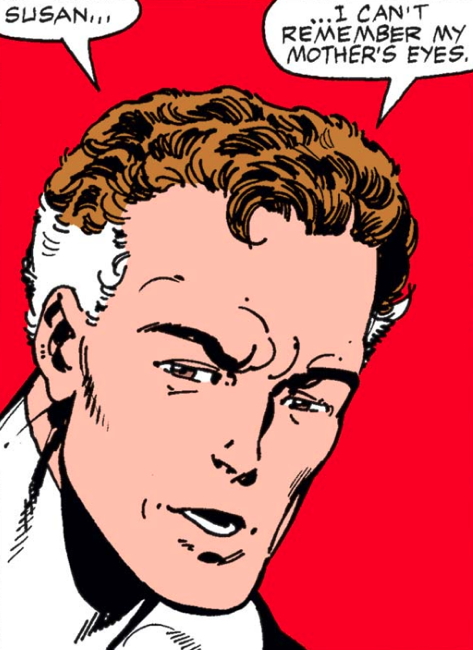
But of interest is the plot element that turns up in the “present day” section of the book…the fact that Reed is suffering memory loss, introduced in this dramatically effective panel:


He continues to say that other memories of his younger years are lost, and attributes this to their recent adventures in the Negative Zone, where Reed’s brain was drained and blah blah I’m not going to get into it, but some alien critter messed with his head and left it Swiss-cheesed.

So it’s decided for some reason that escapes me even though I just reread these three issues right before reading this to go back to Reed’s father’s mansion in California…and I just reread that section of the story and I’m still not clear why they did. Anyway, we learn that Reed’s father, a scientist, had disappeared about ten years ago (“three years” before the team got their powers, leaning into Byrne’s “seven year” span that he assumes the FF had been active).

Eventually Reed discovered that his father had created a time machine that shunted him into an alternate timeline, and in #272:


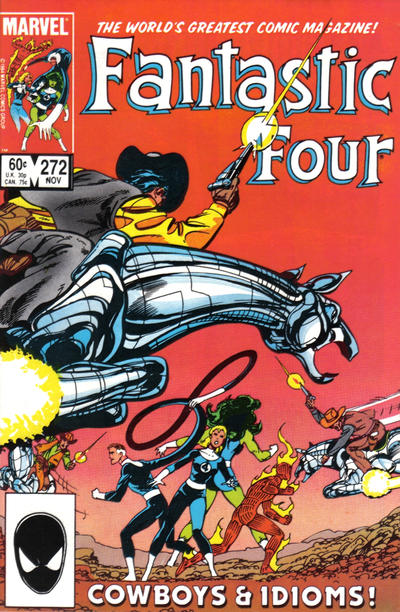
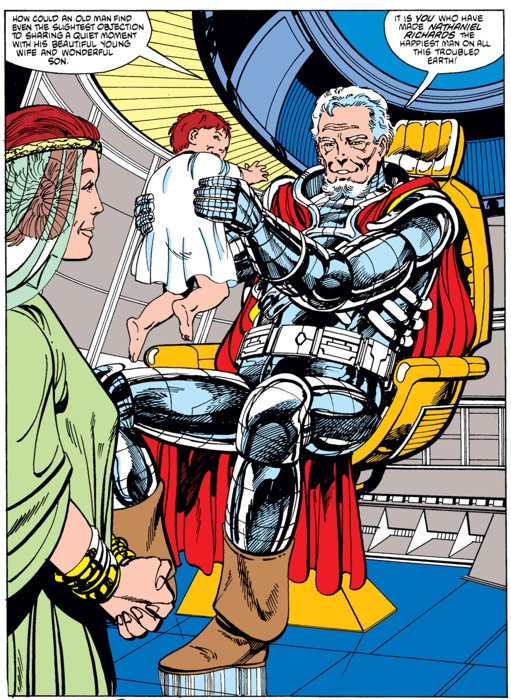
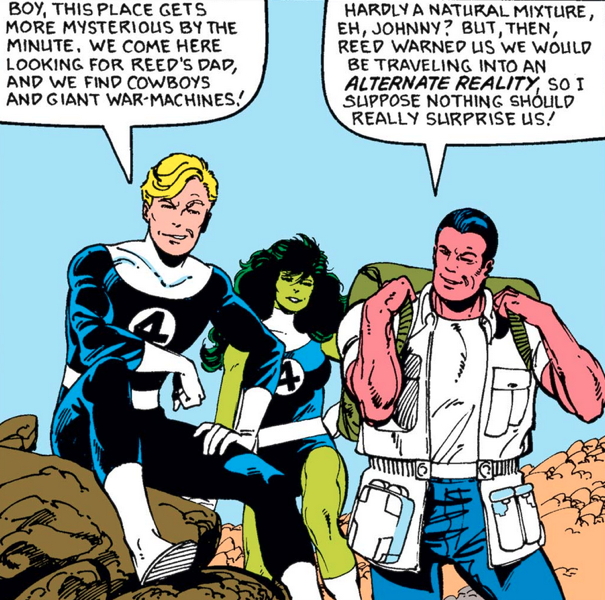
…the FF use Pops’ machine to follow him into the parallel universe. Look, okay, there are cowboys on flying horses on the cover, and we get some neat bits with a sci-fi tinged Old West in this other timeline, but the big story is that Reed’s father is apparently the hated Warlord, who rules over this world:


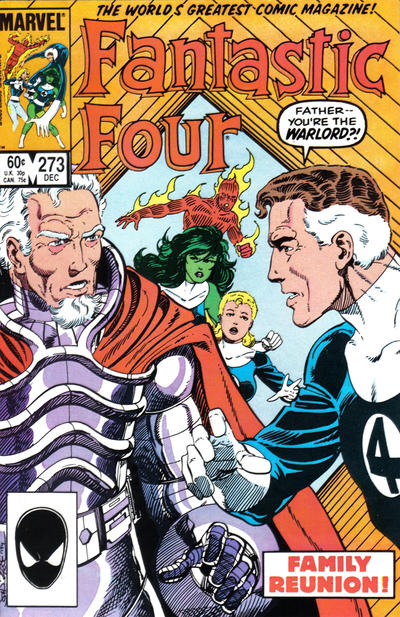
And that brings us to Part Three, #273:


…where you can see on the cover there that Reed and his dad finally meet face to face, which is a neat moment, but boy, this issue is undermined by the fact that Byrne decided to not only write and draw this issue, as he had been on the FF for the previous few years, but letter it as well, and, um:


…the man’s no Gaspar Saladino. I think when I first read this issue, even then I was all “what’s up with the lettering” when I noticed that there was no lettering credit on the issue. Eventually I figured out Byrne did it his own self, which kinda blew my mind just a little. I mean, artists lettering their own work was not a new idea to me, as comic strip artists did it all the time, natuarlly. But in Marvel and DC Comic Books, it was always a separate job that you got someone specifically to do.

I should have realized it wasn’t unprecedented, but I don’t think I realized Jim Aparo often lettered his own work, and it was around this time that Todd Klein was lettering his own scripts on Omega Men. Of course in many independent books, this was often the case…the Hernandez Brothers lettered their own work, Dave Sim did some wild lettering in Cerebus, but that seemed different from the usual assembly-line nature of the Big Two.

Regardless, it did seem like A Step Too Far when Byrne picked up the lettering gig for this issue. He was already perceived as being stretched too thin writing and drawing the multiple books he worked on per month, and adding the not-insignificant task of lettering an entire issue felt like one burden too many. Especially when the result was aggressively Not Good. It looked awkward, the lettering was inconsistent, lines of text looked crooked, and even the word balloons themselves were pretty janky. Lettering can’t be distracting when reading a comic book, and this job was nothing but distracting.

Despite all that, the story continues, with Reed pleading his case to the Warlord (only it turned out (SPOILER) to be Reed’s stepmom, who was acting as the Warlord without Pops’ knowledge).


Note that we are here in the third and final part of this story, and Reed is still emphasizing his loss of memory. Which is interesting because ultimately, when the story is resolved and Reed and his dad have their peaceful reunion…the whole “lost memory” subplot is completely forgotten. The problem that launched this storyline remains unresolved. Far as I know, to this very day Reed still lacks all those memories, because at no point over these three issues does he ever get them back.

I remember noticing this at the etime, and wondering what exactly happened to let that plot element go astray. They didn’t forget it was such, and it was brought up in the concluding issue. Just when everything was said and done, the instigating action to drive the characters into this other world exists only as that: an instigating action. It is not a problem to be solved, but a…is Macguffin the right word here? I feel like that’s not exactly it but my English is failing me here.

But it’s ultimately pointless and I think that made me really wonder how such a gaffe could be made in a professionally published comic book. Yes, I knew about Marvel’s “No-Prizes” sent out for folks spotting (and explaining away!) continuity mistakes, but this seemed like a much bigger problem than that. A problem of a creator getting Too Big for an editor to successfully edit? I didn’t know then, and I’m certainly not sure now.

The lasting legacy of the introduction of Reed’s father in this storyline (beyond the “surprise twist ending” of the story connecting him to the time-traveling villain(s) Rama-Tut/Kang) is that Reed’s dad will return in Avengers: Doomsday in future FF storylines, with alternating personalities. While a seemingly benevolent and kind man at the end of Byrne’s issues, he returns in the Tom DeFalco/Paul Ryan issues as a untrustworthy and manipulative figure, then returns again as a somewhat more positive character. But, as I like to say when talking about future FF events, I’ll say more when I get there.

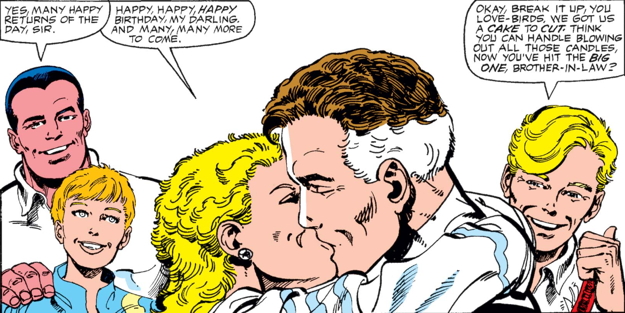
The other note I wanted to add is something I noticed on my most recent rereading…the attempts at pinning down Reed’s exact age. In this panel from #271, Johnny Storm congratulates Reed on hitting “The Big One” for this year’s birthday:


I interpret that as either 40s (most likely) or 50s (still plausible, given Reed’s slightly older status compared to the other 20/30-something superheros at Marvel.

Then Reed says this in #273:


…which still leaves things open a little bit. Reed’s dad vanished about a decade prior, but it’s very possible Reed hadn’t seen him for many years prior to said disappearance. However, if you look closely at the lettering in the second word balloon, the word “twenties” was obviously lettered in after the fact. Apparently someone didn’t want to accidentally “age up” the character by even implying Reed was in his 30s, or older, “10 years ago.”

This run of issues grabbed my attention way back when in good ways (Byrne’s generally fun art and storytelling) and bad (oy, that lettering, and the unresolved plot) that, had I had a blog back then, I almost certainly would have commented upon. It was an experience to get a story with a strong beginning and a clunker ending, leaving me wondering what fell down to allow this to happen. It was just another piece in the puzzle reminding me this comics were made by Human Beings, and sometimes we Human Beings drop the ball, even with the best of intentions.

Next time: the big transition from Byrne to Post-Byrne!

My Fantastic Four-ay: Interregnum.

Aside from some time constraints and other topics popping up, I had this brief pause in this series of posts to give myself an opportunity to sort of consider what I’m doing here.

The reason I started writing these is because I recently read (or reread) a lot of the last 30 years’ worth of Fantastic Four, starting around the time Tom DeFalco and Paul Ryan were doing the book in the early ’90s. I didn’t read every issue…I skipped some of the runs I knew well (like the Walt Simonson issues and the Mark Waid/Mike Weiringo run), and read for the first time the aforementioned DeFalco/Ryan stories, and the suyrprisingly brief J. Michael Straczynski run, and the Dwayne McDuffie issues, and so on.

I also reread the issues I bought and read at the time, but hadn’t revisited in the years since, like the Jonathan Hickman/Matt Fraction consecutive runs of more recent years. It was nice to be reminded of those.

I’m also reading some of these storylines way out of order. I’m currently in the midst of the “John Harkness” issues of the late ’80s Fantastic Four, where series writer Steve Englehart worked under a pseudonym in protest nagainst the editorially-mandated direction of the book. But more on that when I get there.

Plus, I eventually want to reread the Dan Slott run that directly leads into the current Ryan North regime on the title. And I do want to go back and read Chris Claremont’s stretch of issues, despite being warned off of them. Hey, I knew the job was dangerous when I took it.

The intent of this series of posts is record my reactions to these individual runs, with commentary on the events within. It’s really supposed to be more “how do I feel about these books” than “let’s recap what happened,” and I felt like I was sliding more toward the latter than the former.

The “funny recap” (though I wasn’t necessarily trying to be overtly funny when talking about these FF books) was a staple of the Early Comicsweblogosphere, where we’d take some wacky comic of yesteryear and give it a good drubbing from our modern perspectives. I mean, I sure did it a lot, as did the consistently-funnier and better-written Dave’s Long Box and The ISB, to greater effect, but I had fun doing it all the same. But the one thing we all had in common was a deep knowledge of, and love for, the medium, lacking in certain other flash-in-the-pan sites who didn’t seem to know much of anything about comics other than “look at this dumb panel, isn’t it stupid.”

Of late I’ve preferred, when discussing comics like these, to try to go a little deeper than “this is weird.” For example, this post on the Mr. Grumpy comic. Or this oddball Wolfman Jack thing. More than just a recap, but an attempt at trying to dig up info about the item, putting it in context and giving an opinion other than “this is wild stuff.” (Though to be fair, some of that Wolfman Jack comic was real “just look at this” material.)

That’s what I’m attempting to do with these Fantastic Four posts. I’m trying to maintain that balance, but that Frankie Raye post, which started off okay, with my reactions to what was going on into the series, slid into “recap mode” for the rest of the post. Now, I don’t think it’s necessarily a bad post, but it was doing what I was trying not to do, and that’s just telling you with picked-out panels and some text, what was happening in these issue. Too heavy on the “here’s what happened,” light on the “and here’s how I feel about it.”

I suppose one could argue that the recap was necessary to give context to my reactions, but looking at that post it could have been a few panel scans and explanatory paragraphs shorter.

Anyway, that’s something I’ll be working on in future posts. The other thing I should mention: the John Byrne run of Fantastic Four was not included in my current rereadings of the series. And yet, I started off with that in my discussions.

As I’ve noted in this series of posts, the Byrne run starting with #232 is as clean as a break as can be managed in the continuity and storylines in the series. There are some callbacks and returning characters (such as Frankie and Terrax, as discussed in those previous posts), but the precedings are all given a “you don’t need to worry about anything before I took over the title” vibe by Byrne. In effect, Byrne initiates the Modern Era of the Fantastic Four, with an entirely separate look ‘n’ feel than the hundred-something issues prior and the 1970s of it all. This is despite Byrne deliberately evoking the 1960s era of the title by Stan Lee and Jack Kirby.

The reason I didn’t reread these is that…I kinda don’t need to, other than doing a quick scanthrough of the issues i intend to discuss here. I’ve read them all at the time: as I bought them as back issues, I’d read ’em; as I bought them new on the shelf, I read ’em; as I pieced together the run, I read them again and again. Not committed to memory or anything (otherwise I would have mentioned this guy in that post about Byrne’s super-villains). They are, however, very familiar to me, which may be part of the reason why I’m so heavy on recap material versus personal reaction, as it’s so long since my first, earliest readings of the material. It’s hard to dredge up those emotions at this late date.

Now I could very well be obviously going on about nothing. You folks seem to be reacting well to these posts, so I’m perhaps overthinking a problem that only I see. At any rate, I wanted to give you a heads-up in case future posts in this series run a little differently than the earliest installments. I’m sort of just winging it a bit here, so I appreciate your patience as I knock “My Fantastic Four-ay” into some kind of shape.

I’ll be getting back into the comics with the next part of this series, as I may want to mention one or two more things about Byrne’s run before we hit that transitional period between the end of his tenure and the beginning of Steve Englehart’s.

But to give you a bit of a preview of what lies ahead in my series…boy, the Wizard shows up a lot. Like, almost as often as Doctor Doom.


But, oddly, not during Byrne’s issues.

My Fantastic Four-ay: Part Five.

So in our last installment, I wrote about some of the new villains John Byrne created during his Fantastic Four run that never really seemed to go much of anywhere. Someone responded in the comments that Malice, AKA “Dark Invisible Woman,” was one that Byrne came up with and popped up again and again over the decades. Granted, I probably should have mentioned her in that particular post, but I did discuss Malice, and mention her current usage, in Part Three of “My Fantastic Four-ay,” so I didn’t forget her completely!

And to really get right down to it, strictly speaking it’s more a remixing of a character created by someone else, in this case Stan Lee and Jack Kirby their own selves, rather than a whole new person. But that’s splitting hairs a bit…I mean, who created Nightwing? Marv Wolfman and George Pérez, who in the 1980s put Dick Grayson into that outfit and gave him that name, or whoever it was Bob Kane took the credit from when Dick Grayson was introduced way back in Detective Comics #38?

Regardless, it’s a new take on a preexisting character, and I suppose that’s close enough for horseshoes, as nobody younger than me says.

But anyway, in that same vein, let’s talk about Frankie Raye.

Frankie Raye was a supporting character in the Fantastic Four title starting with issue #164, by Roy Thomas and George Pérez, published in 1975 and several years before I started reading the book on a regular basis. Frankie becomes Johnny “Human Torch” Storm’s girlfriend, despite her apparent fear of fire. Natch, they broke up, but she was reintroduced into the book early in Byrne’s run, making her one of the few non-Lee/Kirby FF elements to return in his “Back to Basics” run (along with Terrax, discussed in Part One).

Like those early Terrax stories, I never read any of Frankie’s appearances in the title prior to this Byrne run. She was just another story element that emphasized to me that the Marvel Universe was an ever-growing, ever-self-referential thing, and that while I was tempted to go back and pick up those prior appearances so that these stories I was reading were “complete,” I think even then I realized the futility of doing so. The soap opera and subplot-ridden storylines would make it impossible to ever pick out a completely clean “starting point,” unless I was willing to buy all the way back to Fantastic Four #1, which maybe I would have been but my pocketbook would likely have argued against that course of action.

So that was likely an early lesson taught to me by Byrne’s run on this book…just let his first issue (#232) suffice as close to a clean break as may be possible from what has gone before, and let any previous elements worked back in be explained as they need explaining.

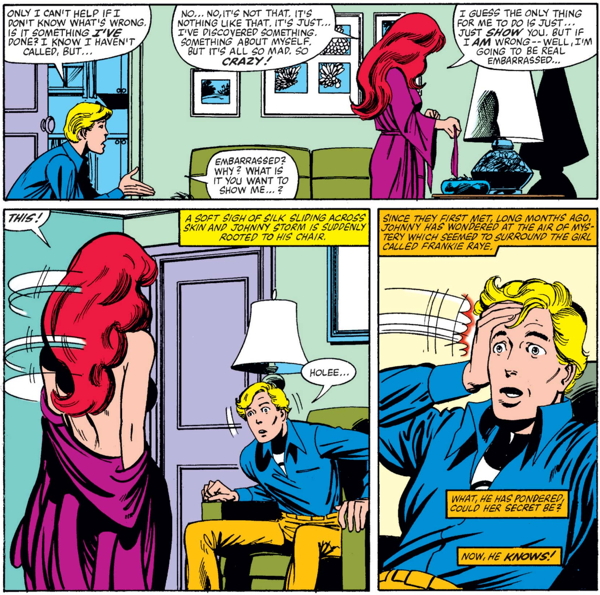
And that’s what we got here. Frankie Raye shows back up, reconnects with Johnny, we’re told enough about the two’s backstory, but then Mr. Byrne pulls one of these on us in issue #237:


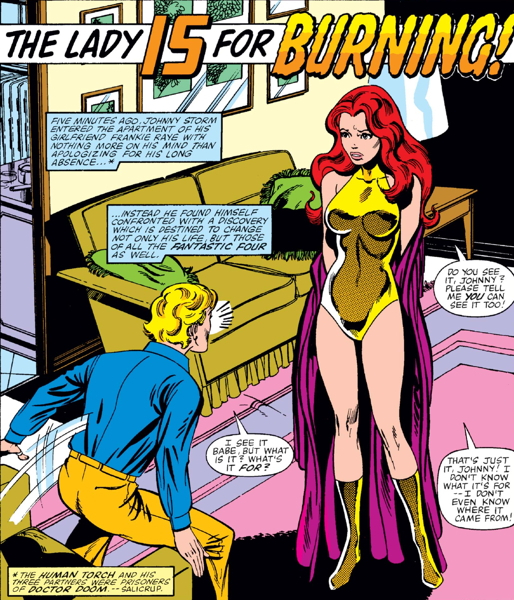
What’s this? Frankie Raye — completely in the altogether? Look, we’ve all read Byrne comics, we know that could totally have happened, but instead we have to wait a month and in issue #238, we see what’s really going on:


She goes on to explain that this costume only appears when she’s otherwise naked, for you “this is a fetish for someone” fans, and she reveals some suddenly awakened memories of her past. Like, for example, helping her stepdad move some barrels of dangerous chemicals:


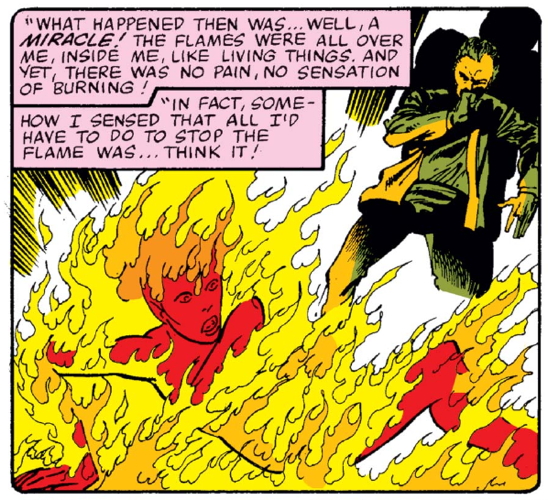
…and after the accident, she finds herself alive, but burning:


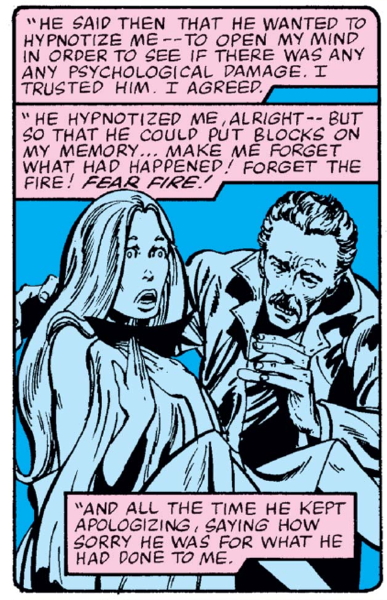
…and in response steppop hypnotizes her into forgetting the whole incident and the fact that she apparently has superpowers, out of guilt or whatever:


Hence that previously mentioned fear-of-flame, you know.

Now as it turns out, her stepdad was Professor Phineas Horton, creator of the original android Human Torch during World War II, and the chemicals he and Frankie were moving around were like those that gave the android its flame powers. Strikes me as a plot contrivance they couldn’t get away with now, given WWII is 40+ more years in the past than when this comic was originally published. Horton being a teen girl’s 100-year-old stepfather now seems unlikely…or even an 85-year-old one, if you want to work it into a flashback timeframe. Just sayin’ Frankie Raye’s backstory is probably one they’d have to adjust if they ever referred to it again.

So anyway, Horton mailed her this costume some years later to help her contain her powers, though via post-hypnotic suggestion or something via a cassette tape included with the costume, she was made to immediately forget that she put it on and to destroy the tape and forget that too. Okay, that cassette would be an MP3 file now, but let’s not quibble.

Regardless of all this backstory, the upshot is Frankie Raye is also a Human Torch-type character now, and she goes on adventures and such with the Fantastic Four and everything is hunky-dory.

Except…a couple of times she used excessive force in her superheroing, showing little to no consideration for what she’s done. And that’s foreshadowing for what happens in issue #244, the conclusion of Byrne’s first major Galactus storyline.


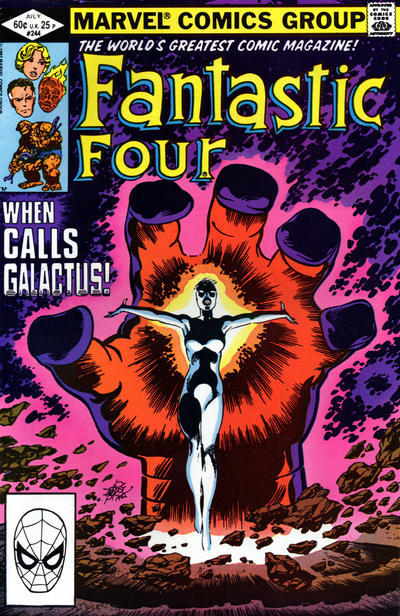
As you can see by that cover there, something drastic is about to go down, and given the subject of today’s post, it’s probably not a shock to discover that’s Frankie depicted on the cover there.

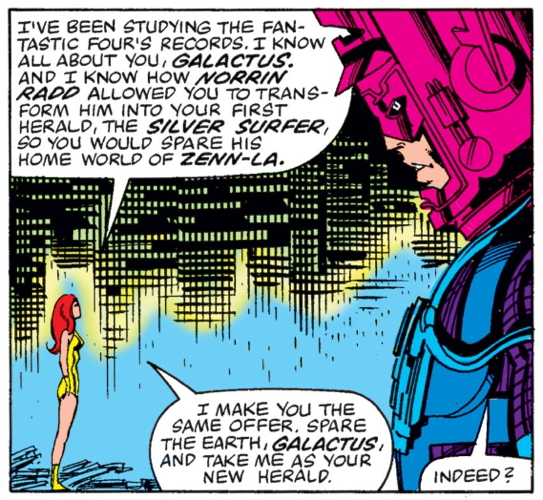
Near the conclusion of this storyline, for assorted reasons Frankie makes the offer to Galactus to be his new herald, à la his former servant the Silver Surfer.


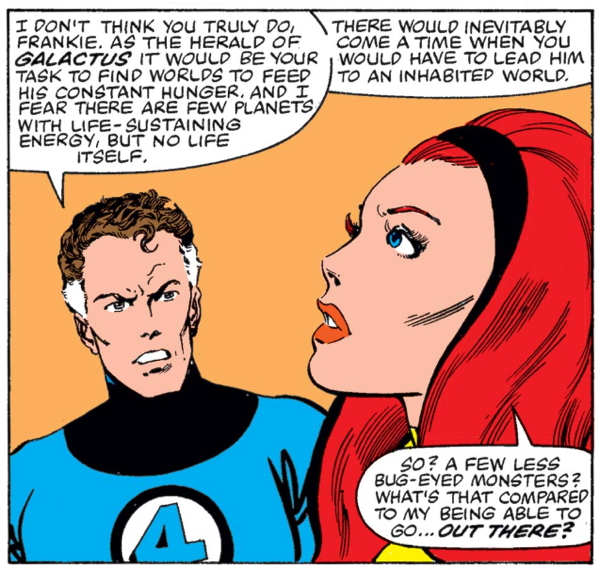
Reed of course tries to talk her out of it, telling her what she’d have to do in this role, and her response is surprising:


…though maybe not so surprising, given her attitude on display during those foreshadowing events I mentioned earlier.

Galactus, for his part, has a pragmatic reaction:


And the deed is done: she’s transformed by Galactus (see the cover above), and leaps into the new role, forsaking everything earthly for her new job:


Johnny clearly has no impact on her anymore, even after being a couple again for a bit, and his reaction is genuinely affecting in the face of Frankie’s (or rather, Nova’s, to use her new name) faded humanity.

And that’s that. Frankie turns up once or twice more during Byrne’s run, notably leading Galactus to the Skrull Homeworld. But also notably, we get the beginnings of a long-running subplot in future Marvel comics that Nova may be developing feelings for Galactus.

By “future comics” I mean mostly Silver Surfer, where that aspect of her relationship with Galactus is touched upon, and she also has some romance with the Surfer himself. We do get a follow-up to Nova’s disregard to the lives of “bug-eyed monsters,” and we also learn that Galactus himself may have had…something approaching stronger feelings for Nova than he let on, especially in the wake of her death.
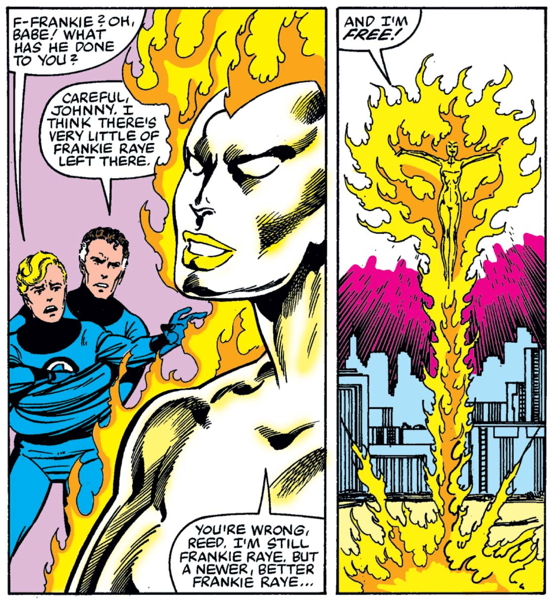
Yes, I said “death,” the character dies in Silver Surfer, though she came back in some form, in the Mighty Marvel Manner, in the Heralds mini, but I hadn’t read it so I don’t know what she was up to there, or lately.
I didn’t even get into her appearance in the alternaute future “The Last Galactus Story” that was serialized, but never completed, in Epic Illustrated. But I think it’s safe to say, like Malice, Frankie “Nova” Raye was one of his reworkings of an established character that did have legs, did continue to have an impact, not just on the Fantastic Four title, but on the Marvel Universe at large.

And farther still, as the “Frankie becomes Nova” story make it, in condensed form, into an episode of a 1990s Fantastic Four cartoon. The character makes other animated and live action appearances as well.

What really struck me most about Frankie Raye is her amoral stance in regards to non-terrestrial life, as presented in #244. That surprised me as a reader still relatively new to the Marvel Universe, presenting a complexity in a character that we identify as “hero,” did heroic things, and had the readers’ sympathy. But she had that one flaw, one that would basically put her in the “villain” category, that made us question any specific attachment we may have had to her. And on top of that, throwing away her humanity, discarding her relationships in exchange for power…that would also be marked as villain behavior in a more black-and-white milieu, but reads as hopelessly tragic in Marvel’s longstanding “characters with problems” foundation. It’s a move that impressed me then, and still, all these years later, even after everything that’s been done with the character since, impresses me now.

My Fantastic Four-ay: Part Four.

So the topic of John Byrne’s mid-’80s reboot of the Superman line came up on Bluesky, where, among other topics, the new villains Byrne introduced was discussed. By and large Byrne took the probably-editorially-mandated approach of retooling some of the old Superman adversaries into something a little more modern-feeling, but between making Mr. Mxyzptlk unpleasant and making Metallo unpleasant, some new creations entered the mix.

…Aaaaand…dropped out of the mix, as for the most part, the new opponents had little to no staying power, or were used only sporadically until mostly just fading away. Like, say, Skyhook, or Dreadnought and Psi-Phon, whatever that one robot mummy thing was called, or even, God help us, Sleez (who apparently appeared about three or so times, which is four more than I expected). Even Bloodsport, who got a little play when a version of the character was used in a Suicide Squad movie, is mostly underutilized.

The one villain Byrne introduced who actually kinda/sorta got over, is Silver Banshee, probably more because of her striking appearance than anything else. Other creators took a liking to her and started developing her presence, and she also made the jump to other media (remember when she was on Smallville? She certainly was!). She was even showing up in the Superman comics relatively recently,

Which is a long way of saying that Byrne seemed to have more luck doing memorable stories with the established characters here than he did creating brand new villains for Superman to fight. But, really, that’s okay…superhero comics are littered with one-shot wonders who show up to fight the hero for an issue, gets sent down the river to do a nickel in the gray bar hotel, and are never heard from again. Byrne cooking up one villain (maaaaaybe two, if you want to count Bloodsport) that manage to make the grade out of however many he attempted isn’t a bad ratio.. I mean, it’s no Lee/Kirby cranking out legendary character after legendary character, but who could ever match those guys.

And that brings me to >Fantastic Four, as I’m sure you were expecting, given the title of this post an’ all. Byrne’s overall goal to his run on the Fantastic Four was that all-too-familiar phrase of “back to basics.” Byrne stripped the title back down to the Stan ‘n’ Jack days, focusing mainly on their creations as adversaries for the early issues, building on their foundation rather than much of what gone on in issues prior to Byrne’s takeover. (One exception was bringing back Terrax the Tamer, a cocreation with Marv Wolfman from Byrne’s previous run on the title, and who had his own measure of staying power).

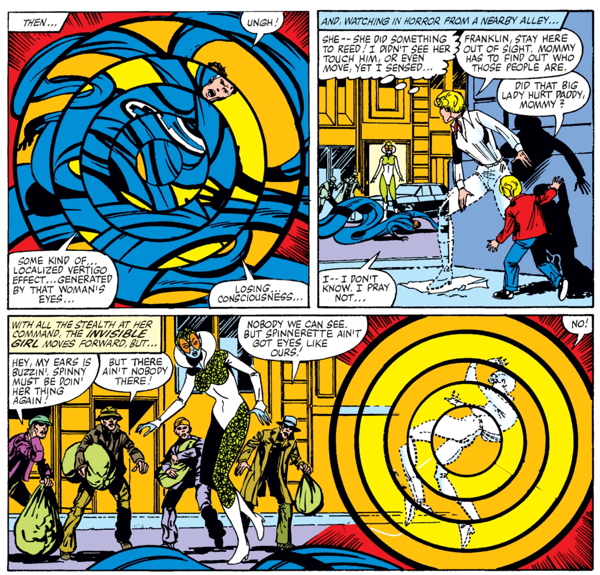
Which isn’t to say that Byrne didn’t make some attempts at introducing new antagonists to the title. In #237, be brought in Spinerette:


…an interesting-looking lady with the power to induce vertigo-like effects:


…I mean, she got a “super-villain” name, she had an interesting look, but far as I can tell, only appeared this one time. Misunderstandings were resolved, she left the planet with her people, and that was that.

In #239, we get some critters that have been pestering a smal Arizona town:


…only it turns out they’re pals with a young girl that had been helping the FF throughout the issue:


There’s a lot goin’ on in this issue that I’m glossing over, but, even though Reed Richards his own self implies that these beings could appear again, far as I can tell, they never do.

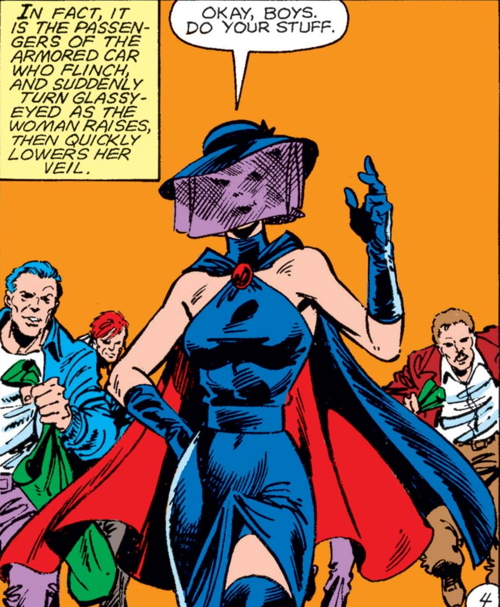
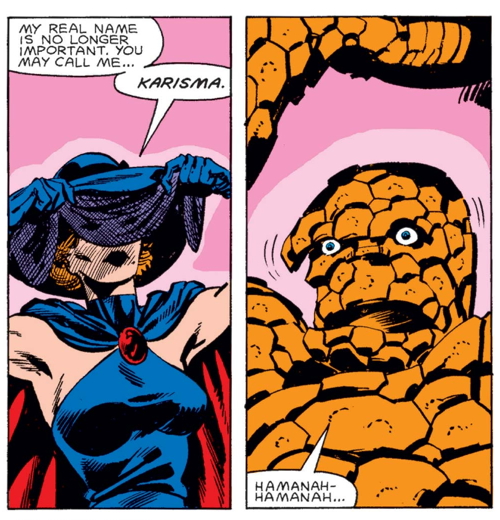
In #266, one of the few issues during Byrne’s tenure that wasn’t mostly drawn by him (Kerry Gammill doing the honors, with Byrne pencilling a couple pages at the beginning and end of the issue, but inking throughout), we got Karisma:


…a villian with mesmerizing powers, shown here putting the whammy on the Thing:


…and she apparently turns up again fighting Captain America at some point, but she’s only had a couple of appearances altogether.

And then there’s the big one (literally). Terminus! I seem to recall Byrne stating somewhere that the intention was to create a Fantastic Four villain that would stand with the other classic FF bad guys, and, well, what we got was a riff on Galactus:


In Amazing Heroes #39, Byrne is quoted as saying

“The whole thrust behind Terminus […] is to introduce a cosmic bad guy who is a cosmic bad guy. Terminus is an extremely powerful menace, but he is not as powerful as Galactus, nor does he have Galactus’s nobility or important role to play in the workings of the universe. […] He’s not beyond good and evil [as Galactus is said to be]. He’s evil and he likes it. I don’t want a character with even a hint of nobility this time. He’s scuzzy. Every time he comes back, he’s going to be nastier. He’s basically out to have a good time, which he defines looting, pillaging, raping, murdering. He’s a kind of cosmic Attila the Hun.”

So, a giant bad guy who destroys planets but, unlike Galactus, is kind of an asshole about it. He’s sort of the answer to “oh, you think Galactus is a ‘bad guy,’ here’s what an actual Bad Guy Galactus would be like.” Terminus even has his own little companion who helps him track down worlds:


…and in contrast to whenever Galactus was defeated and driven away from the Earth, Terminus’s defeat results in him becoming trapped inside the Earth:


Interestingly, in an Amazing Heroes interview some years later, Byrne says

“…I had created Terminus for Marvel, and he was originally created to be a Darkseid-type character, although he evolved into something different.”

Of the FF villains Byrne created, Terminus seems to be the one closest to having the goods, though I believe Byrne only used him the once. He later turned up in an Avengers story by Roger Stern, John Buscema, and Tom Palmer, then was the focus of a crossover among a handful of 1990 annuals. He (or his armor) have made a handful of appearances over the years, making him at the very least a minor villanous player in the Marvel universe, if not the major recurring threat that Byrne had planned.

When I started reading Fantastic Four comics, I think even then I could feel the difference between an established villain and a new creation, why one had staying power and why the other did not. I enjoying reading the Spinnerette story, but I wasn’t left with a feeling of “I can’t wait to see her again,” or “this is the beginning of a long history with this character.” She was a short-term puzzle to be solved for this one story, with no real reason to return to her.

Terminus at least has some apparent depth to him, despite his one note purpose as “cosmic thug.” He’d clearly been around a bit, he had taken a helper from a previous world, his defeat left the promise of a return. This felt like a character with some legs, even if it would be under other creators, at least for a time.

Whereas, for example, Diablo, or the Puppet Master, two villains that turned up very eary in Byrne’s run, felt like guys who were absolutely part of the Marvel universe (because, well, they were) with understandable motivations and histories, and possibilities for further stories. These guys weren’t created as one-offs, they could be plot machines for many stories to come.

Not to say that Byrne’s new villains, aside from Terminus, couldn’t have been. Who knows what those little demon critters from #239 could have evolved into. Or what allegorical purpose Karisma could have served? But they were ultimately minor villains who existed to serve that one story and nobody felt inspired to dig them up again (or at leaset to dig them up too often). Again, that’s fine…not every character can be the Joker or Doctor Doom. And Byrne was hardly the only creator to contibute a new villain to the FF cause that made his or her one stand and was never seen again. Lee and Kirby are hard acts to follow, after all.

My Fantastic Four-ay: Part Three.

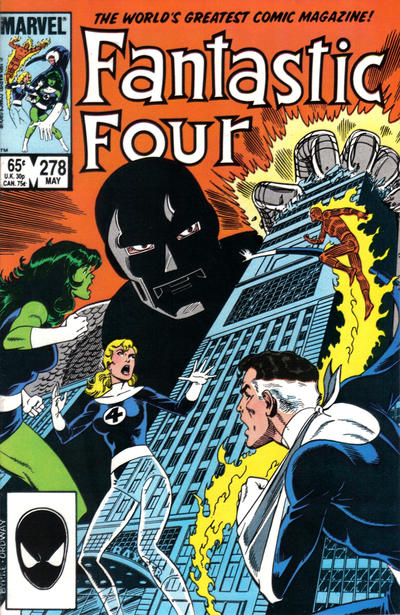
So as you might imagine, even this far out from (some version of) the character’s appearance on the silver screen, I’ve had an upswell of demand for comics featuring Doctor Doom. And not too long ago, a young man, probably 12 or 13, fished a couple appearances out of the Fantastic Four boxes and purchased them, one of which being issue #278 from 1985:


Technically, this isn’t Doom in this issue, but rather his young ward Kristoff, whose mind was reprogrammed with Doom’s memories upon the Doctor’s apparent “death.” Comics, everyone! But it’s a fun adventure (continued into the next issue, with a cover blurb referencing artist/writer John Byrne’s early work for Charlton).

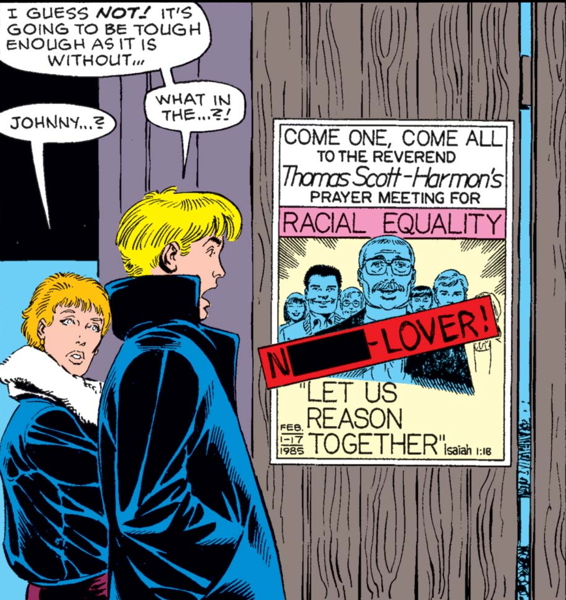
Anyway, an hour or three after that kid bought his comic and left, it occurred to me that a particular subplot appeared in that #278, setting up a story a couple of issues later. Johnny “Human Torch” Storm, with his girlfriend Alicia Masters (which will take some explaining, which I plan to do later in this series of posts) are out for a walk, when Johnny notices someone’s been applying offensive stickers to posters advertising an equality rally:


And just so we’re clear, that panel above is the version you’ll see on Marvel’s digital comic platform, with That Word obscured. It was not obscured in the original publication, in the issues I bought off the stands myself 41 years ago. I can only wonder what that young customer of mine thought when he hit that page in the comic after taking it home that day, and frankly I’m still expecting the phone call at the shop from a parent.

I’m trying to recall my own reaction to the usage in the comic. I was a 15/16-year old white kid reading this, and I think I was…maybe a little surprised to see it, but I could see it was there to Make A Point About Racism and therefore this was leading up to some Important Comics.

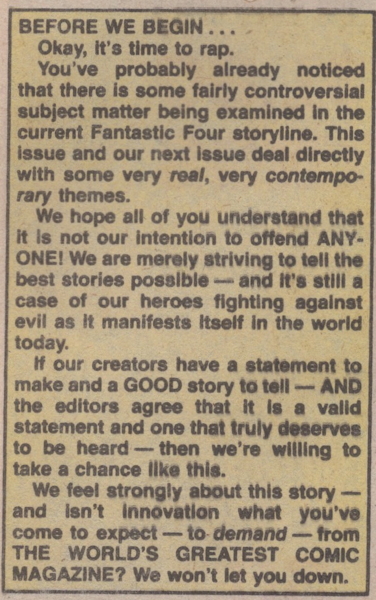
Looking at it now, I can see it as an attempt at making (spoiler, this is the villain behind it all) the Psycho-Man and his emotion-manipulating powers having a more “real world” relevant impact. And using That Word was absolutely there for the shock value, which was apparently a big year for it because it pops up in Uncanny X-Men just a couple of months after this. As that 15/16-year-old kid back then, and as the 57-year-old white guy I am now, I’m not in a position to say “sure, this was okay to do.” I mean, I think hearts were in the right place, judging by this please-don’t-write-us-letters editorial box on the letters page for #278:


(And just so you all know…I looked to see what reactions this issue generated in later Fantastic Four letter columns, and I found one with letters for #277, and another with a page for letters about #279, but none for #278. Not sure what to make of that.)

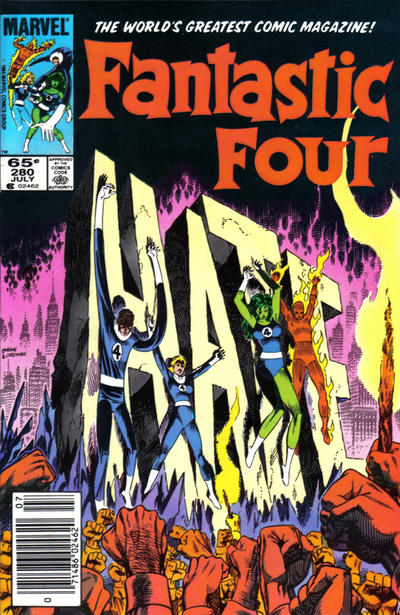
In a postscript in #279, That Word gets dropped again as a set-up for the next issue. And, once we get to issue #280, with this admittedly striking cover:


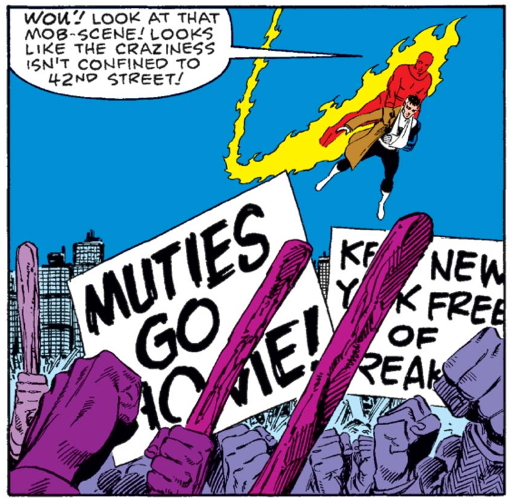
…where this storyline starts in earnest, things get scaled back a little bit, with a policeman under Psycho-Man’s influence harasses an elderly Jewish man, and assaults Wyatt Wingfoot, the FF’s Native American friend. Plus, we get a panel showing an anti-mutant protest:


…which has been, and still is, Marvel’s mainstay allegory for real world racism, feeling a little odd contrasted with the real world racism the comic has been presenting for a couple of issues now.

When all is said and done, the entire point of the slurs and the racism and the violence is to show what a character like the Psycho-Man, and his control over people’s hate and fear, would do in a “realistic” setting. Yes, racism is real, and someone like Psycho-Man would take advantage of it, stirring it up for his own ends, even if his own ends are just causing more hatred and violence for its own sake. But the contrast between a very real-world slur and, well, the inherent comic book ridiculousness of Psycho-Man makes for, at best, a rough fit, resulting in a presentation that feels more like “look what we can do!” than “We Have Something Important to Say.”

The real goal of this storyline is two-fold, and has nothing to do with the racism in the set-up. It’s all about Susan Richards, the Invisible Woman, and redefining her character. In short, under Psycho-Man’s control, and SPOILERS once more for a four-decade-old story, she emerges in the new costumed identity of Malice:


…where she quickly demolishes the other members of the FF with innovative usage of her force field powers. And while the Malice identity, at least during Byrne’s run on the book, departs after the conclusion of this storyline, the character has quite the long tail, appearing and reappearing in one form or another in later creators’ runs, up to Fantastic Four comics being released even as I type this.

The demonstration of Sue’s powers unleashed, combined with her eventual torture at the hands of Psycho-Man and her off-panel presumably-gruesome revenge on the villain, are all part of Byrne’s attempts at “strengthening” her, resulting in this concluding panel in #284:


Despite being a little harder to say out loud than “Invisible Girl,” the “Invisible Woman” moniker has survived to this day. And, largely because of this story, she is still often referred to as the most powerful member of the team.

Which of course is a wild way to wrap up a tale that began with That Word being printed in the comic, in front of God an’ everybody. It’s one of the very few examples of Byrne setting up a story element that doesn’t really come to anything…something similar (though with fewer bad words) occurs in that story with Reed’s father from about a year prior to this, which I’ll probably get to later. It’s just there to show just bad the villain can be, and, well, yes, that’s pretty bad indeed, thanks John.

Again, going back to what I, reading this new in 1985, thought of it…well, I’m sure I didn’t think much about the conclusions I’m drawing here today. I probably thought of it as “comics have really matured if they can make storytelling choices like this!” Or maybe I wasn’t thinking anything of it at all, since I was also reading old undergrounds an’ such at the time, which tended to be a little freer with the language than their four-color counterparts.

I mean, ultimately it’s good to show Our Heroes Hate Racism (a point that now seems sadly lost on some of those who purport to be comic fans), but casually throwing That Word out there in a regular ol’ superhero comic, an edgy move then, is certainly off-putting to modern eyes, regardless of intent.