So as you might imagine, even this far out from (some version of) the character’s appearance on the silver screen, I’ve had an upswell of demand for comics featuring Doctor Doom. And not too long ago, a young man, probably 12 or 13, fished a couple appearances out of the Fantastic Four boxes and purchased them, one of which being issue #278 from 1985:
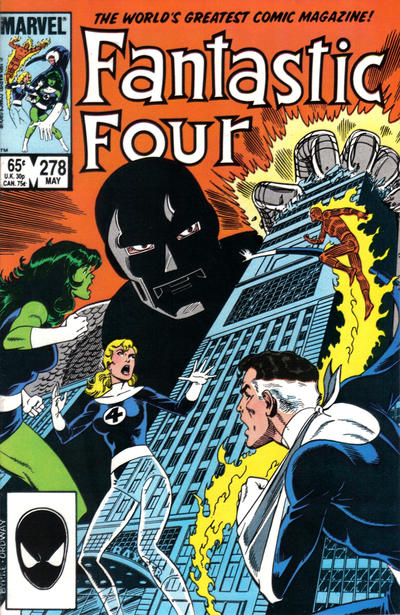
Technically, this isn’t Doom in this issue, but rather his young ward Kristoff, whose mind was reprogrammed with Doom’s memories upon the Doctor’s apparent “death.” Comics, everyone! But it’s a fun adventure (continued into the next issue, with a cover blurb referencing artist/writer John Byrne’s early work for Charlton).
Anyway, an hour or three after that kid bought his comic and left, it occurred to me that a particular subplot appeared in that #278, setting up a story a couple of issues later. Johnny “Human Torch” Storm, with his girlfriend Alicia Masters (which will take some explaining, which I plan to do later in this series of posts) are out for a walk, when Johnny notices someone’s been applying offensive stickers to posters advertising an equality rally:
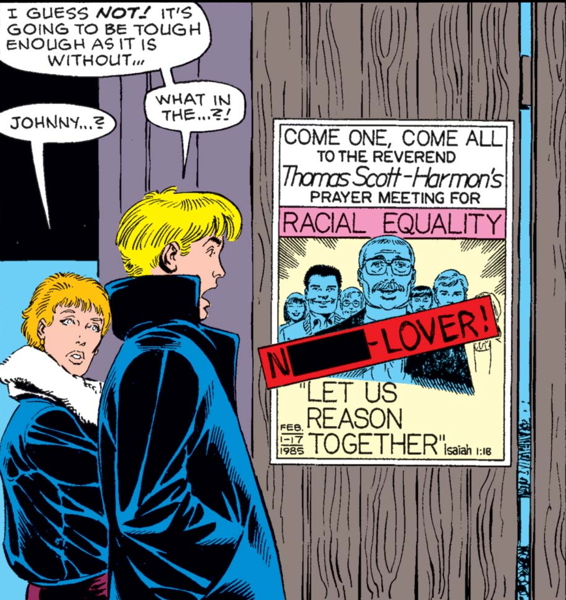
And just so we’re clear, that panel above is the version you’ll see on Marvel’s digital comic platform, with That Word obscured. It was not obscured in the original publication, in the issues I bought off the stands myself 41 years ago. I can only wonder what that young customer of mine thought when he hit that page in the comic after taking it home that day, and frankly I’m still expecting the phone call at the shop from a parent.
I’m trying to recall my own reaction to the usage in the comic. I was a 15/16-year old white kid reading this, and I think I was…maybe a little surprised to see it, but I could see it was there to Make A Point About Racism and therefore this was leading up to some Important Comics.
Looking at it now, I can see it as an attempt at making (spoiler, this is the villain behind it all) the Psycho-Man and his emotion-manipulating powers having a more “real world” relevant impact. And using That Word was absolutely there for the shock value, which was apparently a big year for it because it pops up in Uncanny X-Men just a couple of months after this. As that 15/16-year-old kid back then, and as the 57-year-old white guy I am now, I’m not in a position to say “sure, this was okay to do.” I mean, I think hearts were in the right place, judging by this please-don’t-write-us-letters editorial box on the letters page for #278:
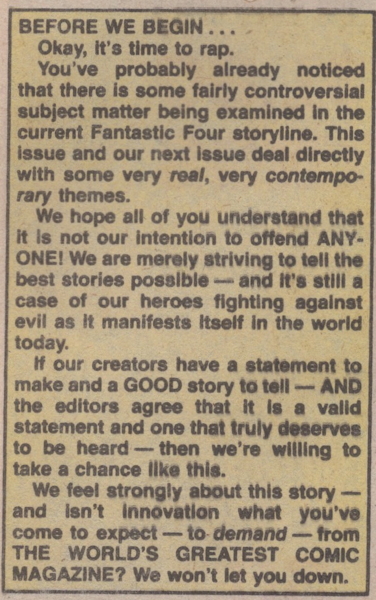
(And just so you all know…I looked to see what reactions this issue generated in later Fantastic Four letter columns, and I found one with letters for #277, and another with a page for letters about #279, but none for #278. Not sure what to make of that.)
In a postscript in #279, That Word gets dropped again as a set-up for the next issue. And, once we get to issue #280, with this admittedly striking cover:
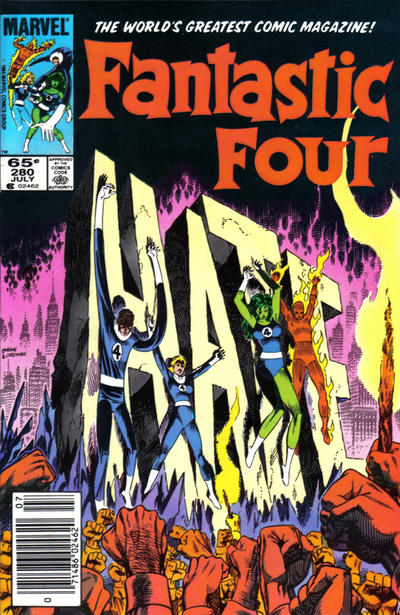
…where this storyline starts in earnest, things get scaled back a little bit, with a policeman under Psycho-Man’s influence harasses an elderly Jewish man, and assaults Wyatt Wingfoot, the FF’s Native American friend. Plus, we get a panel showing an anti-mutant protest:
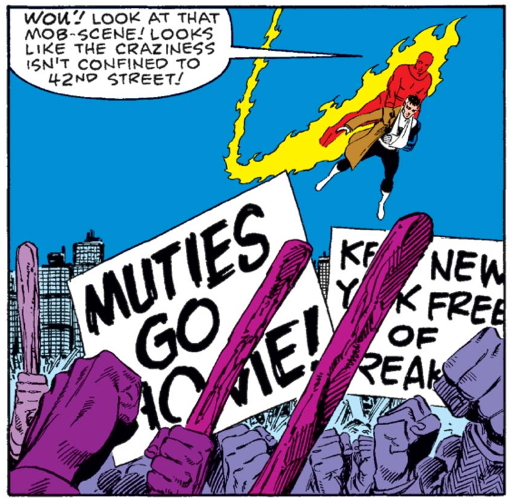
…which has been, and still is, Marvel’s mainstay allegory for real world racism, feeling a little odd contrasted with the real world racism the comic has been presenting for a couple of issues now.
When all is said and done, the entire point of the slurs and the racism and the violence is to show what a character like the Psycho-Man, and his control over people’s hate and fear, would do in a “realistic” setting. Yes, racism is real, and someone like Psycho-Man would take advantage of it, stirring it up for his own ends, even if his own ends are just causing more hatred and violence for its own sake. But the contrast between a very real-world slur and, well, the inherent comic book ridiculousness of Psycho-Man makes for, at best, a rough fit, resulting in a presentation that feels more like “look what we can do!” than “We Have Something Important to Say.”
The real goal of this storyline is two-fold, and has nothing to do with the racism in the set-up. It’s all about Susan Richards, the Invisible Woman, and redefining her character. In short, under Psycho-Man’s control, and SPOILERS once more for a four-decade-old story, she emerges in the new costumed identity of Malice:

…where she quickly demolishes the other members of the FF with innovative usage of her force field powers. And while the Malice identity, at least during Byrne’s run on the book, departs after the conclusion of this storyline, the character has quite the long tail, appearing and reappearing in one form or another in later creators’ runs, up to Fantastic Four comics being released even as I type this.
The demonstration of Sue’s powers unleashed, combined with her eventual torture at the hands of Psycho-Man and her off-panel presumably-gruesome revenge on the villain, are all part of Byrne’s attempts at “strengthening” her, resulting in this concluding panel in #284:

Despite being a little harder to say out loud than “Invisible Girl,” the “Invisible Woman” moniker has survived to this day. And, largely because of this story, she is still often referred to as the most powerful member of the team.
Which of course is a wild way to wrap up a tale that began with That Word being printed in the comic, in front of God an’ everybody. It’s one of the very few examples of Byrne setting up a story element that doesn’t really come to anything…something similar (though with fewer bad words) occurs in that story with Reed’s father from about a year prior to this, which I’ll probably get to later. It’s just there to show just bad the villain can be, and, well, yes, that’s pretty bad indeed, thanks John.
Again, going back to what I, reading this new in 1985, thought of it…well, I’m sure I didn’t think much about the conclusions I’m drawing here today. I probably thought of it as “comics have really matured if they can make storytelling choices like this!” Or maybe I wasn’t thinking anything of it at all, since I was also reading old undergrounds an’ such at the time, which tended to be a little freer with the language than their four-color counterparts.
I mean, ultimately it’s good to show Our Heroes Hate Racism (a point that now seems sadly lost on some of those who purport to be comic fans), but casually throwing That Word out there in a regular ol’ superhero comic, an edgy move then, is certainly off-putting to modern eyes, regardless of intent.
Ugh. A doubly bad storyline, in my opinion.
At the time, the men in my family had two favorite hobbies: talking about WWII and telling jokes using the N-word. Even then, I found all of that unbearable and knew I was/had to be different than them.
But comics were supposed to be my escape, and seeing the same casual racism and casual use of a racial slur was a bummer. It just took the “escape” right out of the comic for me.
And looking at it now, I have to agree, it’s a superficial treatment of a real problem by someone who was trying to be edgy but had no business telling that story.
Same with the Invisible Woman storyline. Attaching Sue’s power-up and adult codename to abusive circumstances was so unnecessary. Her “Invisible Woman” announcement is so sad and resigned when it should be triumphant and empowering. Byrne himself had done a better story about the exact same thing earlier in his run.
I haven’t reread this section of Byrne’s run in a long time, and I see why now. It was a bummer then and it’s even more of a bummer now.
40 years have passed and tastes in edginess have changed.
Just earlier tonight I watched the 1945 movie “And then there were none” which was affected by a similarly slow-paced reevaluation.
Obviously, Marvel should replace the word with “Indians”.
I’m reminded of the issue of Wolverine from the late 1990s that was recalled and reprinted due to the accidental use of a slur.
“a good starter comic for a recalled collection”
Yeah, I think I’ll pass.
https://recalledcomics.com/Wolverine131Recalled.php
As I have mentioned many times (perhaps way too many) This comic – #278 was my first FF issue and proper introduction to the team. I first encountered them in Secret Wars and was excited to see both She-Hulk and (wannabe) Dr. Doom in a story again.
I also mentioned earlier that growing up in the deep South had I guess hardened me to the use of THAT word. Like Thom H. mentioned*, it was a common word used by both family and neighborhood friends. In fact, I first heard one of my childhood friends use that exact two-word term to describe some neighbors of ours, to which I thought “what’s so bad about that?” While I wish I could say I was a more enlightened child in a lot of other ways, I at least had an innate repulsion to the word. I never once heard someone say it and think “boy that makes you look smart.” So, I wasn’t bothered at the inclusion of the word in this story. I was just glad these people were clearly being portrayed as the villains in the story. Over the years I have wondered what people from different regions, upbringings, and ethnic identities felt when encountering that phrase in the comic.
I am of two minds about its usage. On one hand I can somewhat see the merits of including it in a constructive way to show just how ugly and hateful racism is and helping ground the story in real world events, which admittedly in a superhero comic can be a tough thing to land properly. On the other hand, as Thom mentioned, it can take someone right out of a story and kill the escapist vibe. Also, it is an obviously tremendously triggering word for many, many people, and I don’t like the thought of someone experiencing distress when just trying to enjoy a comic. I agree that the story doesn’t really address the issue in a meaningful and constructive way, and it comes off as trying to be edgy and fails.
Comics have a long history of obscuring genitalia and other things deemed offensive. How hard would it have been to originally partially obscure the wording on the poster with a telephone pole or street lamp or something along those lines?
I have thoughts about Malice as well, but I’ve gone on too long as it is.
#280 is one of the many standout covers of Byrne’s run, along with 243, 244, 258, 260, 262, and 263 just to name a few. It was one of the many covers I enlarged on an opaque projector and made a poster of back in commercial art/graphic design class in high school.
*Dang, I didn’t even get WWII stories, just the casual racism.
” she emerges in the new costumed identity of Malice”
That mask is 100% GOOFY.
I’ve long maintained that the closer a super-hero comic gets to reality, the closer it gets to breaking the entire genre. Superman tries to solve poverty… and can’t! Superman tries to foster world peace… and can’t! Superman tries to stop a war in a foreign country… and can’t! Superman ends up looking dumb and pointless. The Teen Titans can’t stop drug addiction. Captain America can’t stop political corruption. Dr. Strange can’t stop abusive cults. Etc.
Analogous threats work better. The X-Men’s struggle against fantastical racism resonates, but Kitty Pryde busting out slurs to make the point momentarily breaks the reality of the super-hero universe. Similarly, Psycho Man stirring up trouble because of mankind’s issues plays less awkwardly than a real-world slur printed in a comic book. The FF can’t fight racism. There’s no way they can solve it, and the immersion breaks.
There are some super-heroes better equipped to handle stories about racism. A minority character having to deal with being targeted works a lot better than Johnny Storm saying racism is bad (even though Johnny Storm saying racism is bad is obviously correct). A minority creator is better equipped to write a more authentic story about prejudice. I applaud creators of the past trying to tackle stories about these issues. I hope future creators learned from both their successes and mistakes.
When I can find them at a decent price, I have been picking up the John Byrne FF run issues bit by bit over the last few years. I had and read them back in the day when they were first published, and my recollection at this point is that I enjoyed the first two years worth of Byrne’s run, which features some story beats which echoed back to the classic Lee/Kirby run. However, after Byrne changed the team’s classic costumes, gave Johnny and Sue bad haircuts, dropped The Thing in favor of She-Hulk, made Johnny and Alicia a couple, had Sue become Malice, and various other things, my feeling was that the series started to go downhill.
I am curious to know if the Comics Code Authority-stamped newsstand edition of Fantastic Four no. 278 also contained the slur–as that would seem to be a pretty big failing on the part of the Comics Code Authority. I guess 1985 was the beginning of the end of the Bronze Age and the start of the Copper Age, as The Dark Knight Returns, and Watchmen would be published in 1986.
I don’t think any other mainstream comic published in the Bronze Age used that slur in a story about racism. But there were definitely Bronze Age stories which sought to bring awareness to and combat racism, including Don McGregor’s Black Panther vs the Klan story arc in Jungle Action and Marvel Premiere, and the highly acclaimed Denny O’Neil and Neal Adams run in Green Lantern/Green Arrow, or Elliot S.
Maggin’s “What Can One Man Do?” Green Arrow story. Still, it does seem that Byrne’s approach was heavy-handed for a mainstream comic; had he been writing for an Epic imprint, or Marvel Graphic Novel (such as X-Men: God Loves, Man Kills) or other Direct Market-only comic meant for a mature audience it might not have seemed quite so transgressive.
It is surprising that Sue Richards didn’t become The Invisible Woman much earlier, considering that most of the 1970s Fantastic Four writers were fairly progressive thinkers. I kind of wonder if Stan Lee had an edict in place forbidding the changing of her superhero name? But, again, it does seem that Byrne was heavy-handed in the sequence of events which lead to her new identity. And was Malice’s costume a riff on Wendy O. Williams from The Plasmatics, or what?
“Don McGregor’s Black Panther vs the Klan story arc”
the hilarious part of that is editorial wanted McG to bring some WHITE PEOPLE into the storyline!
“I don’t think any other mainstream comic published in the Bronze Age used that slur in a story about racism.”
Can’t tell you exactly where, but I do remember a Batman issue of the era which did.