Alistair asks a question that may be longer than my potential answer…let’s see how I do!
“In your experience as a retailer, do you think the success of licensed comics which aren’t aimed at very young kids tends to depend on how closely they connect to their source material? For example, did the Dark Horse Buffy comics become more popular when they started doing an official continuation from the show with contributions by Whedon and the other television writers, versus the ones that came out while the show was ongoing which Whedon had kept at arms length?”
Some sort of close kinship with the source material is usually preferred when it comes to licensed properties. You didn’t mention the art specifically, Alistair, but one of the things that would turn people off from adaptations of movies or television shows is artwork where the drawn characters don’t look at least within reasonable spitting distance of the actors. On the other hand, a comic that looked like it was all traced from photo reference would be a turn-off as well, a weird sort of “uncanny valley” for comics.
That sounds like a…fine line to walk, but in practice there’s more room to breathe for artists on these adaptations, so long as they’re, as I said, reasonably accurate, and consistent, it’s all good. I was reading one particular series based on a sci-fi property, and had to drop it because eventually I couldn’t recognize many of the characters. Not “the comic’s plot changed everybody around,” but “these characters in the comics are supposed to be those characters from the TV show/movies, but unless they’re referred to by name in the dialogue, they’re unrecognizable.”
I get that it’s probably a difficult job to do, making these caricatures of real people “act” on a page while keeping them identifiable as those performers. But that has to be the minimum level of what is acceptable for comics like this.
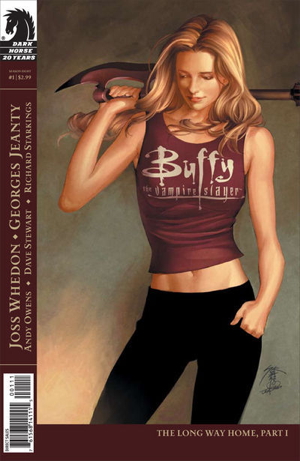 Okay, that was a lengthy aside to Alistair’s question. What’s being asked here is “does a comic get a boost from being promoted as an “official” continuation of the source material?” And the answer is…not always, but it doesn’t hurt.
In the case of Buffy the Vampire Slayer, the Buffy comics had been going on a bit, and were getting to be a little long in the tooth. Sales had been relatively strong at first, but the novelty had worn off as time went on. The “Season 8” series was in effect a relaunch of the comics property, with the added value of show creator’s Joss Whedon’s involvement. Heavily promoted as the actual, real continuation of the TV series, backed up with Whedon’s presence, the Buffy comics got a real shot in the arm that lasted for years ’til the franchise sort of petered out again.
So, in a way, in this case at least, being the “official continuation of the show” did attract a lot of attention. The promotion, the creator’s involvement, the timing of reinvigorating the license right when it needed it…all came together to make a successful relaunch.
Other “Season [n]” comics were released in the wake of Buffy Season 8’s success, including Smallville Season 11 and X-Files Season 10 (and evenually, 11). Didn’t make quite the big splashes the Buffy seasons did, but they had their fans.
“I wonder if that’s why one hears so much more about, say, Star Wars comics versus Star Trek comics: it’s always been the case that the former are an ‘official’ part of Star Wars, part of the ‘official’ what-happened-next stories (along with all the games, novels etc.) whereas with Star Trek comics it’s a lot more nebulous.”
 Yeah, early on as the Star Wars Expanded Universe was in its infancy, someone decided “all these tie-ins are going to be consistent with each other,” and for the most part, they were. That first novel of this new era, Heir to the Empire, contained references to events in Dark Horse’s first mini Star Wars: Dark Empire, and given the book probably had an audience many times the size of the comic, there are probably fans who still don’t know what the deal was with all that. (Unless they looked it all up on Wookiepedia or whatever.)
And Star Trek, by contrast, was just kinda all over the place, not adhering to any particular thread of continuity. Nobody in a Star Trek: Discovery comic book is referencing events from, I don’t know, the 1982 Adobe of Life Trek novel by G. Harry Stine writing as “Lee Correy.” (One exception: Lower Decks would absolutely refer to a 40-year-old Trek book.) There were tie-ins to movies and TV that were “official” parts of those stories, like Star Trek: Countdown (a prequel to the 2009 film), and a Picard comic that tied into the series, which received a little bit of attention, anyway.
I don’t know how much being part of “official” continuity is helping the Star Wars comics. The initial burst of sales on those coincided with Marvel’s reacquiring of the license and their sales push for the new launch. That they’re consistent with other Star Wars media may be a plus, but at this point that level of consistency may be expected from the franchise, or may simply be taken for granted and not singled out at all as part of the appeal of the comics.
But here’s the thing: being part of “official continuity” ultimately doesn’t make any difference. I believe it was the Star Wars folks who came up with the levels of “canon” to the material they were releasing. The movies were the immutable, absolute story of the Star Wars universe. The books and comics and such, while kept consistent with the films, the films were not beholden to anything in them (despite occasionally borrowing names and characters). And then there’s the stuff like the Holiday Special which goes to the Star Wars canon-level where only the amazing stuff happens.
Now, I don’t know if those rankings are still in play, but I think it’s still safe to assume that the movies (and presumably, the live-action TV shows) are under no obligation to maintain continuity with the books and comics, but the books and comics are absolutely required to be in continuity with the movies and TV shows. (And there’s stuff like the Clone Wars cartoon, which I presume is mostly canon, but I’ve already got a headache talking about all this.)
In short, “official” just means “we don’t contradict anything from what we’re adapting,” even those that official status could be bounced at any time. It helps a little as a sales point, and it helped a lot in that initial Buffy Season 8 thing (partially because they were one of the first out of the gate with that pitch), but it doesn’t really seem as necessary now.
And none of what I discussed really gets into comics for, like, Predator or Alien and the like, as those tend to run more episodic and self-contained. (Those the early Dark Horse Aliens comics had an ongoing continuity in some of their early releases…thrown off by events when the Alien 3 movie came out.)
“If that’s not really a straightforward question to answer, I will instead ask in the alternative: do you have any favourite licensed comics?”
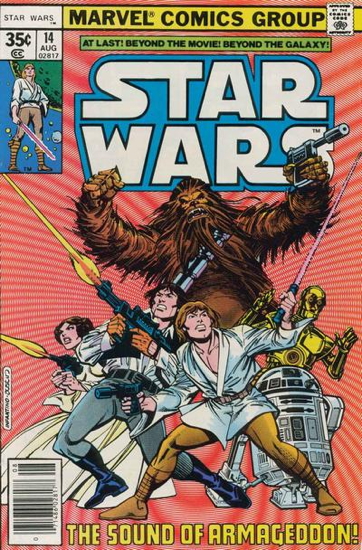
I’m going to go ahead and answer this, too, since you asked so nicely. I still have a soft spot for the first three or four years’ worth of the original Marvel Star Wars that began in the 1970s. Some wild somewhat off-model but still amazing Carmine Infantino art in some of those…that’s a good example of actor likenesses not being spot-on but everyone still being instantly recognizable.
I also love the treasury-sized Close Encounters of the Third Kind adaptation from Marvel, drawn by Walt Simonson. I think this was a case where they weren’t allowed to use the actors’ likenesses, but you don’t even notice.

Also drawn by Simonson is the adaptation of the original Alien film. There are few perfect things in this fallen world, but this is one of them (well, aside from the binding).

And how can any discussion of licensed books be complete without noting the greatest of all time:
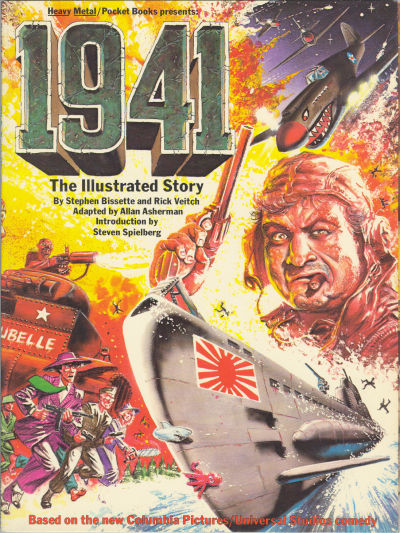
Sheer madness from Steve Bissette and Rick Veitch. I love this comic. Get your hands on one if you can, because it’s pure joy.
Hi Mike!
Many thanks for answering my question – apologies that it ran so long. Very insightful!
One amusing bit of trivia I’ll note re: Heir to the Empire and Dark Empire is that (at least the way I have heard it told over the years) Timothy Zahn, who wrote Heir to the Empire, and Tom Veitch, who wrote Dark Empire, were each invited to cross-reference with each other’s work, but Zahn declined politely because he didn’t like Dark Empire’s story!
(For my own part I’ve always liked Dark Empire more even if it is arbitrarily “worse” just because it’s the one I read first, haha.)
Another fun fact (since you mentioned the original Marvel Star Wars comics, which I’m also a big fan of) is that Tom Veitch actually pitched Dark Empire to Marvel and it was originally solicited as a three-issue prestige miniseries which was meant to be published by Epic in 1989 or 1990. As it happened, the Star Wars comics licence went over to Dark Horse and Dark Empire evidently went with it, so it became what they launched their Star Wars line with (for better or worse!). An interesting “what if” scenario if it had stayed at Marvel.
Thanks again!
Alistair
I think Babylon 5 beat Buffy out the gate with “these are official canon stories”…not continuations though. And, although B5 fans don’t want to hear it, nobody really cared…
I enjoyed those early years post-(One True) Star Wars comics, too, (and the comics strips when I saw them, and the serial in Pizzazz, but one thing that bugs me now when seeing them is that either by Fox/Lucasfilm fiat or Merry Marvel Marketing command had to put the human characters only in their movie clothes (and Leia’s Cinnabon earmuffs hairstyle), or they didn’t have the imagination to vary the designs.
It’s hard to believe there was once a time, and quite a long time from a kid’s point of view, when there was just one SW movie. The comics and our imaginations got to be the only sequels for a few precious years. (Ok, not counting the Foster & Daley novels.)
I had no idea the Close Encounters adaptation was by Walt Simonson, I’ll have to track that down.
My current “white whale” comic is an affordable copy of the Jaws 2 adaptation featuring art by Gene Colan and Tom Palmer. I’ve only seen one copy in the wild, but it was way outside of my price range. Palmer painting over Colan: amazing!
My former “white whale” comic was Kirby’s adaptation of 2001. I picked it up recently at comic con for a little more than I wanted to spend, but holy moly is that treasury-sized Kirby art spectacular!
I think the late ’70s and ’80s ushered forth many great licensed comics. Marvel also published Logan’s Run, by David Anthony Kraft, George Perez and Klaus Janson; Battlestar Galactica, which had several issues by Walt Simonson; Blade Runner, by Archie Goodwin, with amazing art by Al Williamson, Carlos Garzon, Dan Green, and Ralph Reese. And Marvel’s short run of Star Trek started off strong, with very good Dave Cockrum art.
Meanwhile, Steranko adapted Outland to great fanfare in
Heavy Metal Magazine.
And Williamson and Garzon also drew the Flash Gordon film adaptation for Gold Key Comics.
In the realm of independent comics, First Comics adapted the cosmic, counterculture theatrical production of Warp–and Peter B. Gillis and Frank Brunner, along with others, created a compelling continuing story arc.