“Long in the tooth,” get it.

Alistair asks a question that may be longer than my potential answer…let’s see how I do!

“In your experience as a retailer, do you think the success of licensed comics which aren’t aimed at very young kids tends to depend on how closely they connect to their source material? For example, did the Dark Horse Buffy comics become more popular when they started doing an official continuation from the show with contributions by Whedon and the other television writers, versus the ones that came out while the show was ongoing which Whedon had kept at arms length?”

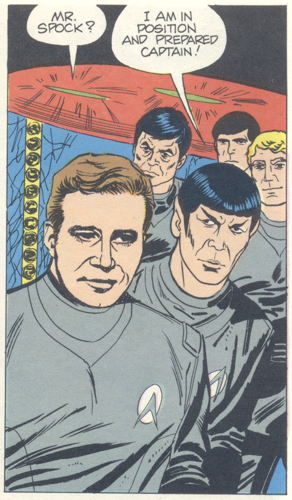
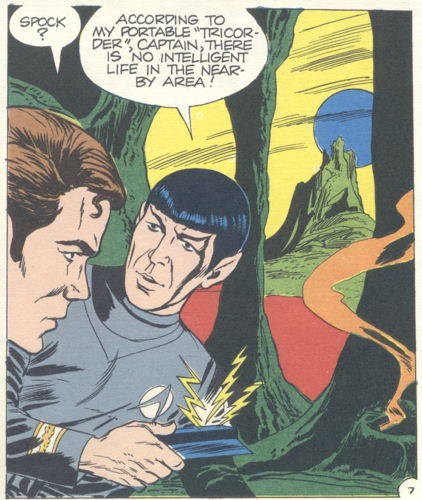
Some sort of close kinship with the source material is usually preferred when it comes to licensed properties. You didn’t mention the art specifically, Alistair, but one of the things that would turn people off from adaptations of movies or television shows is artwork where the drawn characters don’t look at least within reasonable spitting distance of the actors. On the other hand, a comic that looked like it was all traced from photo reference would be a turn-off as well, a weird sort of “uncanny valley” for comics.

That sounds like a…fine line to walk, but in practice there’s more room to breathe for artists on these adaptations, so long as they’re, as I said, reasonably accurate, and consistent, it’s all good. I was reading one particular series based on a sci-fi property, and had to drop it because eventually I couldn’t recognize many of the characters. Not “the comic’s plot changed everybody around,” but “these characters in the comics are supposed to be those characters from the TV show/movies, but unless they’re referred to by name in the dialogue, they’re unrecognizable.”

I get that it’s probably a difficult job to do, making these caricatures of real people “act” on a page while keeping them identifiable as those performers. But that has to be the minimum level of what is acceptable for comics like this.

Okay, that was a lengthy aside to Alistair’s question. What’s being asked here is “does a comic get a boost from being promoted as an “official” continuation of the source material?” And the answer is…not always, but it doesn’t hurt.

In the case of Buffy the Vampire Slayer, the Buffy comics had been going on a bit, and were getting to be a little long in the tooth. Sales had been relatively strong at first, but the novelty had worn off as time went on. The “Season 8” series was in effect a relaunch of the comics property, with the added value of show creator’s Joss Whedon’s involvement. Heavily promoted as the actual, real continuation of the TV series, backed up with Whedon’s presence, the Buffy comics got a real shot in the arm that lasted for years ’til the franchise sort of petered out again.

So, in a way, in this case at least, being the “official continuation of the show” did attract a lot of attention. The promotion, the creator’s involvement, the timing of reinvigorating the license right when it needed it…all came together to make a successful relaunch.

Other “Season [n]” comics were released in the wake of Buffy Season 8’s success, including Smallville Season 11 and X-Files Season 10 (and evenually, 11). Didn’t make quite the big splashes the Buffy seasons did, but they had their fans.

“I wonder if that’s why one hears so much more about, say, Star Wars comics versus Star Trek comics: it’s always been the case that the former are an ‘official’ part of Star Wars, part of the ‘official’ what-happened-next stories (along with all the games, novels etc.) whereas with Star Trek comics it’s a lot more nebulous.”

Yeah, early on as the Star Wars Expanded Universe was in its infancy, someone decided “all these tie-ins are going to be consistent with each other,” and for the most part, they were. That first novel of this new era, Heir to the Empire, contained references to events in Dark Horse’s first mini Star Wars: Dark Empire, and given the book probably had an audience many times the size of the comic, there are probably fans who still don’t know what the deal was with all that. (Unless they looked it all up on Wookiepedia or whatever.)

And Star Trek, by contrast, was just kinda all over the place, not adhering to any particular thread of continuity. Nobody in a Star Trek: Discovery comic book is referencing events from, I don’t know, the 1982 Adobe of Life Trek novel by G. Harry Stine writing as “Lee Correy.” (One exception: Lower Decks would absolutely refer to a 40-year-old Trek book.) There were tie-ins to movies and TV that were “official” parts of those stories, like Star Trek: Countdown (a prequel to the 2009 film), and a Picard comic that tied into the series, which received a little bit of attention, anyway.

I don’t know how much being part of “official” continuity is helping the Star Wars comics. The initial burst of sales on those coincided with Marvel’s reacquiring of the license and their sales push for the new launch. That they’re consistent with other Star Wars media may be a plus, but at this point that level of consistency may be expected from the franchise, or may simply be taken for granted and not singled out at all as part of the appeal of the comics.

But here’s the thing: being part of “official continuity” ultimately doesn’t make any difference. I believe it was the Star Wars folks who came up with the levels of “canon” to the material they were releasing. The movies were the immutable, absolute story of the Star Wars universe. The books and comics and such, while kept consistent with the films, the films were not beholden to anything in them (despite occasionally borrowing names and characters). And then there’s the stuff like the Holiday Special which goes to the Star Wars canon-level where only the amazing stuff happens.

Now, I don’t know if those rankings are still in play, but I think it’s still safe to assume that the movies (and presumably, the live-action TV shows) are under no obligation to maintain continuity with the books and comics, but the books and comics are absolutely required to be in continuity with the movies and TV shows. (And there’s stuff like the Clone Wars cartoon, which I presume is mostly canon, but I’ve already got a headache talking about all this.)

In short, “official” just means “we don’t contradict anything from what we’re adapting,” even those that official status could be bounced at any time. It helps a little as a sales point, and it helped a lot in that initial Buffy Season 8 thing (partially because they were one of the first out of the gate with that pitch), but it doesn’t really seem as necessary now.

And none of what I discussed really gets into comics for, like, Predator or Alien and the like, as those tend to run more episodic and self-contained. (Those the early Dark Horse Aliens comics had an ongoing continuity in some of their early releases…thrown off by events when the Alien 3 movie came out.)

“If that’s not really a straightforward question to answer, I will instead ask in the alternative: do you have any favourite licensed comics?”

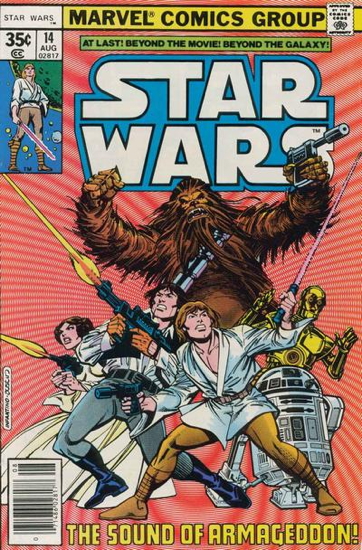
I’m going to go ahead and answer this, too, since you asked so nicely. I still have a soft spot for the first three or four years’ worth of the original Marvel Star Wars that began in the 1970s. Some wild somewhat off-model but still amazing Carmine Infantino art in some of those…that’s a good example of actor likenesses not being spot-on but everyone still being instantly recognizable.
I also love the treasury-sized Close Encounters of the Third Kind adaptation from Marvel, drawn by Walt Simonson. I think this was a case where they weren’t allowed to use the actors’ likenesses, but you don’t even notice.

Also drawn by Simonson is the adaptation of the original Alien film. There are few perfect things in this fallen world, but this is one of them (well, aside from the binding).

And how can any discussion of licensed books be complete without noting the greatest of all time:
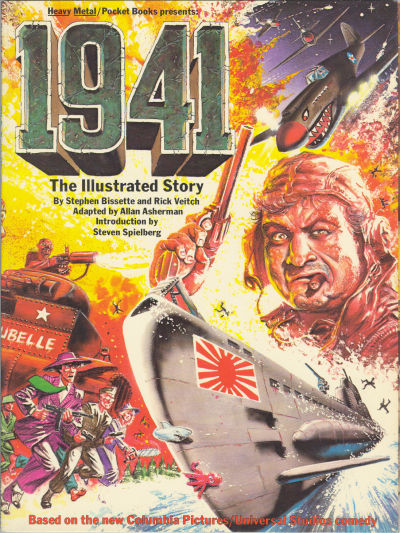
Sheer madness from Steve Bissette and Rick Veitch. I love this comic. Get your hands on one if you can, because it’s pure joy.
I didn’t mean “long tail” as a joke.

First, sorry I missed posting on Wednesday…some days I can fight the effects of this new medication, some days I can’t, and that was a “can’t” day. Even as I type this, today is a “well, maybe day” so we’ll see what happens.

Second, there were a couple of specific things I wanted to point out in an addendum to my Peter David post from Monday.

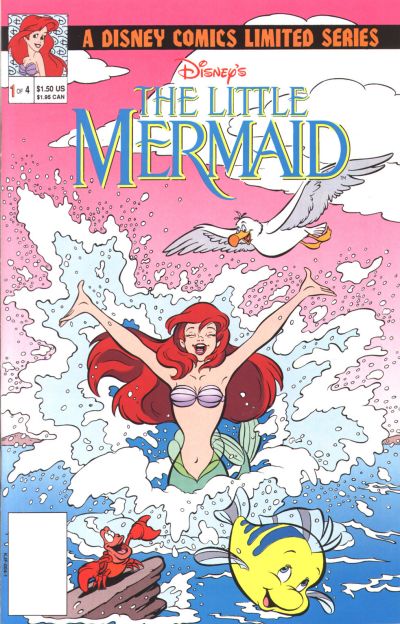
For example, I really should have noted his Disney work on 1992’s Little Mermaid:


…a character he loved so much that I believe it was the reason he named one of his daughters “Ariel.” This, and the spinoff Sebastian series he also wrote, remained popular back issue items for many years.


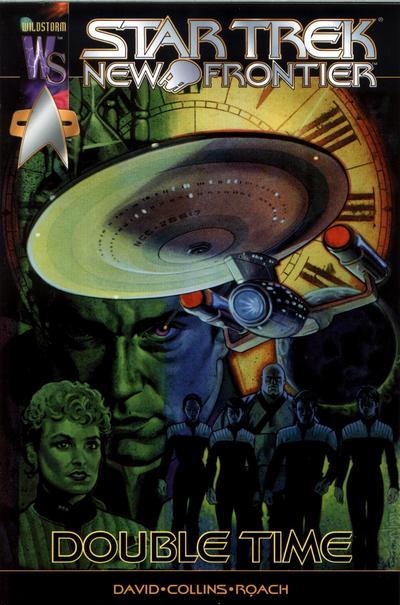
David also wrote a series of Star Trek novels called New Frontier, based around a crew assembled either from supporting characters from other Treks and original characters David pulled from the always-expanding Trek lore. Its mix of deep cut continuity, irreverence, and sci-fi adventure makes it kinda/sorta a proto-Lower Decks, if you sort of squint right.

Anyway, there were some comic book spinoffs from these novels, including the first one pictured above, a David-scripted one-shot released by DC imprint Wildstorm in 2000. A five-part mini-series came out from IDW in 2008, also written by David.

As far as sales go, these didn’t have quite the long tail that the Little Mermaid books did. However, the fans of the books who also read comics were very excited to have these. And I was too! New Frontier was an entertaining extension of the franchise that I hope isn’t forgotten.

I was but the learner, but now I am the master.

…Well, okay, perhaps that quote from Star Wars Episode IV: Remember When There Was Just the One Movie is overstating things a bit, but it was kind of odd to have my former boss Ralph from the previous place of employment come to my shop and fill in for me for most of this Thursday. Yes, I was my old boss’s boss for part of a day, and yes, that seemed strange. But it was quite nice of him to step in, as I was attending funeral services for my girlfriend’s mother at that time. He reported that there were more than a few shocked faces after walking into my store that day and seeing him behind the counter…some folks hadn’t seen Ralph in years got to catch up with him again! (And he’s still selling comics, but just doesn’t own a store, so it’s not like I handed the keys over to a competing shop or anything.) (Or did I? Dun-dun-DUNNNN.)

Anyway, I’ve had a long Thursday, and a long week in general, I’m pretty wiped out, so I’m putting a cap on this week here at Progressive Ruin Industries. I’ll let the batteries refresh over the weekend and I’ll be back in fightin’ trim on Monday.

Though, just so there’s some actual Star Warsian content to justify the title of this post, there’s a couple of things that came up on Twitter last night that I’d been thinking about for a while, and wanted to pose to you folks.

1. It seems like (to me anyway) it’s only a matter of time before Marvel starts mixing the Star Wars license with the regular Marvel Universe. I mean, beyond special variant covers…I’m talking actual comic book stories like Super-Villain Team-up with Darth Vader and Magneto or a Vision/R2D2 crossover or something. How likely do you think that’ll happen?

2. I believe that within my lifetime, I will see an official Star Wars/Star Trek crossover of some sort…probably in the comics, maybe in a novel, almost certainly not in live action. Now, with Disney having dumped four billion smackers into the franchise, there’s almost certainly no need for Star Wars to “team up” with anything, as the films don’t need any sort of gimmicky sales boost, beyond the gimmicky sales boost of being a Star Wars movie. But I think all it takes is one or two or a half-dozen box office crashing turkeys to drive either property to such desperate measures. Star Trek certainly hasn’t been shy about crossing over with other company’s properties, so it feels like that side of the deal wouldn’t say “no.” Think this will happen? In my lifetime? In any of our lifetimes? In the far-flung fuuuuuture?

Get this popcorn to Sickbay.

bullyposse

So my pal Bully, the little bull stuffed with lovin’, is a bit down in the dumps at the moment, and he can use a little support. I posted that above image, made long ago and posted on this site before, to my Twitter account (with a link to Bully’s account), and have been asking people to retweet it. Hopefully, when Bully peeks in on his own Twitter feed, he’ll see all the support he’s been getting there. If you’ve got a Twitter account and can retweet that tweet, please do. You can “like” it, too, but definitely retweet so it gets around. Thanks!

• • •

In other news…this is a hell of thing:

stvoypopcorn
Life goes on, and this weekend life brought me a whole lotta boxes of old Star Wars and (to a much lesser extent) Star Trek goodies…boxes shown here:

toweroswboxes
Mostly unopened action figures, with some other related items, like that Vanity Fair with the — Star Wars cover, I think? — peeking out the translucent plastic , there. And there are some TV Guides, with multiple covers for one issue featuring lenticular images of the Star Wars cast…can’t remember ever seeing those particular Guides before. Anyway, I’ll have plenty to look at and almost certainly post here once I figure out a strategy of how I’m going to deal with all these items. I mean, aside from keeping all the droid toys for myself. Oh, man, if there’s an intact Droid Factory playset in here, I’m closing for the day and just building droids ’til the wee hours.

Of course, the real trick here is determining prices, since it’s been a long time since I’ve had to deal with Star Wars/Trek figures, with not much of an idea of the secondary market on some of these things. I have vague memories of there being some collector demand for certain figures with particular part/run numbers and so on, but I can see that driving me crazy in short order. But that’s just a matter of research…and frankly, both I and the person I’m selling these for are more interested in moving the majority of them out for bargain prices rather than trying to sell that one special Ugnaught w/Variant Purple Speckled Overalls for an extra dollar or two on eBay. But the plan is that some will go on eBay, most will go in the store for relatively inexpensive prices, what with the Christmas holiday coming up…though I’m not sure how many kids are going to want to find a Phantom Menace Ric Olié action figure under the tree, regardless if it’s the “closed-hand variant” or not.

And then there’s the problem of me wanting any of these for myself. For the most part I’ve been pretty good about not buying toys for myself (aside for those toys of a Swamp Thing-ish persuasion, of course) but the little droid figures are just so appealing to me. If I’d had my wits about me as a young Mikester, I could have restricted myself to just buying the droid figures from the Star Wars line all this time and amassed a tiny robot army. Alas, I can only collect so much, what with the comic books, buttons, and glow-in-the-dark novelty socks I’m already gathering. Despite all that, I bet I’ll probably keep something out of these boxes. I’m weak, I can’t help myself.

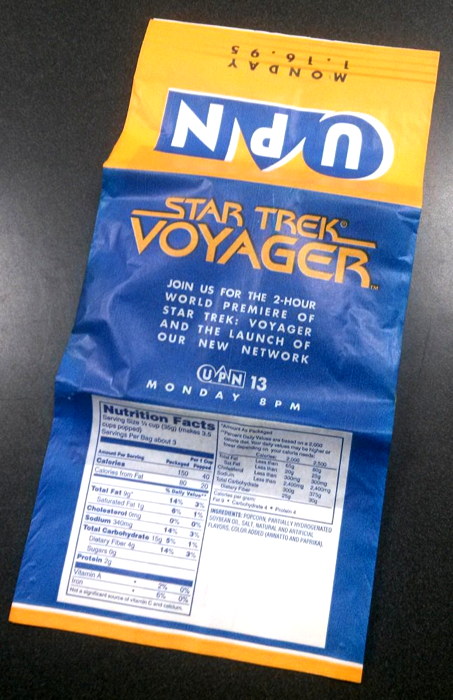
One thing I probably won’t be keeping is that sealed package of promotional Star Trek: Voyager popcorn, pictured above. From what I understand, while unpopped kernels can last indefinitely if stored in an airtight container and kept cool and dry, kernels in a microwave package can go bad relatively quickly. Don’t eat these at home, kids! I’m wondering if I can get away with selling this on the eBay as long as I put a bit warning in the listing: DO NOT POP OR CONSUME – BAG IT UP, PUT IT WITH YOUR OTHER STAR TREK STUFF. …Actually, between typing that last sentence and typing this one, I did check the eBays and found a couple packs of these for sale there, between $10 and $27. Guess I’ll be throwing my hat into the highly competitive Promotional Popcorn Packaging arena.

• • •

Blogging pal Tim continues his series of essays with this latest installment, “Someday We Will All Be Free.” Maybe contribute to his Patreon. (ooh and maybe mine, too)

I’d kind of like to see a Sulu/Chekov/Uhura Going in Style-type movie.

Star Trek: The Next Generation, despite being set long after the adventures of the original Enterprise’s crew in the Star Trek TV series and movies, established in the very first episode that at least one of those characters, Leonard “Bones” McCoy, was still around. And then, a few years later, Spock pops up in a couple of Next Gen episodes, and then Scotty joins the Next Gen party his own self eventually.

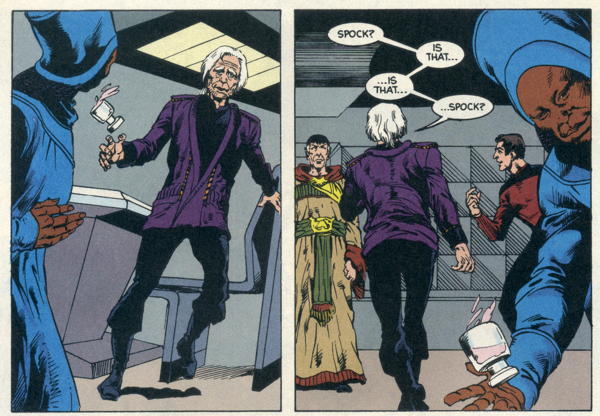
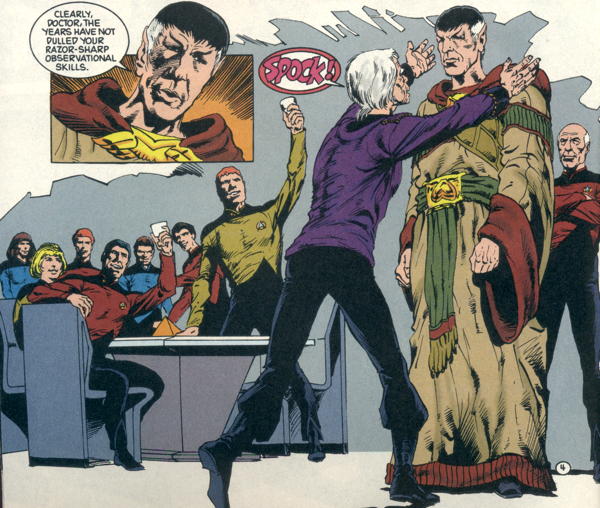
There were some novels bringing bringing together the Original Series characters in the Next Generation context…1995’s Crossover, and some of the “Shatnerverse” novels by William Shatner with Judith and Garfield Reeves-Stevens. I believe the earliest storytelling endeavor to put Old Spock and Old McCoy face-to-face (leaving out Old-ish Scotty, since his return was still a year in the future) was the Star Trek The Next Generation: The Modala Imperative mini-series from DC Comics in 1991. This series itself was part of the 25th anniversary celebratory crossover with Classic Trek, in that tied in directly to the previous Star Trek: The Modala Imperative mini.

Looking at the timing, it seems that Spock’s appearance in this Next Gen comic series (released in the summer of 1991 or thereabouts) actually predates his return in the Next Generation TV episodes (original airdate of November 1991), which is interesting. Of course, given the long lifespans of Vulcans, he would be the most, ahem, logical choice of the original cast to also appear in the Enterprise-D’s time.

Anyway, here are Spock and McCoy, reunited at last in the pages of issue #2 of the second Modala series:


Ah, if only we could have had this happen in live action.

• • •

Another loss to the Star Trek family this week was producer Harve Bennett, who helped revitalize the film franchise with his involvement beginning with Star Trek II: The Wrath of Khan. So long, Harve.


from Star Trek The Next Generation: The Modala Imperative #2 (August 1991) by Peter David and Pablo Marcos

This post spoils the shocking surprises of The Wrath of Khan and probably other Trek films, in case that’s a problem.

So the weird thing about this particular Star Trek series, the first from DC Comics:


…was that, coming only about a year and some months after 1982’s Star Trek II: The Wrath of Khan, it was missing one of the primary elements of the franchise. Given that our favorite Vulcan sacrificed his life to save the Enterprise in said film, the comics were going to have to be Spockless for at least a little while.

The loss was addressed in that first issue, as our Spock stand-in Saavik gets an undue amount of grief from Kirk, as Dr. McCoy points out here:


One of the elements of this series I found interesting (and one that also came into play with Marvel’s Star Wars, especially when it had to go without Han Solo for a while) was how they had to deal with running-in-place between films. The comics were clearly intended to fit within the continuity of the films, and had to react to them or set things up accordingly.

After recovering Spock in Star Trek III: The Search for Spock (SPOILER: they find him), the film ends with a slightly addled Spock who seems to be just on the cusp of recovering his former mental state. Of course, the comics aren’t going to tread water for three years waiting for whatever’s going to happen to Spock in the next film with some extended Vulcan version of Being There. Instead, during a long, and actually pretty good, Mirror Universe story (back when those were rare things) our not-yet-recovered Spock encounters the “evil” goateed Spock:


…an interaction that results in having a functional Spock in the comic book series for the next couple of years.

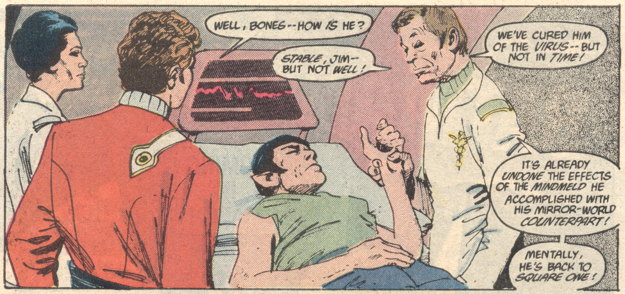
Well, at least until just before Star Trek IV: Free Willy is about to be unleashed, where it’s clear that the film picks up pretty much right where the previous one left off, with no consideration at all given to the fact that between then and “now” Spock was out having adventures with a yellow bird man. Nope, IV was going to feature a Spock still recovering from his “death,” and thus in the comics he had to be knocked back to square one in order to match up continuity-wise with the films. I mean, literally in the comic he’s explicitly described as being back at square one:


“It’s like some kind of…cosmic reset button was pressed, Jim…I don’t understand it!”

Anyway, after IV wrapped up the three film arc that began in Wrath of Khan, the comics may have had an easier time of it by not having to bookend their storylines with putting all the pieces in place to match movie continuity. But at the same time, in a weird sort of way, by not having to directly tie into the films, the comics seemed to lose a little something, some sense of “essentialness” to the franchise as a whole. Okay, not like any of this is essential by any means, but there was a loss of connection to the larger picture that I missed having during those first five or so years of DC’s Star Trek series…a connection that I haven’t really felt in any franchise’s comic book tie-in since.

images from Star Trek #1 (February 1984) – cover by George Perez, interiors by Mike W. Barr, Tom Sutton and Ricardo Villagran; Star Trek #11 (February 1985) by Barr, Sutton and Villagran; Star Trek #36 (March 1987) by Len Wein and Gray Morrow

Leonard Nimoy (1931-2015).


Yes, I’ve posted this pic from that 1977 All About Star Trek Fan Clubs magazine before, but, you know, it’s been nine years, and I’m thinkin’ now is the right time to appreciate it again.

So long, Leonard, and thanks for everything.