Picking up on Monday’s “Trial of the Flash” post, Daniel T links to an interview with its writer, Cary Bates, with relevant info. Daniel T has a choice quote from the interview about Crisis and how it affected his story (and what could have come afterwards).
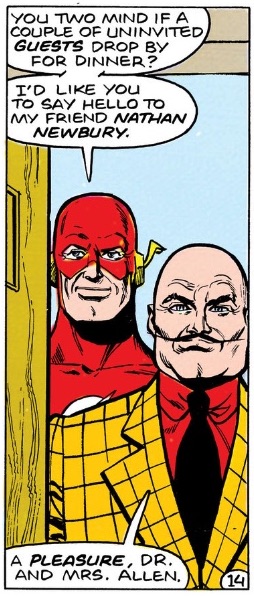
And Scipio…ah, Scipio, fellow veteran of the early 2000s comicsweblogosphere, the horrors we’ve seen. Anyhoo, Scipio popped in to remind me of one of the more…out-there elements of the whole “Trial of the Flash” storyline: Nathan Newbury:
Okay, SPOILERS for a nearly 40-year-old story just below.
Mr. Newbury was an accountant who was serving on the jury for the Flash’s trial. But, as we learn eventually, Mr. Newbury was…”psychically possessed” by a mind from the distant future who was convinced of the hero’s innocence. And also spoke in an overly elaborate manner that I think was said future mind having to communicate using Newbury’s ingrained speech patterns, but I don’t know if that was ever made explicit. (Sorry, I just reread #350, wasn’t going to dive back into the whole series, like, tonight.)
Now by any reasonable standard, once ths court found out about this level of jury-tampering, it’d all be declared a mistrial and they’d start over, right? Well, not according to this news report:
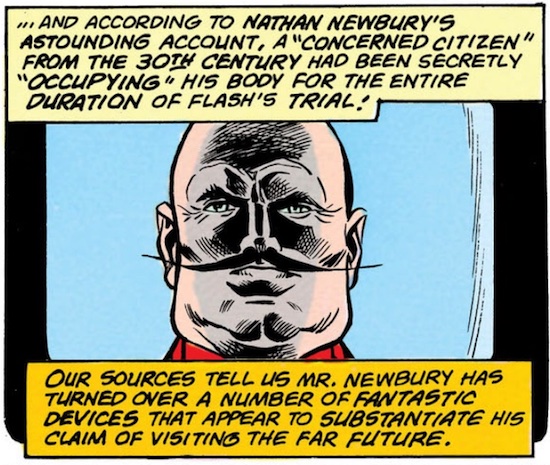

I’ve said before that the nightly news in the Marvel Universe would be indistinguishable from watching wrestling, and that the televised news reports in the DC Universe would instead inspire fear and madness in those who watched. I think this bit of insanity supports the argument. Though I suspect a certain forthcoming Big Trial in the real world may surpass even these wild events. I’m putting my nickel down on “space aliens” in the office pool.
From what I read of Nathan Newbury’s appearance in #350…I mean, it wasn’t so bad. It wasn’t quite the deus ex machina it feels like it should be, if only because the future mind in question has a prior connection to the Flash. And it’s not like Flash comics haven’t been rife with time travel shenanigans over the decades.
So ultimately the most troubling thing about Mr. Newbury is his moustache. That’s a moustache that challenges you. And frankly, the true surprise villain of the piece has a sidekick in this issue with the name of “Snurff,” and that, my friend, is the real crime.
What’s nice about Flash #350, the last of the series, is that Bates (according to the interview linked above) was given enough warning and time to lay groundwork for events coming in Crisis on Infinite Earths via foreshadowing and fore-blatantly-just-saying-he’s-gonna-die-ing.
Plus, there’s the fact that the issue’s villain (I don’t know why I’m being coy, I said there’d be spoilers) is trying to resolve “time turbulence” caused by all the time-traveling bullshit that had been going on (like the Reverse-Flash dying centuries before he was born). For selfish reasons, he’s actually trying to do a good thing, even somehow, it’s implied, saving the Flash from his impending death. He’s practically begging the Flash to let his plan play out even as he’s caught, but to no avail, adding to the coming tragedy that Barry Allen could’ve escaped but for his own actions.
Pretty wild stuff for the final issue of the superhero that ushered in the Silver Age (unless you’re one of those Martian Manhunter truthers). The final caption boxes on the last page read “And they lived happily ever after…for a while…” just to twist that knife a little more. Ah well, it’s all moot now, as thanks to DC’s ongoing plan to make Crisis “never not was” it’s mostly been undone, with Barry being dragged back into current continuity with varying levels of success.
Back then, though, before all the death and return and death again of characters, some of whom don’t even have the decency to stay dead a full month or so before being brought back after their highly publicized demise — it’s a little hard to convey the uncertainty DC fans had, knowing that characters could die or at least be fundamentally changed in this coming Crisis event. And that if the Flash could go, who else is safe? It was quite the feeling, one that was unique to superhero comics of the period.