And now, a message from Marvel’s most-masked character:

…though I suppose one could make the argument that Baron Zemo is even more masked, as his was permanently glued on or something. But ROM’s was, like, literally bolted to his skull, presumably. Anyway, I’m sure there are other contenders over at the House of Mask Ideas. This just popped up from a Twitter exchange between me and pal Cathy.
So on Wednesday’s post, Turan points out the rather spurious use of “anniversary” in relation to celebrations of comics hitting those Magical Round Numbers, usually multiples of 50 or 100. “Anniversary,” for example, is used correctly on this X-Men issue, as, while it was issue #175 (kinda of an oddball number for a special issue in those days, but fine) it was also literally the 20th anniversary of the title’s debut in 1963:

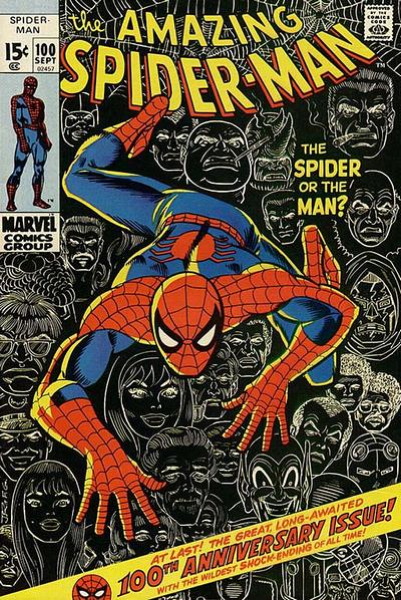
Whereas Spidery-Sam’s solo title had only been around for less than a decade when they called this issue “the 100th anniversary” special:
And as Turan says, there’s no equally-accepted alternative, as a lot of terms like “sesquicentennial” (actually, 150 years) are still tied to, well, years, as you just saw.
However, good news everyone! The Merriam-Webster dictionary, and a couple other sources, cut us comic fans a little slack in anniversary’s definition:
“broadly : a date that follows such an event by a specified period of time measured in units other than years”
I mean, what are issue numbers but counting off months (or 9-times-a-year early on, or like bi-weekly for some modern Marvels) one at a time? That “100th Anniversary Issue” of Amazing Spider-Man could be celebrating its 100th month (more or less) of publication.
On the other hand, every issue is pretty much an anniversary issue of some sort. That Spider-Man? “Special 8th Anniversary Celebration!” But it’s kind of a moot point anyway, as I can’t remember any recent examples of Marvel or DC blurbing a comic as an “anniversary issue” that wasn’t literally for something in its 10th, 20th, or 80th year of existence.
But I wouldn’t worry too much about calling issue #100 of something an “anniversary” issue. It’s too built into the parlance of comics fans that, really, we all know what we’re talking about when we say that. No biggie.
It did remind me of a weird anomaly from ’80s Marvel, though. Issue #296 of Fantastic Four was an extra-sized 25th anniversary issue:

…but issue #300, just a few months later, was a plain ol’ regular-sized issue (with, granted, the momentous marriage of Johnny and Alicia…or is it?):

Now, all these years later, there’s no way that Marvel would have stood for this, and insisted both 296 and 300 be $9.99 giants, but I both appreciate and am surpised by the restrain shown. Alas, the 25th anniversary celebration couldn’t be saved until #300, as its cover date would have been March 1987 and putting it out of the 25th year. (Even though 300 technically was released in late November of ’86. OH, COVER DATES)
But hey, folks are dropping their own suggestions for great anniversary (sorry, Turan!) issues into the comments on Wednesday’s post, so feel free to add your own. Maybe I’ll comment on those in a future post.
 Star Wars #50 (August 1981) demonstrates the problem with media tie-in comics…since Han Solo was frozen in carbonite and whisked away by Boba Fett at the end of The Empire Strikes Back, all the comics published between that movie and the then-forthcoming third film Return of the Jedi had to make do without everyone’s favorite space-smuggler.
  Flash #300 (August ’81) was a 48-page no-ads issue by Cary Bates, classic Flash artist Carmine Infantino, and Bob Smith. Underneath the wraparound cover (showing the Flash feeding knuckle sandwiches to his many villains) we find Barry Allen, heavily bandaged, stuck in a hospital bed. Apparently the accident that gave Allen his super-speed powers instead burned him severely, and his entire Flash career was nothing more than a delusion to cope with his injuries. Allen’s not convinced, of course, and as the story progresses he flashes (har har) back on his own origin, his career, and his friends and allies (like the Elongated Man and Green Lantern). He also goes over the origins of all the villains in his rogues gallery trying to determine which one is most likely responsible for his predicament. It’s a nice overview of the character’s history, as drawn by the one artist most associated with the Flash.
  Detective Comics #500 is cover-dated March 1981, and was blurbed as the “500th Anniversary Celebration,” which means, of course, that Detective Comics began publishing in 1481. Actually, this is issue #500 of the long-running series, and this would have been its 43rd or 44th anniversary issue, which isn’t as terribly impressive as a 500th anniversary, but still, it’s nothing to sneeze at.
  Justice League of America #200 is one of my favorite superhero comics, bought off the stands by a 12-year-old me back in ’82. The plot (involving the return of the alien warriors from the team’s origin story in issue #9 from ’62) basically pits the original members of the JLA (Superman, Batman, Wonder Woman, Flash, etc.) against the team members that joined later. The battles between the heroes are separated out into chapters, each by a different and appropriate illustrator: Atom vs. Green Lantern by Gil Kane, Flash vs. Elongated Man by Carmine Infantino, Green Arrow & Black Canary vs. Batman by Brian Bolland, Aquaman vs. Red Tornado by Jim Aparo, and more — there’s not a clunker in the bunch. Each chapter features at least one full page drawing of the heroes confronting each other…a nice showcase for each artist to strut his stuff. The framing chapters and wraparound cover are by George Perez. It’s 72 pages, no ads, and well worth your time should you happen upon a copy.
  1. I don’t know if I could have picked a worse issue of Uncanny X-Men to have been my first than issue #175, which I bought off the stands over 20 years ago. I don’t mean “worse” in terms of quality (it was fine, certainly better than the dire X-Men comics we’d see in the 90s), but worse in terms of “easily accessible to someone who has never read X-Men before, ever.”