I thought I’d mention the fact that I’ve been reading/rereading over the last several weeks Fantastic Four of the last few…decades, as it turns out. My project started with reading, for the first time, the Tom DeFalco/Paul Ryan run of the early ’90s.
I’d read the Byrne run, stuck around a bit during the Englehart run (but dropped the book before the “John Harkness” stuff started), came back for Simonson, then dropped it again ’til the Waid/Wieringo run and skipping to the Millar run, then I think I was off ’til Hickman came on, and I’ve been following the book ever since.
Boy, that’s confusing to figure out. Especially since, given Marvel’s recent publishing shenanigans, Fantastic Four gets relaunched over and over again with new #1s. But anyway, like I was saying, I started off by reading the DeFalco/Ryan books, which I hadn’t read but was always intrigued by the “what the hell is going on in this book?” feeling I’d get whenever processing these issues at the shop:

It is overall a fun run of comics, just a solid superhero book that, as I saw someone observe, tried to an FF that wasn’t necessarily duplicative of the classic Stan Lee/Jack Kirby run. And overall I think it was successful, bringing in Reed’s father as bit of a potstirrer, introducing Lyja the Skrull as Johnny’s sorta love interest (that’s a long story I won’t be getting into here), plenty of parallel universe happenings, lots of warnings of impending doom (like that cover above), and so on.
And for all the different directions the stories go during this run, by the time this iteration of the Fantastic Four comes to an end in issue #416 (the “last” of the original series), all the various subplots are pretty much tied up (aside, I think, from a lead-in to a then-ongoing X-Men “Onslaught” crossover, but close enough).
After reading that run, I decided to keep going and reading FFs that I either hadn’t read yet or hadn’t read in a while. I wasn’t being a completist about it, as I did skip the “Heroes Reborn” business and then the Chris Claremont-written relaunch that followed. I also jumped over the Waid/Wieringo run since I had reread that not terribly long ago.
I don’t know that you need to hear every thought about every run on the book I either revisited or visited for the first time. I may address these in further posts, but I wanted to note a couple of things.
One, reading (most of) thirty years of Fantastic Four over a relatively short period of time makes you realize just how much is crammed into a fictional history of a book like this. As you read these one issue per month over the decades, you don’t question just how much was supposed to have happened in their lives over an in-universe span of, maybe, a decade or so. Like, how many times has the Baxter Building blown up? Every few weeks, maybe? Or when Johnny was “dead” for two years, but the kids hadn’t seemed to age two years in the meantime? This is stuff you really shouldn’t try to think about.
Two, speaking of ages, Reed and Sue’s daughter Valeria is kind of all over the map. She starts off as a toddler, gets revealed to be super-intelligent, and then once she’s running around with the team her age seems to begin to flucuate. It’s during the Hickman run, I believe, that her age is specifically pinned down as “three years old.” Though, as additional creative. teams come and go, she seems to be aged up to about…7 or 8, maybe? I think she’s older still in the current run. I know, trying to get children’s ages consistent in endless narratives like this is a quick way to madness, and besides, they’ve been going through this with their son Franklin for decades now. Just thought I’d mention that.
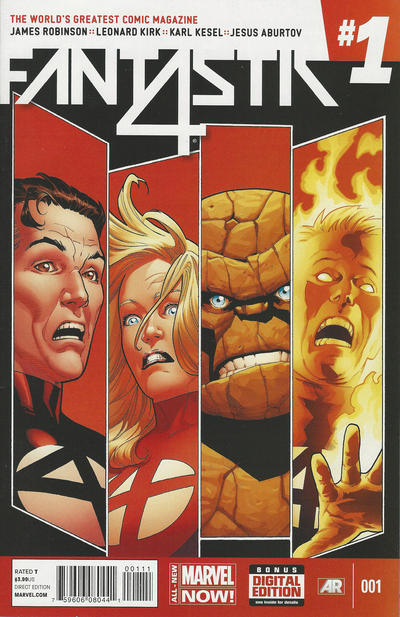
Three, I posted that specific Fantastic Four comic at the top of the post because I had totally forgotten that James Robinson had written the book for a time, around 2014-5. Got his own #1 and everything. And I even read it at the time. I suppose I can be excused for this, as I was opening my shop around then, but still, this book had been lost to my memory.
I’ll see if I can cook up any more observations about the FFs I’ve read in future posts. I will point out that I didn’t read the “Heroes Reborn” stuff, or the Claremont-written relaunch, so I’ll take suggestions as to whether or not I should tackle those.
Wow, the “Fant4stic” logo on that first cover is terrible! The “c” in particular looks wrong, more like a backward “7,” and the giant “4”looks like it’s spilling out from the rest of the word.
Anyway, my FF reading history is similarly choppy. I’ve read most of the Kirby/Lee run (justifiably classic), a little ‘70s FF (which I didn’t like), most of Byrne’s run (the good is very good, but some of it’s pretty rough), some of Englehart’s run (pretty good until it’s not), all of Simonson’s run (awesome!), a little bit of DeFalco/Ryan (not for me), Heroes Reborn (ugh), about 10 issues of Heroes Return/Claremont (it lost me early on), some of Pacheco’s run (nice art, but the writing wasn’t great), Waid/Weiringo (awesome!), the first few issues of JMS (not great), McDuffie/Pelletier (great stuff!), some of Hickman (good, will go back and finish it someday), Fraction/Allred FF (lots of fun, with earned pathos), some of Robinson’s run (not as good as I was hoping), maybe three issues of Slott’s (fine, I guess), and all of Ryan North’s run to date (unabashedly love it!).
My conclusion: It’s hard to write good FF comics! Even Lee and Kirby ran out of steam after a while (although I know there were factors at play that contributed to the decline in the series’s quality beyond the comics themselves). The ‘70s is a lost decade for the series, and most of the ‘90s went by without much in the way of high points. Popular writers (Englehart, Claremont, JMS, Millar, Fraction on the regular title, Spencer, Robinson, etc.) produced runs that didn’t compare to their career highlights. Various spin-offs and minis featuring the characters were inconsistent at best with several commercial and/or creative misfires (The Thing, 4, FF:1234, the Human Torch ongoing in the early ‘00s, FF: Big Town, Ultimate FF before Carey took over, FF 2099, etc).
On the other hand, the best FF comics are able to balance sci-fi inventiveness, family drama, super-heroics, and a sense of hope. Waid & Weiringo/Porter/et al took the team to some extremely dark places, but restored the sense of optimism in a way that worked. The scale of Hickman’s stories went from multiversal war to Reed and Ben sorting out their feelings. North emphasizes the relationships between the characters while coming up with original sci-fi stories built on actual science.
Ideally, future FF writers will be able to balance the imagination and emotion that makes FF work. For now, I’ll keep enjoying the current series, wondering where it will go next.
Fantastic Four has been saddled with some terrible logos over the years. The original was probably great in the ’60s, but looks incredibly dated today. North’s first #1 had the “we’re not even trying anymore” version. The current logo is the best it’s been in quite a while, but it’s still kind of plain.
I wonder why the tone of the FF is so difficult to get right, both in comics or movies. Is it because writers stray too far from the core concept? Or maybe they focus too much on sci-fi while forgetting the family aspect.
The best FF, in my opinion, is when they’re allowed to explore and go on adventures. Sure, they have to protect Manhattan from the latest plot by Doctor Doom or whatever, but in between fights they should always be discovering new dimensions and meeting new aliens. That’s something North is definitely getting right.
I know Franklin and Valeria were both artificially aged up at some point (when Reed and Sue returned and they started publishing Fantastic Four comics again maybe?) It’s always awkward when they do this, but I can’t think of a better solution regarding children aging in comics.
Oh boy, I’ll be glad to see all the comments on this one. It will be helpful because I have a lot of blind spots after Simonson’s run ended – 35 years ago!
Obviously the Kirby/Lee stuff is classic.
I’ve read most of the 70’s stuff. It has its moments, but the EMOTIONAL ANGST is turned up so high that it just feels so overheated. The characters are ALWAYS yelling at each other, as opposed to just occasionally yelling at each other in the Kirby/Lee run.
I enjoy it most in the Essential format. Buscema’s art with the Sinnott inks looks amazing!
The Byrne run is my favorite run of any comics, though it starts to go downhill after the Secret Wars and the addition of the She-Hulk. That’s not a slam on her. I love her on the team, but I think Secret Wars, politics with Shooter, and just being on the book for a while started to dull Byrne’s enthusiasm for the title.
The first post Byrne issues were my first experience of a comic breaking my heart. Bland and repetitive storylines. Late 80’s Buscema does not have the same verve that his 70’s work had. I dropped it within six months and checked back periodically until Simonson came on for his amazing run. I dropped it soon after he left because of the same bland repetitive feeling mixed with the absurd style of the 90’s.
I never went back to monthly reading after that. I bought new issues occasionally, but never felt hooked by it. I pick up random issues in the cheap bins and need to get the complete Waid/Wieringo run, because what I’ve read of that was awesome.
Other than the Waid/Wieringo and Ryan North issues are there other runs I need to read? I’m intrigued by the Hickman/Eaglesham run but haven’t tried it yet.
Like Mike says, there are so many different volumes and relaunches that it can be difficult to keep them straight.
I too wonder why it is such a hard book to write. Is it easier to write a team with a rotating cast like the Avengers? It seems like there you can put a character through the wringer and then focus on another character, of they aren’t working out of you can remove them from the title. With the FF, except for the occasional replacement member, it’s always going to be the core four in the book and a recycling of the same sort of situations they’ve been in many times before.
@Mike Loughlin – out of curiosity, what do you consider the rough stuff in Byrne’s run?
LouReedRichards-I’d say the Hickman run is the only thing you’re missing out on with the book. I rank it as my second favourite run on FF, after Lee/Kirby and before Byrne now, although I’ll have to see where North’s run ranks when it’s finished (right now, it may be overtaking Byrne, for mine). It seems to me as if the FF gets done properly once every decade. Lee/Kirby in the ‘60s, obviously. I enjoyed the Gerry Conway run in the ‘70s more than most, it seems. It had problems, as mentioned, but I felt overall got the formula correct. Byrne in the ‘80s. Simonson in the ‘90s. Waid in the 2000s. Hickman in the ‘10s. North in the ‘20s.
As far as Heroes Reborn and Claremont, they are both easy to skip. Heroes Reborn is awful in every way and isn’t truly in continuity, other than the fact that the FF and Avengers were gone after Onslaught and presumed dead. The Claremont run is mostly forgettable with the type of narrative tics that made many fans dislike his writing after the ‘80s. He tries to turn the book into Excalibur, for absolutely no reason. He introduces a pastiche of Batman and Robin in a rip-off of the movie Matrix which is truly as baffling as it reads in this description. You’re not missing anything.
@LouReedRichards: keeping in mind I haven’t read all of it, the rougher Byrne issues include: the Negative Zone arc (boring), the Johnny story in which a fan lights himself on fire (bad after-school special stuff), Frankie Raye’s origin (so, she had a bodysuit that she couldn’t take off and just never noticed?), and the Malice storyline (ugh). There were a lot of highlights in Byrne’s FF, my favorites being 236, 258, and the Galactus stories. I think it deserves its status as a great run. I think it’s better in parts than as a whole, however.
Being a huge fan of Kirby’s FF run, not too much else in their history has held much interest for me. Byrne had some enjoyable stuff, I really need to go back and re-read Simonson’s run, I liked the Fraction / Allred period, and I’m thinking I need to start reading the current Ryan North run. But when it’s bad, it’s awful. The less said of Englehart, the better. And there was a story where Reed trapped Doom and himself in another dimension that gets my vote as worst comic book ever. Does anybody know offhand who did that story? Read it at the library a few years ago and a bizarre, masochistic part of me kinda wants to read it again, just to see if it makes me as irrationally upset as it did the first time.
Being a huge fan of Kirby’s FF run, not too much else in their history has held much interest for me. Byrne had some enjoyable stuff, I really need to go back and re-read Simonson’s run, I liked the Fraction / Allred period, and I’m thinking I need to start reading the current Ryan North run. But when it’s bad, it’s awful. The less said of Englehart, the better. And there was a story where Reed trapped Doom and himself in another dimension that gets my vote as worst comic book ever. Does anybody know offhand who did that story? Read it at the library a few years ago and a bizarre, masochistic part of me kinda wants to read it again, just to see if it makes me as irrationally upset as it did the first time.
Dubsie-That sounds like Tom DeFalco to me, during the period where Reed and Doom were supposed to be dead, then they found Doom and thought only Reed had died. It could also be Chris Claremont, where Reed took Doom’s place in the armour, and Doom was supposed to be dead. Both were quite bad and sort of similar.
Years ago, while reading FF when the “Wait, What?” podcast did their FF readthrough podcast-within-a-podcast “Baxter Building,” I made this timeline of when various characters were members of the FF. I’m sure there’s some errors somewhere, but people might find it interesting.
https://imgur.com/CWS5FQH
The thing (hah) that surprised me the most, is just how long Sharon Ventura was on the team for her to then more or less be forgotten about entirely. Like, everyone remembers that She Hulk was on the team, but she was a member for less time.
Well…there’s probably a reason for that. Most fans see Byrne’s run as a beloved love letter to Stan and Jack. Sharon is associated with the harmful Steve Englehart run, which wasn’t exactly the high point of his writing skills. Her main character-arc revolves around the background that she had been raped causing her to hate men or being touched, so she eventually came to revel in being turned into a She-Thing, as men didn’t want anything to do with her any longer. Compared to She-Hulk…yeah, I think fans would rather forget.
Mike: read that FF mini by Mike Allred. They make a replacement team with Ant-Man, She-Hulk and others and go to the Negative Zone for what would be a few minutes but it takes 12 issues.
It is very funny, and I thought it odd that Reed was adamant that there be a FF already formed in the event of the worst. But it can be a fast read and honestly, aside from Hickman, the best I’ve read in decades.
I’d like to see Al Ewing’s take. Isn’t he the one that came up with the sliding timeline in THE ULTIMATES?
For everyone: Claremont took over after Heroes Reborn, but did he accept the job or was he previously working on it? Were sales bad because of Heroes Reborn? Just curious.
Are there any decent Marvel podcasts that don’t simply talk about the movies?
That was Claremont’s first work on FF, post-Heroes Reborn. The writer at the end of volumn 1 was Tom DeFalco. Jim Lee took over the Heroes Reborn-version of the FF…with a few different writers, I don’t remember them all right now, but not Claremont. Then, when the FF was relaunched as part of the Marvel U again, Scott Lobdell was the original writer. He quit after about four issues, something to do with fighting with editors, I forget the details, and Marvel got Claremont to accept the job.
Yeah, the Fraction FF (not to be confused with my constant usage of the abbreviation for Fantastic Four) was a great deal of fun.
Fantastic Four was my gateway comic during the John Byrne era. Most of his stuff still holds up, though when I reread it today I find myself wishing he hadn’t swapped out The Thing for She-Hulk so soon.
Lee/Kirby were great, though like many of Lee’s ’60s work, it’s often goofier than you remember. It’s the highlights that stand out, not the stuff like Namor working as a Hollywood producer, or the time Doctor Doom hired some gangsters to take out the FF.
Every time I tried to dip my toe into the 1970s stuff, it just left me confused.
To my recollection, the only part of Claremont’s run that I even remember is about the last 8-10 issues with all the Dr. Doom stuff – some of that wasn’t bad. I’ve blocked out most of that first year of his. The place I feel that a lot of bad FF comes from is when writers try to make it a straight Super Hero book, and it shouldn’t be. The best stories are when it’s a Science/Adventure with problem solving, where some super-heroics just happen. I feel that Ryan North has been hitting this the majority of the time.
I guess the monthly facsimile issues ended after #12 recently. I love seeing Kirby’s art in its intended form. Goofy, goofy stuff after the first six issues. I don’t think L & K hit their stride until the mid-teens or later though there are hints and hopes.
@Michael Grabowski: I think the FF become the “World’s GreatestComics Magazine!” around issue 40- the DD and Frightful Four issues are fun, then it’s the Inhumans, Silver Surfer, Galactus, “This Man, This Monster,” Black Panther, etc. Also, Joe Sinnot completes the classic creative line-up, and the book looks 10 times better than when Vince Colletta was the inker. There are plenty of great issues before 40 but that’s when the series becomes consistent. The quality dips about 25 issues later, but 25 issues of some of the best comics ever is nothing to sneeze at.
@Chris V – Thanks for the Hickman recommendation, I will track those down.
That’s an interesting observation about them getting a good creative team once a decade – never thought about it like that. I don’t think Conway’s run is terrible. I feel for him having to shake things up as one of the first writers after Lee while maintaining Lee’s “Illusion of change” edict. But man, the yelling…
@Mike Loughlin – Thanks, I too find Malice a bit much, and that’s the storyline I came in on (#278). I also agree that the #285 is way too “after-school special”, is the story a meta comment on the urban legend that TV execs were worried about kids setting themselves on fire to emulate the Torch?
I generally like the change of scenery and sci-fi aspects of the Negative Zone storyline, but can see how others might find it tedious.
I also agree with it hitting its stride in the 40’s. Like you said, Sinnot completes the dream team. The Colletta issues… ugh.
For me, Lee’s overwriting can make even the best stories a bit of a slog at times, fortunately Kirby’s artwork keeps the reader engaged even when Lee can’t seem to shut up.
What’s crazy about the Malice storyline is that it’s such a ham-fisted exploration of Sue’s character after Byrne himself had been so thoughtful about her just a few years earlier. For my money, “Childhood’s End” (#245) is a much better Invisible Girl story.
As for the codename, she could have switched to Invisible Woman at any time or after any number of circumstances. I’m not sure she needed to become mind-controlled or start dressing sexy to make that happen. But Byrne (and Claremont) couldn’t seem to stop reliving the Dark Phoenix/Black Queen days over and over again with different female characters.
I totally disagree that “the ’70s is a lost decade for the series.” The ’70s had some great FF story arcs building on the foundations which Stan Lee and Jack Kirby built, written by top Bronze Age talents including Roy Thomas, Len Wein, and Marv Wolfman, as well as some very good art by John Buscema, Rich Buckler,George Perez, John Byrne, and Keith Pollard–mostly inked by the fantastic Joe Sinnott to maintain a fluid sense of continuity. The ’70s FF also brought us Thundera, saw Medusa join the team, saw the first glimpse of Franklin Richards’s awesome power, and had Crystal marry Quicksilver– thus bringing a sense of pathos to Johnny Storm losing the love of his life. We also got Marvel Two-in-One starring The Thing out of the ’70s and, for a while, some Human Torch appearances in Marvel Team-Up. The Inhumans were also spun off into their own short-lived title in the ’70s.
I think that after John Byrne left his tenure as writer/artist the FF gradually went downhill and a lot of continuity eventually got chucked by the wayside. The last few years whenever I have flipped through an issue of FF, the art is generally subpar and there isn’t much fantastic about it.
@Sean Mageean: glad you enjoyed ‘70s FF! I referred to the ‘70s as a lost decade for the FF because I almost never see ‘70s FF referenced in terms of continuity or in fan circles. Growing up, I only heard fans speak positively about Kirby/Lee FF and Byrne’s solo run. In the early internet days, it was the same, although FF 200 would come up as a recommended issue. I didn’t even know Perez had a run on the title until I was at a convention in 2001, and the person in front of me had a bunch of FF issues for him to sign. To be fair, almost everything after Byrne’s run has been ignored by subsequent creators.
As much as I love the North run for the imaginative plots and engaging characters, I agree that the art has been mostly serviceable. I wish he had a better penciller working with him. Humberto Ramos has been better than I expected, but nothing to write home about.
@Mike Loughlin
It is worth noting that Stan Lee (with John Buscema as the main artist) remained as the primary scripter on FF for more than a year after Kirby quit, with a handful of issues written by Archie Goodwin.
And George Perez started out as an assistant to FF artist Rich Buckler in the early ’70s, and by the mid ’70s Perez landed the gig as the primary FF artist for a good stretch of issues. Ross Andu, and Ramona Fradon also illustrated several stories, and Steranko drew several covers, of the early ’70s FF.
Gerry Conway and Bill Mantlo also scripted the FF during the ’70s, so, all in all, the ’70s FF run did maintain fairly high standards in terms of solid Bronze Age writers and artists. And right before John Byrne took over as both writer and artist, there was a nice FF run in 1980-81 by Doug Moench and Bill Sienkiewicz.
But I understand that tastes vary, and perhaps the ’70s FF run was, to an extent, trying to recycle the greatest story beats from the Kirby days. I also acknowledge that John Byrne arguably wrote and illustrated the best FF run after the classic Lee/Kirby run, but I don’t think the ’70s FF run should be sold short.
@Sean – I agree that there are many elements in 70’s FF that deserve recognition. As I noted, the Buscema/Sinnott art is exquisite – esp. in the B&W format of the Essentials, but also quite beautiful in color as well. Buckler’s work also works well in the Essentials format, but I’m always taken out of the story a bit because I’m too busy playing “name that swipe.” I didn’t realize that his swiping was as pervasive as it was until I stumbled onto a website about 15 years ago that cataloged and compared his swipes to the Kirby originals. My god, so many swipes…
All of the names you mentioned did professional level, work on the title. As a kid who started collecting the FF in the mid-80’s the overwhelming narrative was that pretty much everything between Kirby and Byrne was bland and forgettable. As I acquired 70’s FF I was prejudiced by this belief. I finally grew to see the era for its own merits, but even now I still have some reservations about this period of the FF.
I find nothing special in the Moench/Sienkiewicz issues, but tastes of course vary. To me it’s a waste of Bill’s talent – it’s a bland house style that has neither the appeal of his early Neal Adams influence nor the amazing work he would start to do a few years later. I don’t recall the stories being particularly compelling (Space Vikings, the Ebon Seeker, Space parasites.) It’s been a long time though, they might be due for a re-read.
Sorry to ramble. I can talk about 70’s FF all day!
@LouReedRichards
What’s not to like about Space Vikings???
I have always enjoyed Doug Moench’s writing, and, although that run features fairly early Sienkiewicz art in a quasi-Neal Adams style, it is still solidly drawn–and Sue Richards, in particular, looks great.
Sure, compared to their classic Moon Knight run, their FF run isn’t on the same level, but I found it enjoyable enough.
I also recall some fairly solid FF annuals from the ’70s–one with an epic Hulk/Thing battle, another co-starring The Invaders, and a few with really nice George Perez art.
I think it is also important to remember that before the New X-Men–and Wolverine in particular –became extremely popular in the ’80s, the FF was considered one of Marvel’s top books, and during the ’70s The Thing became a break out star in Marvel Two-in-One, and was probably Marvel’s second or third most popular character after Spider-Man and (maybe) The Hulk.
It is true that Rich Buckler swiped a lot of Kirby panels, but evidently it was with Roy Thomas’s and/or Stan Lee’s blessing. Also, if you look at the history of published comics prior to the mid-Bronze Age and the rise of The Comics Journal and other fan publications, swiping wasn’t that uncommon. In fact, Joe Simon himself swiped one of his old Golden Age Captain America covers from the ’40s and repurposed it for an Adventures of The Fly cover in the late ’50s.
Sean,
Sorry for the delayed response.
Of course there’s nothing wrong with space vikings, we are comic book fans after all. Thor is a space viking and he’s great!
I’m glad you enjoy the Moench/Sienkiewicz run. I’m certainly not interested in trying to talk you out of liking something you like.
I skimmed over those issues again. I do find Bill’s art looks better when not inked by Sinnott, who is an inker I generally adore. Bruce Patterson’s inks on that space trilobite story looks particularly nice.
Some of those 70’s and early 80’s annuals are wild! The Ditko one in particular looks pretty bizarre. I haven’t read it yet. It looks like it probably isn’t my thing; I’m not a huge fan of post 60’s Ditko. I will have to read it just to figure out what is going on!
As far as Buckler and the swipes are concerned, I didn’t mean to make it sound like it was all his fault. I know the powers that be wanted it to look as Kirbyish as possible. To me, that just underlines the stagnation that the title was experiencing. His run does have its charm.
I had the same problem with the Defalco/ Frenz Thor run after Simonson. I HATED that run at first. Even ripped a copy to shreds in front of my Mom. Yeah, that was way over the top dramatic. I’ve picked up copies since then and have really enjoyed the ersatz Kirby vibe! Tastes, they’re a funny thing!
Like I said, glad you like them!
@LouReedRichards
I appreciate your honest, and humorous, responses.
I do agree that Bruce Patterson is a great inker. I’m particularly partial to his inks on Keith Giffen’s early run on The Legion of Super-Heroes. I guess I would have to dig out old FF issues to compare Sinnott inking Sienkiewicz’s pencils versus Patterson inking them. I think Tom Palmer would have been a natural fit as the preferred inker for early Sienkiewicz art as it is so steeped in the Neal Adams school of comic book artistry.
I stopped reading/collecting comics by the late ’80s, and only returned around the time of the New 52, but I did run across a few issues of the Defalco/Frenz Thor run about six months ago in a dollar bin and bought them. I quite enjoyed them, although they can’t be said to be in the same league as the Simonson run. I think a few of them were inked by Don Heck. Now that I’m older, I have a greater appreciation for Don Heck, Ron Frenz, etc.
To one extent or another, most people are a product of the times which formed them, so, I will always be partial to comics from the Bronze Age and early Copper Age. But I also think there is a legitimate case to be made for the mid-’70s to early ’90s being the zenith of American superhero comics–certainly in terms of the artwork, and, to a large extent, in terms of the stories as well. “The Marvel Method” truly produced thirty or so years of very enjoyable comics, from my perspective.
I know I get on my high horse quite often, but as you said, tastes are a funny thing. Fair play to everyone for enjoying whichever comics they like!
Likewise Sean!
Agree with all that you said.
I bowed out of the monthly habit in the early 90’s and just look for new stuff and pick up back issues occasionally.
The Marvel method certainly was an innovative approach. I agree that it produced amazing work. I only wish the pencillers had been given more credit as plotters.
I don’t think of it as you on your high horse. I appreciate that you are passionate about the things you love. like you said, fair play for liking whatever anyone likes.