[SPOILERS for Watchmen ahead, if anyone needs to be warned still]
So I spent some quality Twitter time on Sunday botching an observation I had about Watchmen. Basically, what I said was that, as a counterpoint to the idea that Dr. Manhattan was the only superpowered being in the Watchmen universe, there was also that island full of psychics, also gifted with supernatural powers that don’t exist in the real world.
Couple things wrong with that. One thankfully dawned on me all by my lonesome without someone having to come in and say “DUH MIKE YOU SO STUPID.” No, not thing about psychic powers being fake, that’s totally true, but the bit of business about “island full of psychics.” It’s an island of artists recruited by Adrian “Ozymandias” Veidt to generate horrible images that the “alien” brain would be prgrammed with, and then transmit upon teleportation to its destination, adding mental trauma to the physical destruction.
Wait a second, gonna add a spoiler warning to the beginning of the post here in case anyone still hasn’t read Watchmen.
Okay, done. Anyway, that’s the deal. I tried to amend my original statement by saying brains of psychics were cloned or whatever to make the alien brain, and one of my oldest internet pals, Mr. Dan Kelly, reminded me that it was just one psychic used in the alien brainn production. Specifically, a “human sensitive,” to use the actual phrase that Veidt initially uses. Basically the same thing, since the purpose is to send out a “psychic shockwave [to kill] half the city.”
My intent, to demonstrate that Dr. Manhattan was not the only superpowered being on Earth in this fictional universe, was correct. Just the details were wrong, and to what degree of “psychics” were implied to exist. Though Veidt does reference in issue #12 (or Chapter 12) that the event will affect other sensitives for years to come, but as will be shown in a moment, he may not be the most reliable source of information. LOOK, I’M GIVING MYSELF HALF CREDIT, SO THERE.
But then there’s something I haven’t considered. Twitter pal Bob Clark had some comments about Watchmen, and the character of Adrian Veidt specifically, to which I hadn’t paid enough attention. That Veidt himself, with all his grand schemes and plans and such, his controlled manner and his poise, is just totally off his chump. Bob notes that we’re so used to Rorschach being, quote/unquote, “the crazy one,” that we overlook the fact that Ozymandias is even more so. Ultimately, as Bob says, there might not be any “psychics” at all, just Veidt, in his unbalanced state, thinking he has access to a psychic brain, to go along with all the other improbable plans he’s made.
In the text, it’s left vague enough as to whether any “psychic shockwave” actually occurred. The death total is three million, but perhaps that was caused by the very act of the teleportation event itself. On Veidt’s wall o’monitors, we hear refernces to “the insane” (which, you know, who wouldn’t be knocked off kilter by a giant freaking alien suddenly appearing in town), and about a “pregnant woman convinced her unborn child was eating her” (again, losing one’s cool in reaction to an out-there event like this wouldn’t be surprising). Anyway, just trying to say, Bob could be right, maybe Veidt just believed psychics were a thing, and the actual physical element of this plan was enough to cause the mental trauma being reported.
Or maybe psychics are a thing here, because comic books. I mean, not trying to be a debunker or anything, just found Bob’s interpretation interesting and worth considering, particularly in the context of what this says about Veidt’s own state of mind.
There’s also the point made in the story (again, by Veidt, so take it as you will) that the psychic’s brain that was used for the “alien” was made “bigger and more powerful” by his science guys, so who knows what they did to it to make it generate the effect (not necessarily psychic, but perhaps something sufficiently physically disrupting to nearby brains) that could injure or kill. Again, despite the real world trappings of the series, it’s still a comic book, and the ol’ “comic book science” card is in play here.
Thanks, Bob, for the interesting thoughts on Watchmen. Always glad to see it can still stir up conversation after all this time!
By the way, the psychic’s name is given as “Robert Deschains,” in case you need it for your next trivia contest.
What brought all this on was commenter Randal observing
“Wait…that was a year before…did…did Watchmen copy Squadron?!?”
And yes, there are some similarities, particularly in the short-version high-concept description of “what if SUPERHEROES were REAL!?!?” But these are definitely two different entities, with varying agendas and executions, and I’m pretty sure Watchmen was being developed without any knowledge of Squadrons Surpreme‘s existence. If anything, I’d say Alan Moore took more inspiration from the political/social implications of his own Marvelman stories, not to mention the novel Super Folks.
Plus, let’s not forget that the idea of “superheroes in the real world” was an idea that had been floating around in comics for a while, not just the idea of what the very existence of superheroes do to the world around them, but simply “what would an actual real life superhero be like?” Not nearly to the extent of Squadron Surpreme or Watchmen, of course, but it was there. Superheroes tackling issues beyond, say, punching Kanjar Ro in the nose for the 80th time…pretty much the entire Denny O’Neil/Neal Adams run on Green Lantern/Green Arrow was this very thing, talking on drugs, overpopulation, pollution, etc.
The shared Marvel Universe was founded on a version of this, with heroes existing in real cities (primarily New York) instead of invented places like Metropolis or Gotham City. Even little things like Peter Parker catching a cold but still having to go out and fight crime as Spider-Man, or worrying about money, or worrying about how superheroing is impacting his normal life…all humanizing problems presented in a superhero context that directly address the issue of “what would doing this sort of thing actually do to someone’s life?”
A long time ago, on this very site, I noted that the very act of putting actual human beings into the costumes and acting out the stories made the 1960s Batman TV show just as much as deconstruction of the genre as anything Watchmen did.
And even further back…that Wikipedia lnk to Super Folks mentions Moore admitting inspiration from the Mad Magazine parody “Superduperman,” itself a relatively savage demolishing of superhero tropes. And there’s the issue of All-Star Comics where the Justice Society of America addresses the topic of disabled veterans.
And, look, there are countless other examples and I can probably spend all day typing them in here. But the point is…as a medium for expression, of course comics, even superhero comics, are going to try to make their stories more relevant and relatable to real world issues. Sure, having two 12-part “maxi-series” at around the same time dealing with the same sort of thing, kinda sorta, was unusual timing, but more coincidental than anything else. Just sort of the natural outcome of what had come before. Both series were above and beyond what we’d seen in the past, of course, but not entirely without antecedent.
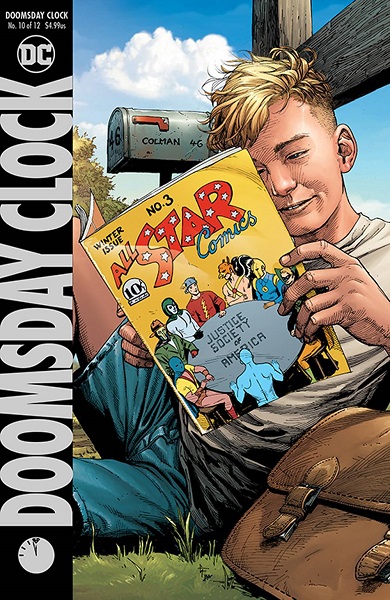
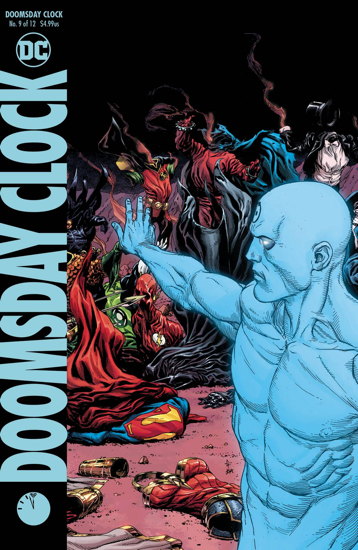
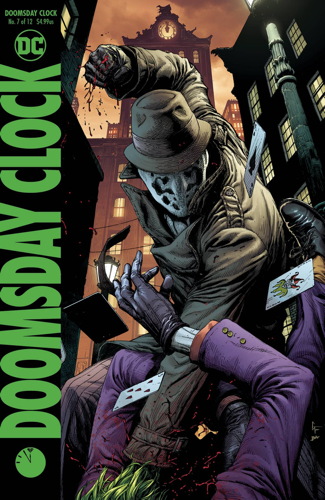
 So I haven’t really said a whole lot about Doomsday Clock beyond my
  As such Crisis and its impact became problems mostly in hindsight, starting with small things (“whoops, we fucked up Hawkman, sorry everyone!”) and quickly ballooning into much larger issues (“oh, hey remember continuity? Here’s some more different continuity!”). Doomsday Clock‘s…quirks, shall we say, were anticipated well ahead of time. We were all watching that person in the scary movie, reaching a hand out to the door handle, while we shouted “NO, DON’T OPEN THAT DOOR!” Reasonably sure we all foresaw the inherent awkwardness of combining a singular, self-contained work by creators at the peak of their skills with a decades-old haphazardly-assembled, repeatedly rebooted, shared universe to the point of using the former as another tool to shore up the latter.
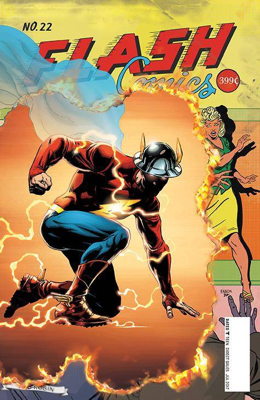
  Doomsday Clock is a different animal with different purpose, and the depth of the original has been replaced mostly by trivia (“hey that guy’s daughter is Elasti-Girl from the Doom Patrol!” and other such nuggets that end up in clickbait listicles breathlessly detailing those Easter eggs “you may have missed!” somehow despite them basically being shoved in your face and captioned “THIS IS A REFERENCE TO SOMETHING”). The new series appears to be primarily about reclaiming superheroes from the legacy of Watchmen and similar descontructive attempts, in that the last two years of DC’s overarching storytelling has positioned the previous “New 52” continuity reboot as a literal attack on the DC Universe by Dr. Manhattan.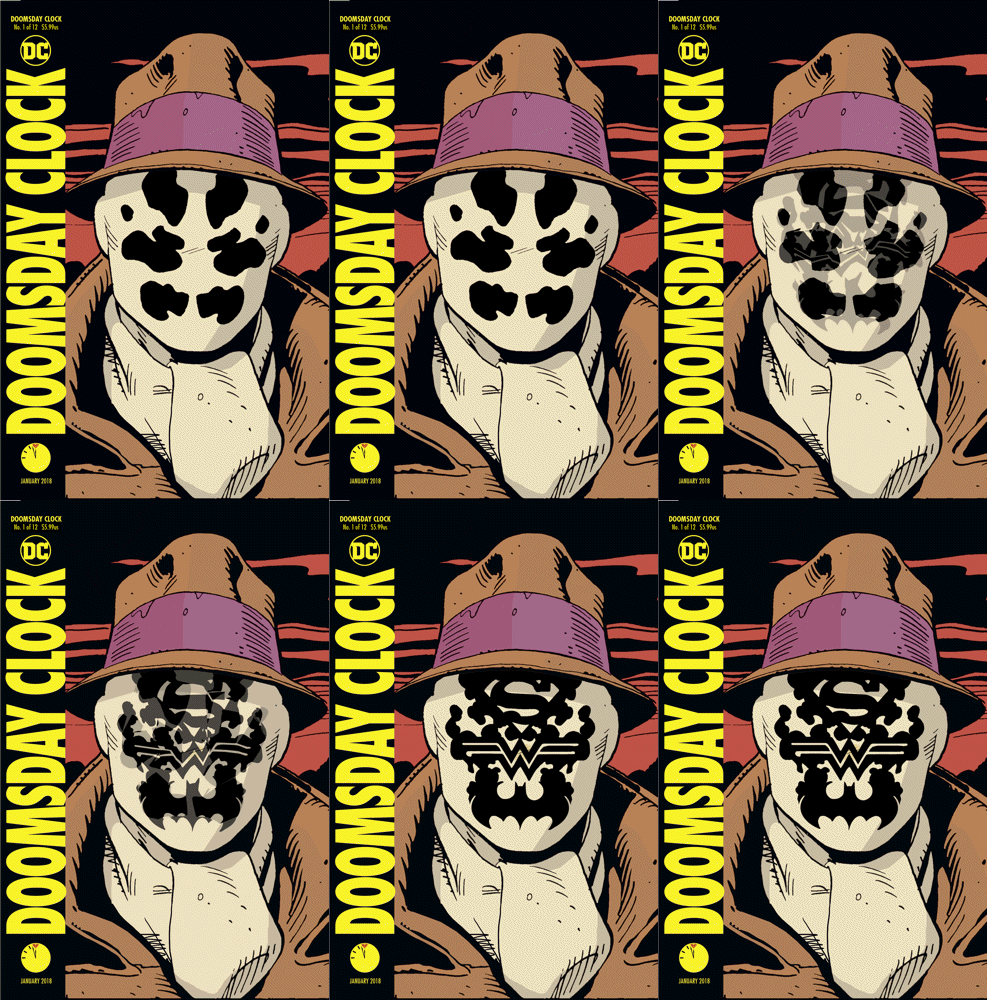

 [SPOILERS AHEAD]