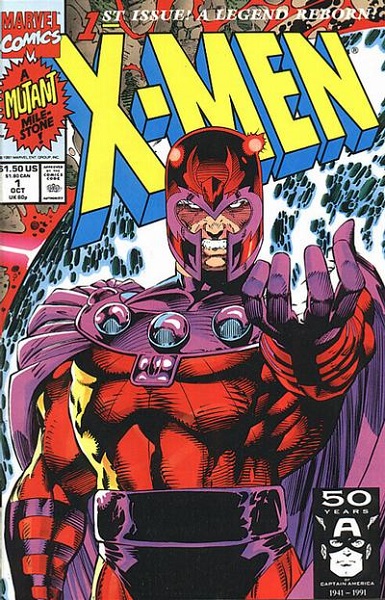
If you’re trying to decide “what’s the most famous example of variant comic covers of all time” — first, c’mon, what’re you doing with your life, and second, I think just through the sheer magnitude of copies that were unleashed upon an unsuspecting public, it’s gotta be 1991’s X-Men #1:

There were four different covers produced, the first three featuring a different mix of members of the team, with the final cover presenting their arch-nemesis Magneto. The four covers formed a single image when connected together, but if you didn’t trust your hand-eye coordination to assemble so complex a puzzle, Marvel had your back with the fifth variant: a gatefold cover that opened up to present the full image.
Unlike Spider-Man #1, the covers weren’t released all at once. Instead, Marvel decided to dominate comic sales for over a month by releasing each cover one per week, starting with the A, B, C and D covers (as they are usually referred to), culminating in the gatefold cover in the final week.
Orders were gargantuan. In total, over 8 million copies were produced, though as has been noted by multiple observers, and just through my own personal observation, a good chunk of those remained in retailers’ hands.

Speaking of personal observations, I’ve written in the past about how once impossibly-common comics from the ’90s marketplace are becoming slightly less easy to find in the wild, simply due to the attrition of stores that were active then having shut down in the intervening decades and taking their backstock with them. I’ve also written about how many of the people buying comics at the time either had no idea how to take care of their comics at the time (despite the wide variety of comic storage supplies being offered, and purchased, in sizeable amounts), or simply neglected their collections and let them fall to disuse and ruin over the years.
The point being…a comic that was once so commonplace and contemptuously familiar that copies were given away free with purchases is now, kinda sorta, becoming “collectible” again. Not to keep referring to things I’ve said in the past, but I’ve said in the past that even without actively buying copies of X-Men #1 in collections, I’m accumulating a backlog of it. And I’d say only abut a third of the copies I’ve seen have been in Near Mint or better, and when you actually have a copy in Near Mint (and not, say, VF- which you’re calling “Near Mint”) it can sell for a pretty good price nowadays.
Again, this all depends on local supply. There are probably still plenty of areas of High X-Men #1 Concentrations where they flow like water, and you merely need to dip your hand in a stream to retrieve a copy or three. And they’re all over eBay, natch. But, in areas populated primarily by newer stores, where even the bespectacled old men who have direct memories of those times and will gladly share them with you (ahem), they may not be as in deep a stock as they historically had been.

It was a large confluence of causes that resulting in this massive amount of orders:
- The ’90s were a boom time for collectible comics, with a huge influx of new customers driven to comic shops primarily by the 1989 Batman movie, with earlier successes like Dark Knight, Watchmen and Teenage Mutant Ninja Turtles helping to push the expanding market as well.
- It was the time of The Hot Artists, and Jim Lee may have been the hottest artist of the time. Launching an expansion of Marvel’s popular franchise with Lee on art chores couldn’t help but grab market attention.
- The investors were out in force. The aforementioned Teenage Mutant Ninja Turtles arguably kicked off a new wave of folks looking to make their fortune trading in “rare” comic books, and what could be rarer than eight million copies of X-Men #1? Okay, nobody knew it was going to sell that many copies, but it was a pretty easy guess that it was going to move some large numbers. That didn’t stop people from buying boatloads of copies in the hopes that they’d be able to turn them into houses or kids’ college funds down the road.
- This may be hard to imagine, but there was a time in comics publishing that when a new series was launched, the expectation was that the series would continue so long as sales held out, and maybe if sales dipped a little, the publisher would try things like “new directions” or “fresh creative teams” or more promotion to support the book. The idea that new #1s for titles would flash by like strobe lights was not one that was considered. As such, retailers would order plenty of first issues of titles, as that would likely be the most sought-after number in the back issue bins over the years, and hopefully decades, of the title’s life.
- And yes, the multiple covers. Outside of investors, just plain ol’ folk who bought comics and weren’t necessarily looking to turn a buck. As I brought up early on this ongoing series of “variant covers” posts, having different cover images was a way to encourage the regular reader to pick up more than one copy of a particular item. Plus, having the additional twist of making all the covers connect into a larger picture…it’s a cunningly evil plan that, I can tell you at least from my memories of selling the things at the time, worked quite well indeed.
Some have pointed to this as being one of the causes of the ’90s market crash, and…I don’t know, I think there may be worse offenders (I won’t say any names, but the initials stand for Deathmate) since, all things considered, X-Men #1 actually sold (though again, not nearly as many as were ordered). There were bigger stinkers out there, at least to the point that X-Men wasn’t seen as a flop, whereas something like Turok: Dinosaur Hunter was. That said, I’m sure enough people got burned on their investments on ’90s comics, including X-Men #1, that they, and their money, fled the marketplace, reducing cash flow and feeding the crash.
So wither X-Men #1? It remains a popular seller, as do assorted issues from the 1991 series as a whole. There’s a whole new audience of comic book buyers and X-Men fans who weren’t around thirty years ago when this series launched. And there are plenty of customers who were around but misplaced, sold, or damaged their copies in the meantime and want replacements. And, of course, there’s the current wave of speculation mania driving sales on any “key” and/or first issues.
I don’t always have every cover in stock, but I usually have at least two or three different ones on hand. The cover I see the least? The gatefold cover. The one I see the most? Surprisingly, the fourth cover with Magneto, given that, according to this article, it was the poorest selling of the first four. And that gatefold cover was the highest selling. Huh, go figure. (Again, it all depends on how many copies actually got into people’s hands, and didn’t disappear with the retailers who ordered them.) It’s my memory that, as each cover was released every week, sales dropped a little with each one, with a boost on that final fold-out issue. But I could be wrong…it’s been 30 years, after all.
And which cover did I buy, since as a 1990s comics buyer you were legally required to buy at least one copy of X-Men #1? Why, the gatefold edition, of course…I wasn’t going to miss out on any of that artwork!

Next time in my variant cover-age, even though John kinda beat me to the punch: Robin comics! A whole lot of ’em! Holy gimmick covers, Batman!